
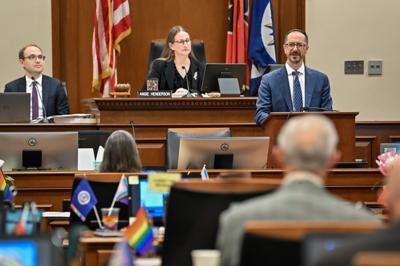

The Metro Council on Tuesday gave its final approval to Nashville’s $3.8 billion budget for fiscal year 2027, which is set to include a grocery tax cut and investments in affordable housing.
The final spending plan, set to take effect July 1, came in the form of a substitute budget filed by the council’s Budget and Finance Committee Chair Kyonzté Toombs and is largely based off Mayor Freddie O’Connell’s proposed budget.

More than 100 residents address council — also advocating for funding Nashville General Hospital, childcare initiatives, city employee pay raises
Under the plan, Metro makes significant investments in affordable housing, which was among the top priorities listed by Nashvillians during a public hearing earlier this month. These include an additional $1 million on top of O’Connell’s proposed allocation for the Barnes Housing Trust Fund, making the total funding amount $23 million.
In addition, a new affordable housing loan program is set to receive $7 million. The budget also includes $15.7 million for the city's homeless services office and $4.5 million for a program that provides counseling related to eviction rights.
Along with housing investments, the council targeted affordability in this year’s budget — notably including a 22 percent local grocery tax cut expected to save Nashville families $72 per year. This makes up $9 million of the city’s budget.
At-Large Councilmember Quin Evans-Segall proposed an amendment to the budget, which ultimately failed, that would have scrapped the grocery tax cut and reallocated much of the $9 million in funds toward housing initiatives through the Barnes Fund.
“By building that housing, we are taking the pressure off the middle-income earners who are often going into that housing stock that those folks who really need it are looking for,” Evans-Segall argued.
“We're creating more of that housing and [that] actually lowers cost overall for everybody in the economy pretty significantly, and it's not $6 a month. It's hundreds, if not thousands, of dollars a month. And to me, that is where we need to do the squeeze to get the juice if we're going to help people here.”

Tennessee Republicans watch Nashville's FY27 budget closely for violations of new state immigration laws
The FY 2027 budget also includes $735,000 for the Tennessee Immigrant and Refugee Rights Coalition, a Nashville-based nonprofit organization advocating for immigrant rights in the state. The funding recently became the subject of criticism from the state’s top GOP leaders, who argue it could violate some of Tennessee’s increasingly stringent immigration laws.
The Nashville Entertainment Commission will receive $300,000 in funding, in contrast to O’Connell’s original proposal to scrap the commission. Following public outcry during this month’s budget hearing, the mayor’s office reversed course and is now proposing a restructure of the office of entertainment through an ordinance to make the office a department with an executive director. This would be housed within the mayor’s office in partnership with the entertainment commission.
However, this plan is opposed by Councilmember Joy Styles, who — along with several co-sponsors — is proposing an ordinance to keep the office of entertainment independent of the mayor’s office.

The commission — hatched as a city hub for film and music promotion — has been dogged by political fights and procedural issues
Other allocations include:
$401,500 to the Nashville Fire Department for a second fully funded shift of the REACH program
$250,000 to support workforce development initiatives through the Urban League of Middle Tennessee
$60,000 to support the Pet Community Center’s spay and neuter services
$100,000 to The Branch to support food access and English language classes
$101,800 to the General Sessions Court to support a new social worker position
O’Connell addressed the council at the start of Tuesday evening’s meeting, urging members to support the substitute budget. He noted the importance of easing affordability for Nashvillians through housing investments and the grocery tax cut. He also criticized the Tennessee General Assembly’s lack of action toward cutting the state-level grocery tax.
“So while the folks up the hill have balked at putting money back into the pockets of Tennesseans by cutting the state grocery tax or funding this reduction, I hope you'll support $9 million of economic relief for Nashville families and pass this reduction to local sales tax on groceries,” O’Connell said. "We cannot miss this opportunity.”
The final budget passed 35-2, with Councilmembers Jeff Eslick and Courtney Johnston voting no on the matter. Johnston argued against the property tax rate that funds the budget.
“The largest bill that Davidson County sends Nashvillians is their property tax bill,” said Johnston. “And we've been talking about the grocery tax, and I feel like we're majoring in the minor [by saying], 'We need to have a little bit of relief here and a little bit of relief here,' when meaningful relief could come from really putting together an efficient budget that has as little waste as possible.”
A separate ordinance that sets the property tax rate, set to remain the same as the mark of last year, passed 29-7. Councilmember Jacob Kupin, who voted in favor of the overall budget, voted against the tax levy and cited concerns over raising property tax rates in his district, which includes much of downtown.
“I can't just continue to stand here and support a tax levy that I know is breaking the backs of our city, breaking the backs of our residents,” Kupin said.



Post a comment as anonymous
Report
Watch this discussion.
(0) comments
Welcome to the discussion.
Log In
Welcome to the discussion.
Keep it clean. Please avoid obscene, vulgar, lewd, racist or otherwise abusive language. Comments featuring hate speech or threatening or violent content will not be tolerated.
PLEASE TURN OFF YOUR CAPS LOCK.
Be truthful. Don't knowingly lie or mislead.
Be proactive. Use the “report” link on any comment that violates our comment policy.
Share with us. We'd love to hear your feedback.