

After struggling to get off the ground, the city’s Office of Entertainment could shutter under the mayor’s proposed fiscal year 2027 budget. The effort suffered from slow and uneven progress since being formalized in 2023 as the mayor, the Metro Council and the office’s 15-member volunteer board — the Nashville Entertainment Commission — struggled to see eye to eye.
Councilmembers Joy Styles and Jeff Syracuse fought over the creation of a Metro coordinating entity for venues, songwriters, musicians and the city’s burgeoning film industry as early as 2022. At the time, both were ambitious councilmembers with backgrounds in the music business — Styles as an artist and Syracuse in BMI’s local office. In 2023, the city passed legislation for a 15-member entertainment commission only to tweak certain procedural rules at the behest of new Mayor Freddie O’Connell in what became an extended power struggle over hiring control and Metro authority.
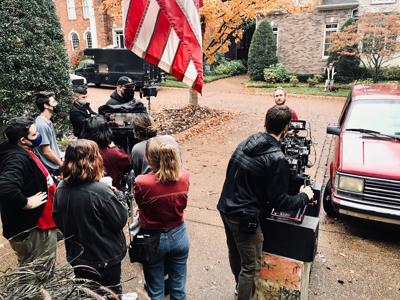
The film industry has expanded in recent decades, with cities like New Orleans and Atlanta benefiting tremendously from coordinated efforts to attract production. Recently, feature films including Holland as well as TV series like 9-1-1: Nashville and Scarpetta have shot and continue to shoot locally. Advocates hoped the office could help organize and foster the various entertainment industries, like film and music, that thrive in Nashville.

From Altman’s ‘Nashville’ to Khouri’s ‘Nashville,’ ‘9-1-1: Nashville’ to ‘Scarpetta,’ does our town have the infrastructure to become Movie City?
“A film commission serves multiple purposes,” says Peter Kurland, a film audio engineer and commission member who also represents film and stage crews as part of industry union IATSE. “The number one purpose, in my view, is to market the community to employers who want to come to Nashville to shoot projects and to get them to hire local people. An equivalent issue is to assist people making movies in Nashville in getting permits, getting contacts they need, and also finding crew and locations.”
Kurland, who also owns and operates Darkhorse Theater with his wife Shannon Wood, says he has dedicated hundreds of hours over the past few years trying to get the commission up and running. The commission codified bylaws in 2024 and focused on the first step in January 2025 of hiring an executive director.
Despite receiving hundreds of applications, a job description error from Metro HR forced the city to restart the hiring process last summer, aided by an influx of $250,000 in last year’s budget. After narrowing down the pool to two candidates, the commission passed the short list to O’Connell in February for final interviews. The mayor’s office went quiet until May 20, when it notified the commission that all funding would be cut in O’Connell’s new budget.
“Historically, [jobs like these] have become political favors for campaign supporters," Kurland says. "A number of us have been working for the last 10 years trying to get that position to be a professional film commissioner. We invested three years that were all wasted. Even if we get this back on track, I’m not sure if we’ll get the top candidates again after we’ve gone through this process twice and no one was hired. No one wants to do that, probably including me.”
Kurland also learned that mayor’s office employees Jamari Brown and Gordon Richard had represented the city to film producers visiting Nashville in the interim.
Styles is now in her second term and campaigning for mayor while a term-limited Syracuse rolled off the Metro Council in 2023. He later joined the commission at the mayor’s request and was one of the applicants to be the Office of Entertainment’s executive director. Styles, who did not endorse O’Connell’s run for mayor and is now challenging him for the office, casts the debacle as incompetence from O’Connell tainted by political retribution toward her. She alludes to O'Connell's campaign promises about prioritizing arts funding.
“This city makes money on the backs of artists every day, and we have got to fund this office, a money-generating office, to market and promote Nashville to support our creative community,” Styles tells the Scene as she prepares for the council’s budget work sessions, where she will have the chance to push change in the mayor’s proposed budget. “I’m going to get the money back in that office. I’m not playing that game anymore. It is pathetic for a man to abuse his power to mess with one councilmember at the expense of his constituency.”
O’Connell’s explanation: The entire budget had to be tightened due to certain revenue cuts, like the grocery tax relief he announced earlier this year, and state and federal funding the office describes as both declining and unpredictable.
"During the hiring process for the executive director, fiscal constraints emerged that forced some difficult decisions," reads a statement provided to the Scene by Mayor O'Connell's office. "We believe an office of one, without adequate administrative and operational support, creates undue pressure on any candidate hired for this position. We want to engage in discussions with the commission on how this administrative and operational load can and should be supported. In the meantime, we have supported the filming of Scarpetta Seasons 1 and 2 as well as 9-1-1: Nashville through the Mayor’s Office of Film and Special Events, and we will continue to support similar projects through that existing infrastructure."



Post a comment as anonymous
Report
Watch this discussion.
(0) comments
Welcome to the discussion.
Log In
Welcome to the discussion.
Keep it clean. Please avoid obscene, vulgar, lewd, racist or otherwise abusive language. Comments featuring hate speech or threatening or violent content will not be tolerated.
PLEASE TURN OFF YOUR CAPS LOCK.
Be truthful. Don't knowingly lie or mislead.
Be proactive. Use the “report” link on any comment that violates our comment policy.
Share with us. We'd love to hear your feedback.