
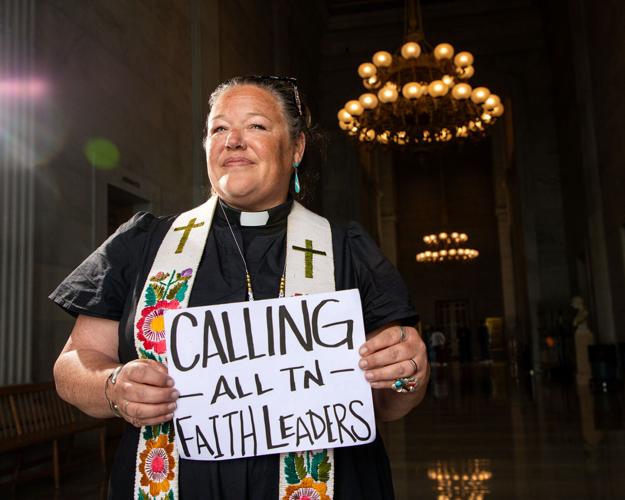


The Rev. Ingrid McIntyre
The hardest part of the Rev. Ingrid McIntyre’s work at the state legislature is the opening prayer.
State lawmakers take turns nominating a pastor to pray before each House and Senate floor session at the Tennessee General Assembly. And often, says McIntyre, that prayer is at odds with the legislation discussed afterward.
“This is my love language,” McIntyre says of prayer. “This is the language I use to live my life, and you are hijacking it to use it as a weapon for your ideals, and that is not what they are there for.
“They’re voting for this thing that is gonna rip children away from their parents,” she continues, referencing the state’s draconian immigration laws, “and that doesn’t really align with what I heard in your prayer this morning.”

We recap what the state legislature did — and didn’t do — this year at the Capitol
McIntyre and many of the state’s legislators share a religion: Christianity. She and one lawmaker, Sen. Bill Powers (R-Clarksville), even share a pastor — McIntyre’s own father. But their interpretations of their faith have put them on opposite sides of the aisle, and the aisle is widening.
When the Tennessee General Assembly is in session, after leading Glencliff United Methodist Church on Sunday, McIntyre typically spends the rest of her week at the state Capitol. Ever-present in the halls and at meetings, she has been heckled by representatives who call her “father” when she wears her clerical collar. They’ve said “nice scarf” in reference to her liturgical stole. She’s even been accused of being a paid protester. “Have you seen my bank account?” she asks. She’s also been removed from the Capitol chambers for interjecting during the proceedings, but she always comes back.
“That’s the thing that I really feel called to, is to be a witness here — a witness who inserts their thoughts every once in a while,” she says.
McIntyre works with the Southern Christian Coalition, a grassroots group of progressive pastors focused on political engagement. Locally, there’s overlap between SCC and the Nashville Downtown Church Collective, a 2023-formed group of pastors operating downtown churches. For many of them, their proximity to Capitol Hill makes the legislature part of their responsibility as pastors. These progressive pastors share a goal: showing that Christianity is more than the conservative viewpoints common among Tennessee’s Republican supermajority.

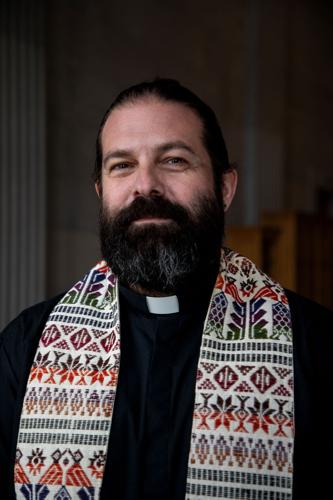
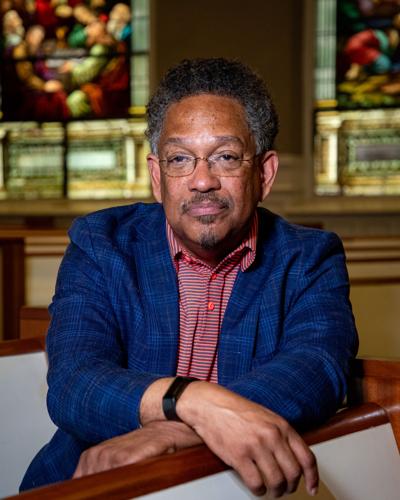
The Rev. Austin Becton
State Rep. Johnny Garrett (R-Goodlettsville) — one of the sponsors of this year’s legislation requiring local governments to work with ICE — is a member of Long Hollow Church, part of the Southern Baptist Convention. House Majority Leader William Lamberth (R-Portland), who sponsored legislation criminalizing the act of simply existing in the state as an undocumented immigrant, lists himself as a Baptist too. The state Senate’s co-sponsor for both bills, Senate Majority Leader Jack Johnson (R-Franklin), references his faith in campaign materials.
The Rev. Austin Becton with the Southern Christian Coalition had hoped that immigration would not be a hot topic at the Capitol during this year’s recently concluded legislative session. The Tennessee General Assembly has focused on banning abortion, increasing access to guns and stifling the rights of trans people — things that, he notes, aren’t explicitly mentioned in the Bible. Immigrants are mentioned in the Good Book, however — they’re referred to as “strangers,” “aliens,” “sojourners” or “foreigners” in different translations. The directions are clear, says Becton: Care for them.
“At least biblically, it’s crystal-clear,” Becton says of the Bible’s view on immigration. “I’m sitting here dumbfounded today listening to rhetoric of some conservative faith leaders. How are you justifying this?”
When they’re not at the Capitol, Becton and McIntyre — among other clergy members — accompany immigrants visiting the Department of Homeland Security for routine immigration check-ins. They collect contact information and offer to store people’s belongings, bearing witness to circumstances in which people have been abducted by U.S. Immigration and Customs Enforcement.

Attorneys say once-routine immigration cases are now ending in detention
If he had taken another path, Becton says he might even have shared the viewpoints of his more conservative counterparts. He was poised to take over the Pentecostal church he grew up in after his father retired. It was a very conservative community, and he felt its ire when he began to question the congregation’s views. “Why doesn’t pro-life include capital punishment?” he remembers asking.
“To watch the venom that came from that little statement was the beginning of a wakeup call for me,” Becton tells the Scene. “Because I was like, ‘Why are you getting so angry over really just trying to say, how do we value the dignity of human life?’”
He transferred to the Anglican church, starting a successful parish in Nashville in 2020. In June of last year, in honor of Pride Month, he posted an essay online criticizing Christian churches’ treatment of LGBTQ people. That caught the attention of his higher-ups, Anglican bishops. Rather than facing a disciplinary ecclesiastical trial, as it’s known in the church, Becton opted to resign. He’s now working to transfer to the Episcopal Church, known for its full inclusion of LGBTQ individuals.

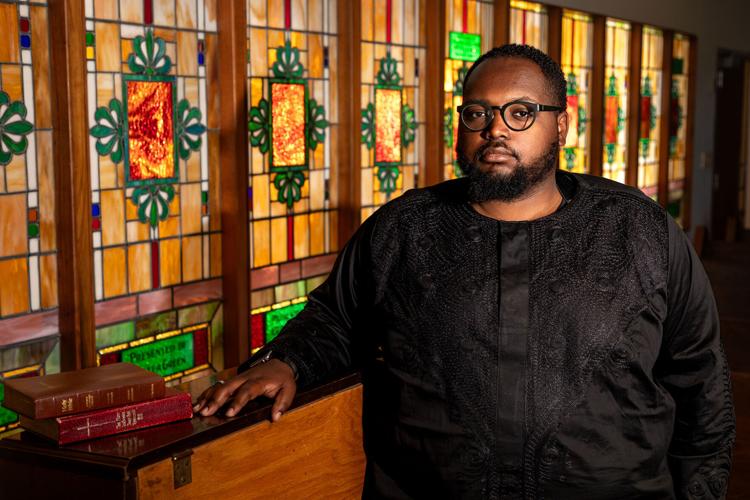
The Rev. Royal Todd
Like the sponsors of this year’s anti-immigration legislation, the Rev. Royal Todd — associate clergy at First Baptist Church, Capitol Hill — is a Baptist too. His views, however, differ greatly from those of Garrett and Lamberth. (When writing about their church, members of First Baptist Church, Capitol Hill are careful to use its full name. Stop before “Capitol Hill” and readers may mistake it for its deeply conservative Southern Baptist Convention counterparts — including Nashville First Baptist Church less than a mile away.)
“Over and over again, from Genesis to Revelation, God asks of us, be mindful of how you treat the stranger, because you were once the strangers,” Todd says. “Over and over again. That’s a thread that nets the gospel together. So I think there’s a strong biblical foundation for not just tolerating, but welcoming immigrant populations.”
The Nashville-based Southern Baptist Convention has been hit with many lawsuits — including suits alleging sexual abuse — in recent years. It’s a topic that Tennessean reporter Liam Adams has reported on extensively. The denomination also recently removed churches from SBC membership because they had female ministers. Additionally, the SBC does not ordain or allow marriage for LGBTQ individuals. Even so, it’s the largest Protestant denomination in the country. A Pew Research study published in 2025 found that 4.4 percent of U.S. adults are Southern Baptist. The second-largest Protestant group is United Methodists at 2.2 percent of U.S. adults.
First Baptist Church, Capitol Hill was the first Black Baptist church in the state to ordain a woman. Its founder Nelson Merry, who was formerly enslaved, was incarcerated in the late 1800s because he illegally ordained a marriage between an interracial couple. The church is part of the historically Black National Baptist Convention, as well as American Baptist Churches and Progressive National Baptist Convention. The church has hosted civil rights leaders on its grounds, including Diane Nash, Martin Luther King Jr. and even Frederick Douglass.
LGBTQ members are welcome at FBCCH.
“We are the Baptists that aren’t interested in what happens in the bedroom,” quips the Rev. Shane B. Scott, who began leading the church in 2024. At the 150th anniversary of FBCCH in 2016, the church had a joint worship service with its SBC counterparts Nashville First Baptist Church. But that wouldn’t happen today.
“I made it very clear that we cannot be in relationship if you are insistent upon supporting the policies of Donald Trump,” Scott says of Nashville First Baptist. “I have nothing to do with you.”
Scott has frequented the nation’s capital for political actions during his tenure as a pastor. He displays a photo of himself with late Republican U.S. Sen. John McCain in his office, taken the day before the politician voted to preserve the Affordable Care Act in 2017. The ACA has since been gutted by the Trump administration.
Scott notices a difference in Republican politics compared to just two years ago, when he prayed during the legislative session.
“These men and women have been given the weighty task of speaking and working for the people of the state of Tennessee,” he prayed at the time. “Their responsibility isn’t to just some people, but they have a responsibility to all people. And so God, I come today lifting them up to you that you would have mercy on them.”
Emphasizing “all people” was an indictment, but also an admission that we all need grace, Scott says. Since then, he says, “Their fear of Donald Trump has made them unreasonable.”
“I think that there are some good people on the other side of the aisle, but they’re scared of this man, and as a result, he is playing them like a puppet.”
Trump’s deputy chief of staff Stephen Miller collaborated with the Tennessee General Assembly’s Republican leaders on this year’s slate of anti-immigration legislation. The president has seen overwhelming support from white evangelical groups — he has a 72 percent approval rating among the group, according to Pew Research Center data.

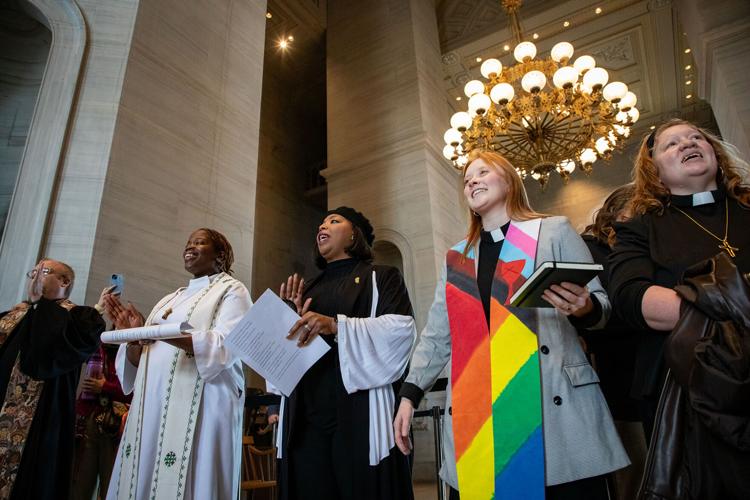
Clergy members on the first day of the 2026 legislative session
The most visible markers of a progressive church: ordaining women and LGBTQ clergy, as well as allowing LGBTQ parishioners to be married in the church. Evangelical Protestants tend to lean right politically and are more socially conservative, while mainline Protestants — also known as modernist Protestants — are more socially and politically liberal.
Christians also separate themselves in the way they interpret the Bible. One common difference between progressive and conservative Protestant groups is how literally their church leaders interpret the Good Book.
The Rev. Travis Meier of First Lutheran Church in downtown Nashville does not consider the Bible to be infallible.
He defines progressive viewpoints of the Bible through answering the following with a yes: “Can we be OK with difference? Can we struggle with the world not being black-and-white? Can we sit in the uncomfortable gray areas of life? Can we be OK with not having the answers to questions?”
Having studied the Bible in several languages, Meier acknowledges that it has contradictions, and as a historian, he also includes historical context. For example, marriage is defined in several contradicting ways in the Bible — a fact that is relevant to efforts to ban LGBTQ marriage in Tennessee this year.
“I take my little sign of eight biblically sanctioned visions of marriage and say, ‘Which of these eight are you talking about?’” says Meier, a member of the Southern Christian Coalition and founder of the Nashville Downtown Church Collective. “A committed relationship today shouldn’t be judged on the social paradigms of seventh century B.C. Assyria. Are we going to base our sexual ethics on a 2,600-year-old understanding of human relationships?”
Progressive pastors also express a shared concern about the rise of Christian nationalism — an ideology positing that America was founded as a Christian nation and should remain so today, and its laws should be based on Christian values.
“It’s a narrow view that says, ‘This is all for me, and you’re not a part of it unless you believe what I believe, say what I say, look like me, act like me, do what I say,’” says Meier. “‘If not, you’re either gone, or we’re gonna enslave you, or we’re just gonna get rid of you completely,’ which is unfortunately a history that Christianity itself has to reckon with the damage it’s done historically.”
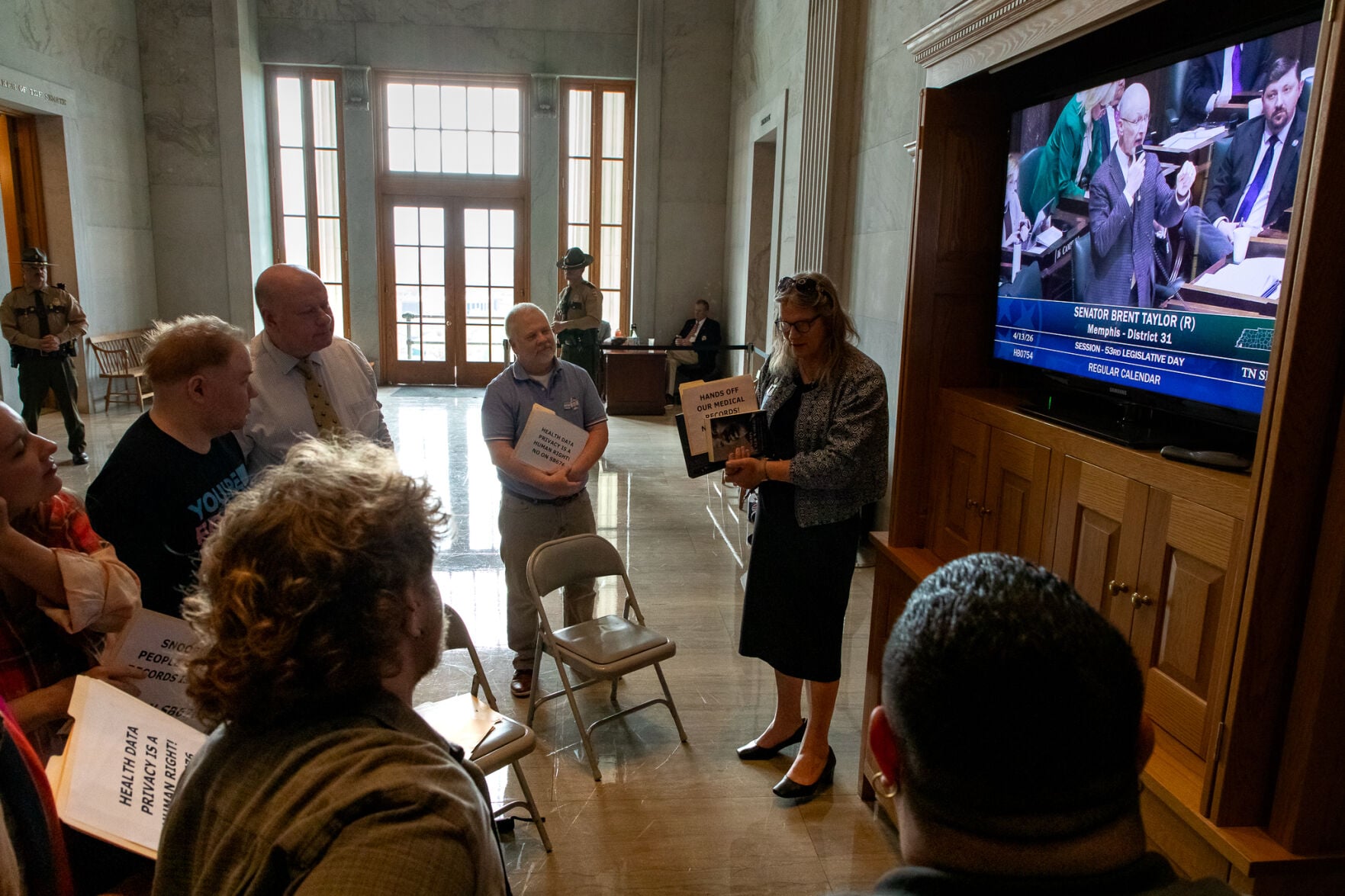
Bill co-sponsor calls gender-affirming care a 'fad' but removes county information requirement at request of protesters
While the Rev. Zach Sasser with Downtown Presbyterian Church frequents protests, vigils and other political actions, he’s taken to starting his Sunday sermons with a bit of fluffy good news.
“Sometimes the role of the church is to just help everybody breathe and have some space and then have the moral framework so they can go back out and engage where they’re capable,” Sasser says.
One of the roles of a Christian, Sasser says, is to try to bring heaven to earth. To make it more heaven-like here, he says, laws should be fair, people should be treated well, and they shouldn’t have to worry about where their next meal is coming from or whether they have access to housing. It’s part of a repeated refrain from pastors featured in this story — it’s most important to care for people on the margins of society.
“What I see in the elected representatives is a need for power and control, and some of them probably … feel like there are bad things in the world and they want to fix it, and the way they can do it is through garnering power and controlling it,” Sasser says. “I also think there are a lot of people who just want to be in control.”

The Rev. Stephen Handy
Like the leaders of First Baptist Church, Capitol Hill, the Rev. Stephen Handy of McKendree United Methodist Church wants to take a page from Martin Luther King Jr. and other leaders of the civil rights movement. It’s why in 2023 he marched silently as religious leaders carried seven caskets to the Capitol in honor of the victims of the Covenant School shooting. Handy says that when you disrupt the flow of capitalism, that’s when you’ll really get the attention of the powerful.
“We’re pointing fingers, and we’re screaming and yelling, and he didn’t do that,” Handy says of MLK. “People get caught up in the emotions of the event, so they then walk away and I say, ‘What was accomplished?’ So you let your anger out. You’re just gonna go back and watch more television, right? You’re gonna rebuild that anger.”
Outside of political demonstrations, Handy also regularly visits divinity school classmate and pastor of Lee Chapel African Methodist Episcopal Church — his friend, state Rep. Harold Love (D-Nashville).
One of the more tenured downtown pastors, Handy has been putting his focus lately on bringing the church to people downtown. They’ll host live music on the rooftop of the church’s Christian Life Center and plan to offer a community meal on Church Street in the future.
“We want to simply gather, because we know food brings people together,” Handy says. “We also know preaching can irritate people.”
Thanks to Meier’s latest efforts and a grant from Project Thrive — a program developed by the Curb Center for Faith Leadership at Belmont University — the Nashville Downtown Church Collective is in lockstep more than ever, meeting once monthly. They want to put their large buildings to good use, including for the city’s unhoused population. They offer meals and a clothing closet at McKendree, and nonprofit social enterprise The Contributor is housed at Downtown Presbyterian Church. While all the congregations deal with expensive repairs in aging buildings and need income in addition to congregation tithing, part of the ethos of the Nashville Downtown Church Collective is this: If we’re all just trying to survive, why compete anymore? All of the churches share a staunch belief that they need to be downtown, to bear witness to everything that happens there.
“I tell people we cannot afford to lose our witness in downtown Nashville,” Handy says. “We can relocate tomorrow. I get a call about every other month. People want [to buy] this space, and I get it. But do we need another high-rise in downtown Nashville?
“We need to build communities that are beloved, which means that they’re diverse, they’re equitable, they’re intentional, they look like the kingdom of God. So as long as I’m here, we’re not going anywhere.”
Some days when the Tennessee General Assembly is in session, McIntyre is one of just a few clergy members at the Capitol. Full-time clergy like herself do have a lot on their plates, she acknowledges. But Southern Christian Coalition members hope more will join them in person. She also points out that “Southern Christian” may be a vague term, but it challenges a common assumption — the group’s name illustrates that Southern Christianity and conservatism don’t always go hand in hand.
“The call is, at least for me, to do something outside of the four walls of the church building,” says SCC’s Becton. “We’re in a place where if faith leaders don’t think they need to be engaged right now, there’s a problem.”

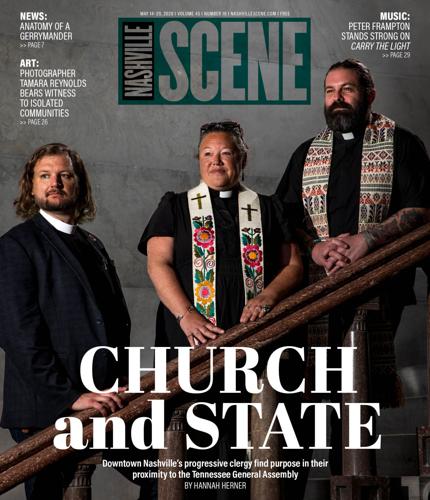
From left: the Revs. Travis Meier, Ingrid McIntyre, Austin Becton

Post a comment as anonymous
Report
Watch this discussion.
(0) comments
Welcome to the discussion.
Log In
Welcome to the discussion.
Keep it clean. Please avoid obscene, vulgar, lewd, racist or otherwise abusive language. Comments featuring hate speech or threatening or violent content will not be tolerated.
PLEASE TURN OFF YOUR CAPS LOCK.
Be truthful. Don't knowingly lie or mislead.
Be proactive. Use the “report” link on any comment that violates our comment policy.
Share with us. We'd love to hear your feedback.