
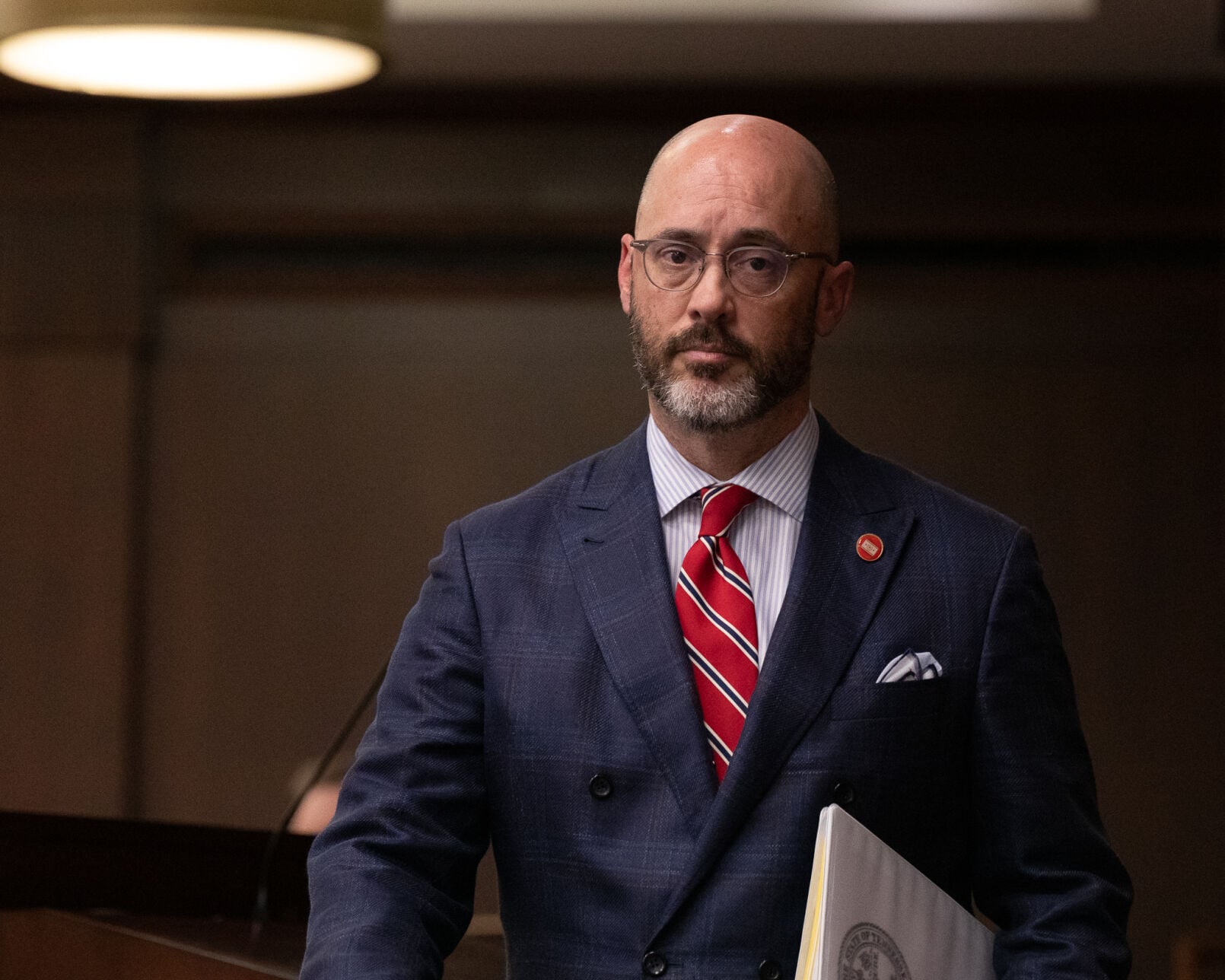

The Tennessee House of Representatives passed legislation Monday that would require sheriffs’ offices across the state to enter into agreements with the U.S. Immigration and Customs Enforcement Agency’s 287(g) program.
House Bill 2219, sponsored by Rep. Johnny Garrett (R-Goodlettsville), passed largely along party lines on the House floor in a 71-25 vote. Its Senate version will be heard Tuesday by the Senate Finance, Ways and Means Committee. Three House Republicans — Reps. Jody Barrett (R-Dickson), Monty Fritts (R-Kingston) and Michael Hale (R-Smithville) — joined Democrats in voting against the bill.
The ICE’s 287(g) program has four categories: The Jail Enforcement Model, “designed to identify and process removable aliens — with criminal or pending criminal charges — who are arrested by state or local law enforcement agencies”; the Task Force Model, which “serves as a force multiplier for law enforcement agencies to enforce limited immigration authority with ICE oversight during their routine police duties”; the Warrant Service Officer program, which “allows ICE to train, certify and authorize state and local law enforcement officers to serve and execute administrative warrants on aliens in their agency’s jail”; and the Tribal Task Force Model, which “serves as a force multiplier for tribal law enforcement agencies to enforce limited immigration authority with ICE oversight under Title 25 USC 2804.”

Verification, reporting requirements part of proposed bills filed
Garrett characterized the bill as “legislation designed to protect Tennesseans,” saying it will allow sheriffs’ offices to choose how they want to partner with ICE through the program. Sheriffs’ offices that don’t enter into agreements with ICE could see state funding withheld.
The agreement gives local law enforcement agencies access to federal resources, including an ICE database and training. ICE pitches the agreement as something that “helps you keep your community safe from potentially dangerous criminal aliens.”
When asked by Rep. Bud Hulsey (R-Kingsport) about sheriffs across the state retaining their constitutional authority and agency, Garrett responded, “I do not believe that when you delegate that authority under the federal statute or 287(g) that the sheriff is not in control of that destiny, of that enforcement, under 287(g).”
“Our county sheriff's departments are pretty busy already, but this is going to be an unfunded mandate, and going to have so many costs that are not defined in this legislation — that is the fear that I am hearing,” said Rep. Gloria Johnson (D-Knoxville), adding that sheriffs’ offices could be at risk for lawsuits related to incidents that happen in local jails. The bill’s fiscal note reads “not significant.”
Garrett dismissed these concerns, noting that Knox County currently works with ICE. According to federal data, that arrangement began in June 2020 under the Jail Enforcement Model. Seventy-three law enforcement agencies currently partner with ICE across the state, including the Tennessee Highway Patrol.
Garrett has dismissed arguments that the bill would see an influx of new detainees in already crowded jails and disagreed that the bill risks creating a financial burden for sheriffs’ offices, noting that ICE eventually reimburses partnering agencies for costs.
Rep. Gabby Salinas (D-Memphis) submitted an amendment to ensure transparency via an annual report to be issued to the General Assembly and the governor. The amendment failed.
“When people are scared, crime goes unreported, including for victims of trafficking,” Salinas said.
Debate around the bill has been heated throughout the session, with outbursts from activists and arguments between lawmakers in committees. It is one of several bills Republicans crafted in conjunction with Stephen Miller, President Donald Trump’s deputy chief of staff and homeland security adviser, who is leading the administration’s immigration crackdown.



Post a comment as anonymous
Report
Watch this discussion.
(0) comments
Welcome to the discussion.
Log In
Welcome to the discussion.
Keep it clean. Please avoid obscene, vulgar, lewd, racist or otherwise abusive language. Comments featuring hate speech or threatening or violent content will not be tolerated.
PLEASE TURN OFF YOUR CAPS LOCK.
Be truthful. Don't knowingly lie or mislead.
Be proactive. Use the “report” link on any comment that violates our comment policy.
Share with us. We'd love to hear your feedback.