
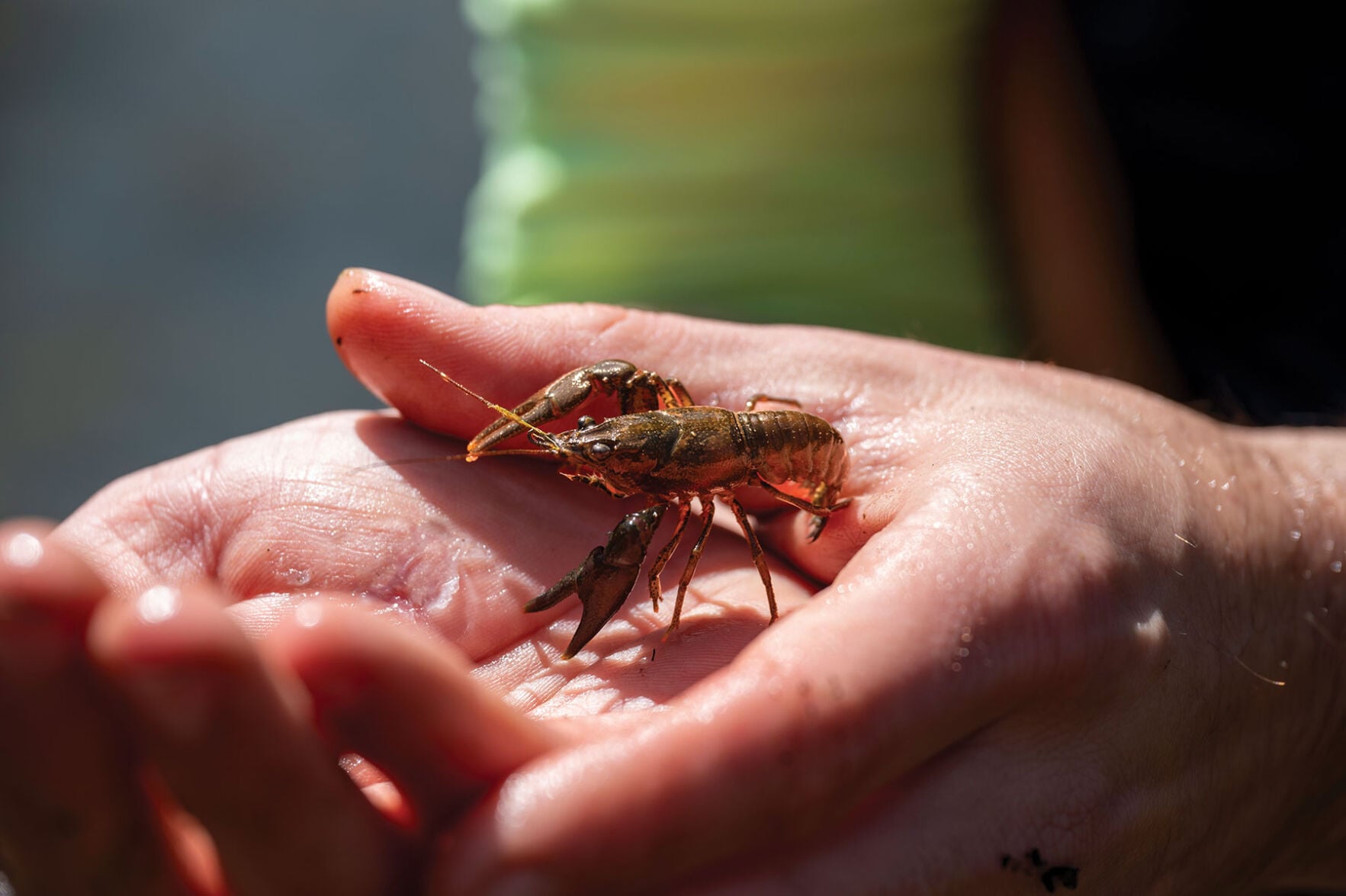

In Nashville’s Mill Creek, a small but mighty group of crustaceans makes for an unexpected cleanup crew.
These are the Nashville crayfish, a species whose entire population resides solely in Mill Creek — mostly Davidson County, but also part of Williamson — and nowhere else in the world. They spend much of their time eating dead and decaying organic matter like leaf litter, according to the Nashville Zoo’s ectotherm curator Dale McGinnity.
“The Nashville crayfish is really unique,” McGinnity tells the Scene. “They’re really important for sort of keeping the creek clean.”
The Nashville crayfish was first added to the federal endangered species list in 1986, making it the first species of crayfish to be classified as such. For more than a decade, the Nashville Zoo has conducted population monitoring of the Nashville crayfish with the help of funding from the U.S. Fish and Wildlife Service. Through the data collection, McGinnity says researchers have seen crayfish numbers remain largely stable at Mill Creek in recent years.
But the small population isn’t the only characteristic that makes the Mill Creek resident stand out from other crayfish species. McGinnity says they’ve become known for having a rather gregarious personality.
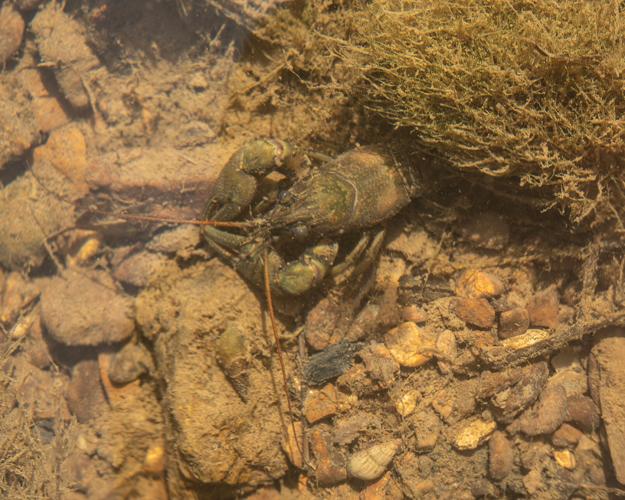
“We found over 100 crayfish during our sampling efforts of Nashville crayfish under a single rock,” he says. “So they have a super high density within the watershed, and they seem to be sort of more social and communal than any other species of stream-dwelling crayfish that I’m aware of.”

Crayfish in Mill Creek
And while many species of crayfish are nocturnal, the Nashville crayfish is often active during the daytime, when the creatures can be seen basking in the sun. McGinnity says that, along with sunbathing, socializing and helping to keep the creek clean, the Nashville crayfish plays a crucial role in the ecosystem, where they serve as prey for hundreds of species — including fish, birds and otters.
While population numbers suggest the Nashville crayfish appears to be thriving, there remain many questions about potential threats to the species. With the area surrounding Mill Creek having undergone rapid development, some advocates have raised concerns about the impact of construction on the Nashville crayfish. But so far, the crayfish seem to have remained resilient.
“I think if it weren’t for the stormwater control measures required of builders, then it would have really had a negative impact on the Nashville crayfish population,” McGinnity says. “But that development [is] better now than it used to be, because people understand the impacts of building without thinking about stormwater runoff.”
McGinnity says the introduction of an invasive species, which could include other crayfish, is one potential threat to the Nashville crayfish. He cites an example: when red swamp crayfish (the kind typically found in Louisiana-style crawfish boils) were introduced in Europe.
“[Red swamp crayfish] carry a fungal disease that the North American crayfish have evolved with, and it doesn’t hurt them, but it really wiped out the native crayfish in Europe once it got out,” says McGinnity.
Organizations like the Mill Creek Watershed Association and Cumberland River Compact work to restore water quality in the creek and ensure that it remains a clean and healthy environment for all of the species that inhabit the area. The Cumberland River Compact has conducted dam removals throughout Mill Creek, a practice that restores the flow of the stream and allows fish and macroinvertebrates, like crayfish, to travel freely throughout the creek.
Still, stormwater runoff remains a threat to the area and could have a negative impact on the ecosystem if not managed properly, says Gray Perry, watershed science and restoration program manager at the Cumberland River Compact.
“Tennessee has some of the highest biodiversity of freshwater species in North America, and it’s up there in the world,” says Perry. “We just have so many different types of fish species, tons of mussel species … lots of different macroinvertebrates and vegetation too. … We have a lot of awesome stuff, and it’s good to protect our habitat when we can.”

Stories on the local tree canopy, Tennessee quarries, the endangered Nashville crayfish and more — plus, how to get free trees and recycle your electronics



Post a comment as anonymous
Report
Watch this discussion.
(0) comments
Welcome to the discussion.
Log In
Welcome to the discussion.
Keep it clean. Please avoid obscene, vulgar, lewd, racist or otherwise abusive language. Comments featuring hate speech or threatening or violent content will not be tolerated.
PLEASE TURN OFF YOUR CAPS LOCK.
Be truthful. Don't knowingly lie or mislead.
Be proactive. Use the “report” link on any comment that violates our comment policy.
Share with us. We'd love to hear your feedback.