
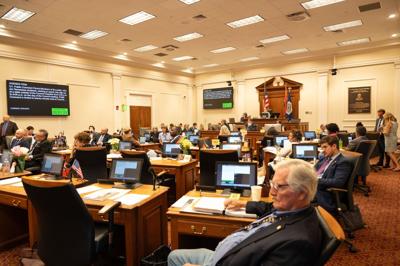

More than 100 Nashvillians packed the Metro Courthouse Tuesday night to give their feedback on Mayor Freddie O’Connell’s proposed $3.8 billion budget for fiscal year 2027.
Among the long lists of requests made during the annual public hearing — which stretched on for nearly four hours — one topic reigned as a top priority for many citizens of Davidson County: affordable housing.
Mirroring their requests during the council’s pre-budget public comment period in February, Nashvillians pushed for the council to fully fund Metro’s affordable housing initiative, the Barnes Housing Trust Fund, at $30 million — a funding amount that has also received backing from the Greater Nashville Realtors.

Funding for housing and schools, grocery tax cut eyed in mayor's FY 2027 Metro spending plan
Many other advocates pushed for a $10 million investment in social housing — affordable, mixed-income, publicly owned, controlled by the community and funded by a housing bond. These advocates also pushed for $9.5 million for a revolving loan fund for social housing.
“It's one thing to say that you want us to stay here — it's another to fund and embrace a model that actually ensures that,” Andrew Krinks, co-founder of the Nashville People’s Budget Coalition, told the council. “You have the power to improve our lives, and I hope you’ll use it.”
O’Connell’s proposed budget includes a $22 million allocation for the Barnes Fund, representing a $7 million increase from last year’s figure. If approved by the council, it would be the largest Metro investment in the Barnes fund since its inception in 2013.
The mayor’s proposal also directs $69 million to Metro’s Unified Housing Strategy, a housing solution plan introduced in 2025, as well as the allotment of $7 million for a subordinate debt pilot to create a revolving loan program to initiate an affordable housing bond.
Nashville Area Chamber of Commerce President and CEO Stephanie Coleman expressed the organization’s strong support of the mayor’s housing investment, which housing leaders praised at a conference last month.
“You cannot run a city — its hospitals, its schools, its restaurants, its small businesses — on [workers] who can no longer afford to live in it,” Coleman said to the council Tuesday night.
“Housing has become economic infrastructure as fundamental to our competitiveness as transit or schools, and here's what the business community most wants this body to hear: This is a solvable problem, not with a single headline or a silver bullet, but the way hard problems are actually solved — through patient, unglamorous, evidence-based work sustained year after year until it compounds. And this is exactly what this budget is.”
A recent Vanderbilt University poll found that 82 percent of Nashvillians say they cannot afford to buy a house in Davidson County. In addition, the poll showed that 73 percent of respondents want the mayor to address affordable housing, up from 61 percent of respondents in 2025.
A host of other citizens, including representatives with the Nashville Hispanic Bar Association and the Legal Aid Society of Middle Tennessee and the Cumberlands, pushed for $9.3 million for Metro’s support of eviction-right-to-counsel-initiatives, as opposed to the mayor’s proposal of $2.4 million.
“Increased funding would allow us to expand outreach, provide more multilingual legal education, increase representation, and help more families stay housed before a crisis occurs,” said Michelle Salazar, director of social work at the Nashville Hispanic Bar Association.
“Eviction is not just a housing issue — it's a justice issue, a public health issue and economic issue. Stable housing creates stronger families and safer communities.”
Another top priority expressed by residents who spoke during the public hearing is full funding for Nashville General Hospital. Hospital employees came out in droves to plead for funding, and many other Metro workers expressed their solidarity in regard to directing dollars toward the hospital.
“Every year, healthcare costs continue to rise, supplies cost more, staffing costs more,” said Brenda Gordon, an employee of Nashville General Hospital. “The demand for care now continues to grow. Yet every year we find ourselves fighting for the funding necessary to simply operate and continue to serve the city. This is not sustainable.”

The commission — hatched as a city hub for film and music promotion — has been dogged by political fights and procedural issues
O’Connell’s current budget outlines a contract subsidy for the Nashville Hospital Authority to help operate Nashville General Hospital with $67,879,500 — an increase of more than $7 million compared to the figure of the previous year. The proposal also includes $11.8 million for scheduled capital improvements.
Residents also requested the council make further investments in childcare and pay increases for Metro employees.
In addition, owners of businesses located in Midtown pushed for $50,000 to fund a proposal from the Civic Design Center for community engagement and renovations at Buddy Killen Circle.
Citing music and entertainment as an economic engine for Nashville, several residents also urged the funding of Metro’s Office of Entertainment, which appears to be scrapped under the mayor’s budget proposal.
In other business:
In a narrow vote, the council rejected the annual budget for the Central Business Improvement District, a downtown tax district provided with services run via the Nashville Downtown Partnership. NDP has come under scrutiny for its connection to the 2024 arrest of 10 unhhoused people in the district and for the entity’s response to a fire in the Nashville Public Library's downtown parking garage last summer. Needing 21 votes for passage, the budget received only 20 affirmatives from the council. NDP will submit a new budget to the council for consideration. The failure to pass resulted in a quick but heated exchange between Councilmembers Deonté Harrell and Jordan Huffman, a spat that was quickly quelled by other members of the council. Meanwhile, a separate budget for the Gulch portion of the CBID, which is soon set to merge with the initial district, speedily passed.
On first reading, the council passed a zoning bill that would create stricter regulations for data centers in Nashville. The legislation is sponsored by Councilmember Rollin Horton and would impose restrictions on the size and kinds of centers powering computers and AI allowed in Davidson County. Limits on water use, noise levels and air pollution would also be implemented under the bill, which follows a recent plan announced by Fisk University to construct a 70,000-square-foot data center on its North Nashville campus.
Two resolutions focused on Nashville Electric Service’s response to Winter Storm Fern were indefinitely deferred. One of the resolutions would urge the NES board to fire the utility’s CEO, Teresa Broyles-Aplin. The other resolution would express “a lack of confidence” in the leadership of the board during January’s historic ice storm.



Post a comment as anonymous
Report
Watch this discussion.
(0) comments
Welcome to the discussion.
Log In
Welcome to the discussion.
Keep it clean. Please avoid obscene, vulgar, lewd, racist or otherwise abusive language. Comments featuring hate speech or threatening or violent content will not be tolerated.
PLEASE TURN OFF YOUR CAPS LOCK.
Be truthful. Don't knowingly lie or mislead.
Be proactive. Use the “report” link on any comment that violates our comment policy.
Share with us. We'd love to hear your feedback.