

Lisa Boyle remembers the trees cracking on Sunday morning.
“ We had so many trees fall, and I was getting scared of that too, because we kept hearing them,” Boyle tells the Scene. “We lost power Sunday and spent one night freezing our butts off under a million blankets, sleeping in our coats. It was Monday when we finally left around 6:30 in the evening. At 3 o’clock in the morning, I got the call.”
For the second time in 13 months, Boyle’s house was on fire.
“T he reason I got the call is that I’ve become so friendly with my neighbors — they were able to alert me,” explains Boyle, who recently moved back to Nashville from Los Angeles.
The Boyle family lost their home in the Pacific Palisades fire that tore through a residential section of the Californian coast in January of last year. Boyle had been in her new Forest Hills home for a few weeks when Winter Storm Fern — or as she calls it, the Great Freeze — swept across Davidson County. After losing power on Sunday, Jan. 25, alongside more than 200,000 Nashville households, she and her son lit the home’s fireplaces for the first time since moving in. They snuffed out the fireplace before leaving for a hotel, but a trapped ember stayed lit somewhere near the roof.
The house burned from the top down.

Our coverage of January's severe ice storm
“ The first time I lost my house in California, our whole community lost their homes together — it was painful, but it was a shared pain,” Boyle tells the Scene two weeks after losing her second house. “This is much more selective. But I did learn that I sure picked the right place to be. Even before the fire, my neighbors reached out in ways that I hadn’t experienced before — it was refreshing to get back here and to feel that neighborly love.”
The few family treasures that survived the Palisades fire in a bank vault burned in Nashville a year later. An environmental lawyer by trade, Boyle stresses that more frequent and intense natural disasters have followed humans’ destabilization of the earth’s climate. She brings up a recent Instagram post by Tennessee’s former U.S. Senate Majority Leader Bill Frist, a Republican, that explains how a destabilized climate has allowed freezing Arctic air to spill into North America.
During 20 minutes of recounting her story with effervescent optimism, Boyle’s voice cracks just once.
“ Even with the loss of those things that I held so dear, my son and I could have been asleep upstairs in that house,” Boyle says. “I’ve learned, twice in a row, that material things really don’t matter. The thing that you’re left with is an incredible gratitude for your life, for your community, for the people that you love.”
On the Saturday before the power outages began, a citywide snow day — complete with partying on Lower Broadway, $2 martinis in Sylvan Park and all-ages sledding on the city’s golf courses — turned dark when the sun went down. With temperatures below freezing and a layer of snow already blanketing trees and roads, semi-frozen precipitation began building a thick coat of ice on nearly every outdoor surface.
“That night, while we were just working with routine typical snow, more snow moved into the county,” the Nashville Department of Transportation and Multimodal Infrastructure’s newly named acting director Phillip Jones explained to the mayor’s Winter Storm Response Commission on Feb. 23. “Lower temperatures, freezing rain, sleet — it changed the whole ball game to how we were responding to this event. Sunday the 25th, tree failures, power outages, signal damage begins. We began to activate in a completely different manner.”
Windshields turned translucent and icicles hung like stalactites from bumpers. Nashville’s tall trees — which would soon become the storm’s main tool of duress on homes, cars and city powerlines — began splitting under the weight. Uncertainty began to creep in, threatening the sense of order that separates civilization from survival. Branches and limbs fell with no regard for the organized human life below. Entire trees crashed down, surfacing massive root balls, sometimes along main roads or onto cars and homes. Power lines came down with them.
“The combination of freezing rain and ice has impacted the NES service territory overnight, with trees being weighed down by ice causing them to snap and take down power lines,” reads Nashville Electric Service’s first storm update, issued on Jan. 25. “Right now more than 188,000 customers are currently without power. Our teams are fully staffed and already in the field assessing damage and beginning repairs, and contract crews have been called in to assist.”
More numbers followed. One-hundred-twenty NES line workers in the field, with 40 more contractors on shifts of 14 to 16 hours. Executives expected 155 reinforcements by Monday morning. It took several more days for NES to fill out its ranks, which eventually peaked at 1,900 lineworkers. Residents refreshed NES’ online service map, which showed outages in real time. More than 230,000 customers were without power at some point, making Winter Storm Fern the biggest single outage event in NES history.

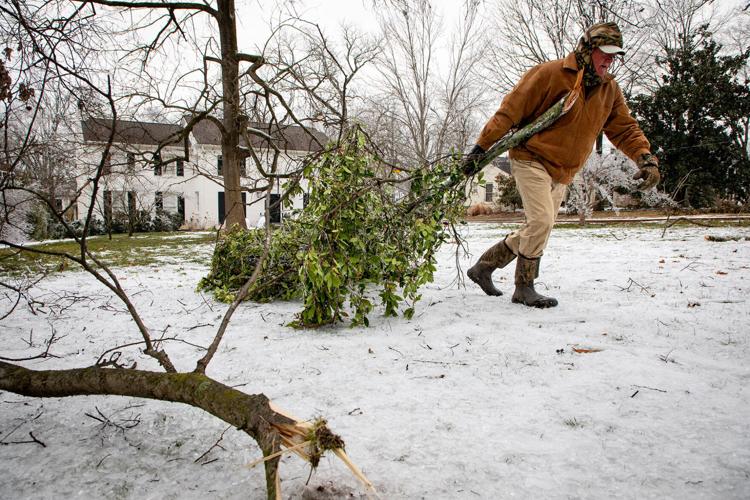
Tad Porter removes branches from the yard of his Estes Road home, Jan. 30, 2026
The utility was scrambling to respond to the extent and severity of ice damage. NES CEO Teresa Broyles-Aplin later described these days as “much more akin to a system rebuild than a storm restoration.” Initial grid reports became obsolete as wind and fallen branches took out more lines or, in some particularly frustrating cases, took recently repaired lines back offline. Brent Baker — NES’ executive vice president and chief operations and innovation officer, who was largely responsible for coordinating the utility’s storm response — appeared with the mayor and other department heads in Metro’s storm briefings.
Ice and falling branches became just two of a growing list of active dangers that revealed how close Nashville is to chaos. Without power, individual households — like the Boyles’ — searched for ways to meet basic needs with the materials they had on hand. City leaders linked five deaths in Nashville to the storm, two of which were attributed to carbon monoxide poisoning — a hazardous risk of running generators indoors or near ventilation intakes. (Monroe Carell Jr. Children’s Hospital at Vanderbilt reported that dozens of children, who are more sensitive to respiratory irritation, were treated for carbon monoxide poisoning during the storm.) Fire, burst pipes, hunger, toxic fumes, bitter cold, roadways without traffic signals and live electrical lines all unspooled the city’s typically comfortable relationship with physical, mental and emotional safety. Rumors and misinformation about the mayor and NES further unsettled the city and sowed anger among residents desperate for a clear forecast as they made choices about whether to risk car travel, and how to provide for children and pets.
Baker and Broyles-Aplin are now fighting for their careers. The public, state lawmakers and local elected officials are pointing at NES for mishandling its storm response, and many see firings as the best way to restore public trust. As they condemn NES leadership, officials are careful to praise the union line workers who, at times, endured freezing temperatures for up to 16 hours overnight, returning power to neighborhoods.
Sentiment turned against the local power company when daily restoration totals slowed to a crawl. The utility at first struggled to efficiently assess the widespread damage — described privately by one NES board member as a “carpet bombing” — and directed crews in the field to prioritize grid work that had the highest impact, often translating to denser areas with less tree coverage, to bring the most people online the fastest.

Senator used office to coordinate personal restoration timeline with Teresa Broyles-Aplin for Brentwood residence
At a media briefing on Wednesday, Jan. 28, Mayor Freddie O’Connell reported that 100,000 customers were back online. It was the last storm briefing in which O’Connell appeared publicly with NES’ Baker, as calls for clear timelines and information were met with equivocation from the utility’s leadership.
Behind the scenes, Broyles-Aplin was accepting the gravity of the storm at the same time as the city. “Time to ask for more help?” she wrote to herself in a two-line email at 5:53 a.m. on Sunday. A professional accountant, she had ascended to executive leadership first as CFO. She had delegated the technical storm response strategy to operations employees under Baker in favor of higher-level work. On Tuesday evening, Broyles-Aplin personally fielded a call from U.S. Sen. Marsha Blackburn’s office about when crews would restore power to the senator’s Brentwood home, forwarding the request to NES operations manager Kevin Phelps and requesting updates until Blackburn got power back. It was Thursday before Broyles-Aplin took questions directly from reporters. NES’ two public faces kept communicating in confusing executive speak. Baker specifically preferred to recount how much work had already been done, even while tens of thousands remained without power. When discussing NES updates, he spoke in general terms like “stabilization,” “acceleration” and “scaling.” A typical sentence came out in robotic bursts.
“ Taking care of this community is paramount — it is the most important to us, and making sure our customers are restored,” said Baker at NES’ first press conference separate from Metro officials, on Jan. 29. “We are working hard to get scaled up continually until we can hit the speed to restore.”

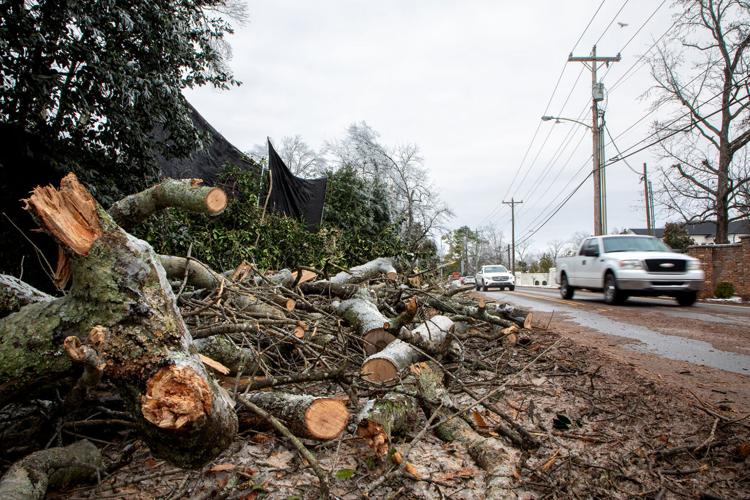
Downed trees following Winter Storm Fern
Broyles-Aplin, the CEO, frequently deferred to Baker in public appearances. She leaned on phrases like, “I commit to you that we will take a look.” At the height of the storm, Baker often avoided giving yes-or-no answers to reporters, promising that more information waited just around the corner.
Baker is a trained engineer and has done utility work his whole career; his expertise is not behind a microphone, especially during a period of extreme stress and a media spotlight. But the episode broadly exposed that NES was not prepared to communicate clearly — the mayor described the utility as “unequipped to communicate about a crisis” roughly one week after the outages began. NES, which is not a government entity, does not have a public information officer — a role that helps government agencies communicate with the media. It does have contracts with high-profile public relations firms FINN Partners and Hall Strategies, cumulatively worth more than $10 million. Both were in place before the storm. During these critical hours, getting information from NES was a mess. Communication between the utility and its reputation team seemed even less organized as individuals involved clearly understood how badly NES’ image was suffering in real time. One NES communications consultant, who responded via email to a Scene information request, said he would “take matters into his own hands” if the Scene didn’t honor a request for anonymity.
Soon after the storm, a pervasive rumor claiming that NES — whose workforce is represented by the Service Employees International Union — turned away linemen from the International Brotherhood of Electrical Workers did lasting damage to the utility’s corporate image. The accusations flew across social media as supposed proof of NES incompetence and were bolstered by a Tennessean article before being denied publicly by IBEW vice president Brent Hall. Still, Baker struggled to explain publicly why so few line workers were ready to respond when the storm hit.
Rob McCabe, a senior NES board member, confirmed with Broyles-Aplin at a Feb. 25 meeting that the utility has about 240 linemen on payroll — meaning that NES reported that just half of its own frontline workforce were in the field when trees began falling Sunday morning. That is to say nothing of the slow ramp-up of contractors, which Baker attributed to two factors: Linemen were staged in Memphis, where worse storm damage was expected, and NES’ grid demands hours of specified training before a lineman can get in the field. Media also seized on annual reports and statements that indicated NES backed away from sufficient tree-trimming in recent years, strengthening critics’ case that better preparation could have mitigated the citywide disaster.
Thousands of households were primarily frustrated that they were left in the dark. Many Nashvillians had neither electricity nor a clear power restoration timeline. The company’s remote alert systems were not functioning properly, sometimes incorrectly telling customers that power had been restored. The information vacuum fueled armchair social media investigations into NES practices like lineman numbers, vegetation control and why more lines weren’t underground. (NES buries many new power lines but has not retrofitted the existing grid, citing prohibitive costs.) Some of the worst-hit areas — Belle Meade and its adjacent siblings Forest Hills and West Meade, full of large residential plots and covered in a contiguous thick old-growth tree canopy known as the Western Highland Rim Forest — are also among the city’s wealthiest, oldest and best-connected, all accustomed to prompt service from the city.

O'Connell notes utility will be 'held accountable' regarding power restoration efforts, issues executive order to form storm-response commission
“The reality is that our leadership failed throughout the storm and has been failing throughout many storms,” said Metro Councilmember Sandra Sepulveda, turning to face Broyles-Aplin at a Feb. 10 special joint committee meeting. “I don’t understand how we continue to be in this position given the amount of storms we’ve had in this city since I began this term.”
Councilmembers slammed NES at this special-called meeting, their first chance to directly question individuals involved with the city’s storm response. Criticisms of NES united political enemies on the council. One resolution, a legally toothless demand that Broyles-Aplin be fired, is co-sponsored by outspoken East Nashville liberal Emily Benedict and conservative Courtney Johnston of Crieve Hall.
The mayor, who has direct power to appoint NES board members, hasn’t faced as much public blowback. Starting on Thursday, Jan. 29, O’Connell did not include NES officials in his own storm briefings, physically avoiding what had quickly turned from a government service to a toxic political liability. A survey from Republican political consulting firm Baker Group Strategies conducted from Feb. 9 to 12 affirmed O’Connell, whose approval rating came in at 55 percent. Just 9 percent blamed him for ice-storm chaos, while 67 percent of respondents were “very dissatisfied” with NES. Another 40 percent of those polled supported firing CEO Broyles-Aplin, including 51 percent on Nashville’s West Side.
Storm analysis has now been funneled into various commissions and reports that will cost more time, money and attention. City agencies like the Nashville Fire Department and NDOT are already vowing to share findings of rigorous after-action reports. The NES board tasked old-school attorneys Aubrey Harwell and Bill Harbison, both named partners at two of the city’s top firms, to conduct an external review of NES’ handling of the storm, expected in 90 days. Their first step is hiring another set of consultants with specific experience reviewing utilities after weather disasters. O’Connell named a special nine-member Winter Storm Response Commission, which has commissioned yet more lawyers to produce a separate review by August. Former Nashville Mayor and Tennessee Gov. Phil Bredesen — also the founding chairman of solar energy company Silicon Ranch — leads that commission.
“I thought you would have gray hair by now,” a bald and bandaged Bredesen joked to Broyles-Aplin when the NES CEO stepped to the mic to address the mayor’s commission at its opening Feb. 23 meeting.
Several other agency heads had spent the previous hour explaining how their success during the ice storm came from careful planning, coordination, communication and preparedness.
“We opened fire stations and police precincts to provide shelters from the cold,” said Nashville Fire Chief William Swann, who also heads Metro’s Office of Emergency Management and was a steady presence next to O’Connell throughout the storm’s press briefings. “This did not happen by chance. It was intentionally done. We had this set up within 24 hours. We worked with the Red Cross, who ran the shelters. We had the Office of [Homeless Services], the health department, Nashville Fire Department personnel working as EMTs and paramedics, Metro PD working as security. LifeFlight Vanderbilt EMS and Ascension EMS to help us have wraparound services.”
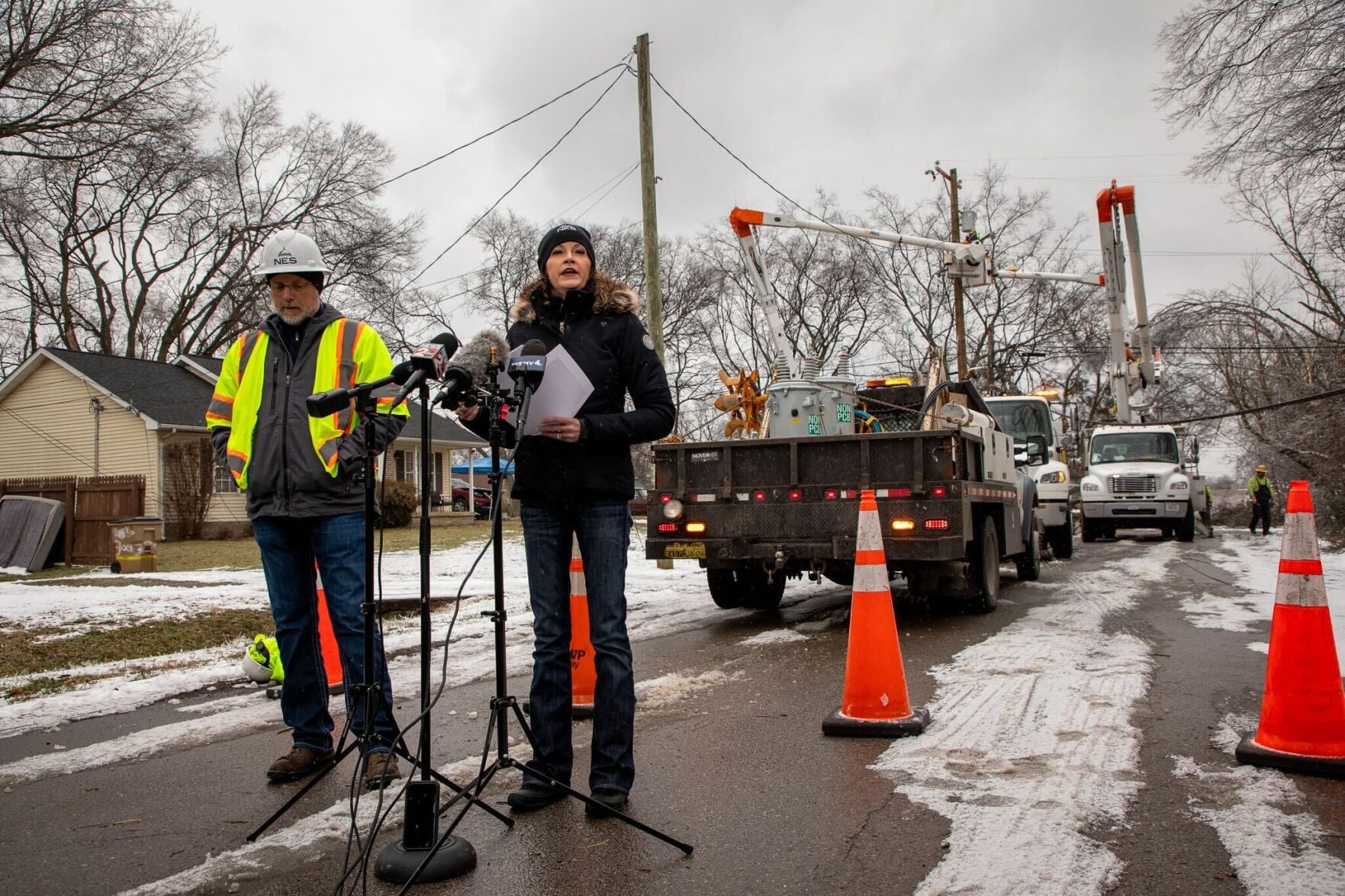
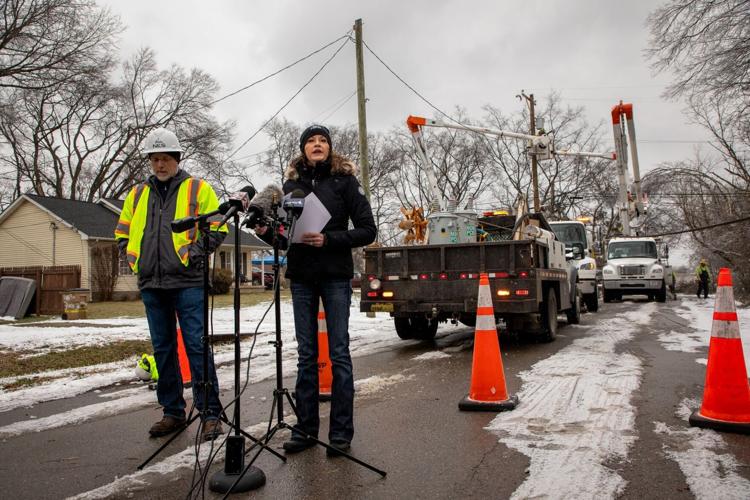
NES' Brandon Whitlock and Teresa Broyles-Aplin, January 2026
Swann, a prominent department leader whose job bridges professional experience and politics, seemed to be speaking from lessons learned from the public blowback. Each glowing detail directly paralleled an NES criticism.
“One of the great highlights was that the national Red Cross came in,” he continued. “They were blown away with how many resources we had here in the shelters. We used different types of messaging: We used social media, [Integrated Public Alert and Warning System] messaging, and made sure we coordinated these efforts on a daily basis.”
Metro Water Services’ Assistant Director Brent Freeman emphasized how they did pre-storm winterization and scaled up crews to respond to main breaks that at one point plagued the city. Phillip Jones — the new acting head of NDOT — explained how his department’s sweeping evaluation across the county identified “any and everything” that might threaten transportation and got roads open to traffic. Swann and the other department heads who spoke at the Feb. 23 meeting did not face the same challenges faced by NES, nor the scale or scope of work, but they took a victory lap. Broyles-Aplin found a way to broach but avoid taking responsibility for NES’ failures while defending her professional track record.
“I would be remiss, and would like to dive in briefly to acknowledge, that we did not meet the expectations of our customers through this storm,” she told commissioners. “Through this storm, we did not provide the level of service and communication that our customers have come to expect from NES. We’ve historically had really good reliability and improved communications over the years. We were unable to deliver that through this storm.”
O’Connell says he’s in talks with state leadership about the utility’s future
Other department heads serve directly under the mayor, who can hire or fire them like a cabinet. As utility executives, Baker and Broyles-Aplin serve at the pleasure of the city’s volunteer Electric Power Board, which consistently praised the utility’s leadership at its monthly Jan. 28 meeting, a special-called Feb. 9 meeting and a Feb. 25 meeting, during which board members seemed to be growing a bit uneasy. One indicated that the board is under pressure to appease state legislators, who are posturing for a state takeover of the utility, before the end of this legislative session. Lt. Gov. Randy McNally has explicitly called for Broyles-Aplin’s firing and another, state Rep. Johnny Garrett (R-Goodlettsville) filed a resolution “condemning” NES’ storm response.
At the Feb. 25 NES board meeting, Broyles-Aplin introduced several new initiatives. A newly approved contract will enable NES to better model its grid and tree canopy with Lidar (a form of landscape mapping that uses lasers), helping manage vegetation and making trimming and incident response more efficient. Broyles-Aplin hopes to hire a public information officer in the coming months, telling the Scene she “sees value in having someone that has our operational knowledge” as opposed to PR consultants. The utility will also explore “strategic undergrounding” for lines. Broyles-Aplin explains that problems with the public-facing outage map should be fixed by the end of March, including Spanish language information, accessibility for the visually impaired, and the ability to withstand lots of traffic. After that, NES says it should be able to provide estimated restoration times for customers, a key missing piece during Winter Storm Fern. A little extra contract preparation will also make it easier to scale up workers.
“One pillar that we’re focusing on includes different ramp-ups and potential pre-staging of resources,” Broyles-Aplin told the board. “Currently, we have all of our storm work contracts in place, so if we were to have a storm in the next few weeks — well, next couple of months — we have emergency storm contract agreements in place.”
There may be a storm in the next couple of months, but there was also a storm just six weeks ago. The speed and ease with which NES corrected its course also demonstrates that it was not prepared before the ice hit. Instead, chaos followed disorganization. Misinformation, physical danger and public resentment followed the chaos, as Nashville looked to its leaders, and its leaders looked at each other. Maybe, with enough consultants and committees and reports, someone will apologize.


Post a comment as anonymous
Report
Watch this discussion.
(0) comments
Welcome to the discussion.
Log In
Welcome to the discussion.
Keep it clean. Please avoid obscene, vulgar, lewd, racist or otherwise abusive language. Comments featuring hate speech or threatening or violent content will not be tolerated.
PLEASE TURN OFF YOUR CAPS LOCK.
Be truthful. Don't knowingly lie or mislead.
Be proactive. Use the “report” link on any comment that violates our comment policy.
Share with us. We'd love to hear your feedback.