
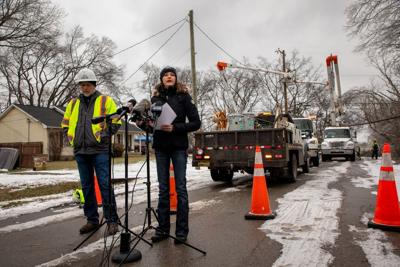

In the immediate aftermath of Winter Storm Fern, Nashville Electric Service fell short when it came to its emergency response plan, estimated restoration timelines for power outages and communication methods, and lacked a damage prediction model. That's according to an independent preliminary review released on April 17.
The report comes after the NES board gave approval for an independent review in February. In the months since, law firms Sherrard Roe Voigt & Harbison and Adams & Reese selected PA Consulting Group to complete the investigation. A full review will be released in mid-June.
“During the initial days of the storm, customers were unable to report outages due to issues with the outage reporting system and call center operations,” the report’s executive summary reads.

Utility will donate $1 million to recovery fund, suspend late fees and disconnects through June
“In addition, restoration information was at times inaccurate, inconsistent, and delayed. Collectively, the weather conditions, extensive damage, and the busy signals that some customers faced when they called to report outages contributed to a negative customer experience.”
The initial review found that NES faced issues with operations and communication during storm restoration.
“The [emergency response plan] was aligned at a high level with industry practices but lacked the detail, scalability, and procedural guidance needed to support a large-scale event, resulting in reliance on institutional knowledge rather than structured execution,” the report reads, noting that the emergency response was prepared to align with outages to only 50,000 customers. Winter Storm Fern impacted approximately 230,000 customers.
The report also highlights issues within NES’ incident command structure, which “lacked continuity due to simultaneous role rotations, unstaffed critical positions, and the absence of defined transition protocols.” This resulted in a “less than clear view of the chain of command” and inconsistent messaging.
The report also notes NES' lack of a damage-prediction model that would have aided in estimating resource needs before the storm. The report says this limited the service’s ability to secure outside assistance and resulted in a delayed request for resources and a slower overall response.
NES was also delayed in providing an accurate estimated time of restoration for customers who lost power, the report says, also noting communication shortfalls.

Six weeks after Winter Storm Fern knocked out power for hundreds of thousands of people, Nashvillians are looking for answers
“Communications operated in parallel with operations rather than as an integrated function, with limited access to operational data and inconsistent execution of defined roles and workflows,” reads the report. “This resulted in a reactive approach to communications. It resulted in delayed, inconsistent, and at times inaccurate messaging, as well as duplicated customer inquiries across multiple channels into NES which further added to the workloads of operators who had to address public inquiries in addition to active restoration activities.”
The report outlines five initial recommendations for NES, which include:
Expand NES’ emergency response plan and training and exercise programs to help better prepare and respond to large-scale events.
Update the incident command structure with clear roles, responsibilities and accountability to ensure clear delineation of focus areas and coordination.
Develop a damage prediction model to support earlier decisions and action when it comes to resources activation, communication and planning response.
Develop an estimated time of restoration strategy to develop customer specific restoration timelines for unplanned outages on blue-sky days and during weather events, as well as global restoration timelines for major events.
Establish a storm-specific communications structure with a designated communications lead and supporting communication pathways across the response.
The report notes areas that it says NES succeeded in during storm response. This includes the service provider’s restoration efforts resulting in “only” 17 minor injuries, such as slips and trips, and no serious injuries. The report commends NES for utilizing outside resources for assistance.
“As restoration efforts through (Wednesday) Day 4 were clearly not meeting customer expectations ... NES sought help from utility experts (albeit a little delayed) to provide assistance in developing mechanics to calculate ETRs,” the report reads. “NES recognized there was a need for technical expertise and brought in seasoned help to close gaps and create new processes.”
The review also commends NES for taking “aggressive action” when it comes to tree trimming post-storm.
Additionally, it says “there was little to no evidence of crews (NES or non-NES) having to wait around for work assignments or materials.”
This article was first published by our sister publication, the Nashville Post.



Post a comment as anonymous
Report
Watch this discussion.
(0) comments
Welcome to the discussion.
Log In
Welcome to the discussion.
Keep it clean. Please avoid obscene, vulgar, lewd, racist or otherwise abusive language. Comments featuring hate speech or threatening or violent content will not be tolerated.
PLEASE TURN OFF YOUR CAPS LOCK.
Be truthful. Don't knowingly lie or mislead.
Be proactive. Use the “report” link on any comment that violates our comment policy.
Share with us. We'd love to hear your feedback.