





Two campaigns — one on either side of Marsha Blackburn — have tried to stop the Tennessee Republican’s path from senator to governor. Paved with campaign experience, well-connected allies and plenty of money, Blackburn’s race to succeed term-limited incumbent Gov. Bill Lee looks like hers to lose. Or at least, to win less convincingly than the U.S. Senate reelection campaign she ran less than two years ago. Now, like then, Blackburn declined the Scene’s multiple requests for an interview.
Donors and party insiders say Blackburn coveted the governor’s seat even before her second Senate campaign. Blatant job-hopping fuels the “professional politician” label that has become her major opponents’ strongest weapon.

U.S. senator touts ties to President Trump in bid to become first female elected to the post
“ Marsha Blackburn’s number one funder is a voucher schemer out of Pennsylvania, who’s already given a million dollars to her campaign — it’s political insiderism, big money and PACs having their say with our elected officials,” says Memphis City Councilmember Jerri Green, the Democrats’ likely nominee for governor. “She continues to be in the big pocket of big lobbyists outside of Tennessee, and she doesn’t listen to Tennesseans. There’s nastiness on the national level that Tennesseans are just sick of.”
From the right, U.S. Rep. John Rose attacks Blackburn as out of touch, inexperienced and insufficiently pro-Trump. Rose is currently in his fourth term representing Tennessee’s 6th Congressional District in the U.S. House of Representatives, where he has slipped into relative obscurity inside Republicans’ right flank.
Both parties’ primaries will be held Aug. 6, with early voting beginning July 17. Also on the Republican primary ballot will be far-right state Rep. Monty Fritts of East Tennessee. On the Democratic primary ballot, Green is joined by four lesser-known Democrats, including Nashville steel guitarist Adam “Ditch” Kurtz.

Jerri Green
“The Founders envisioned a citizen legislature, and it might sound corny, but eight years was good enough for George Washington, and before I first came to Congress I decided it would be good enough for me too,” Rose tells the Scene, referring to the first president’s self-imposed two-term precedent. “I believe that even more firmly now. The environment in Washington is very corrosive, and if you stay here too long, you lose touch with the voters who sent you here to represent them.”
Rose levels the same accusations at Blackburn, whom he considers his only relevant opponent. First elected to U.S. Congress in 2002, Blackburn has spent years inside the Beltway “deciding whether to push a red or a green button,” as Rose describes the job of a legislator.

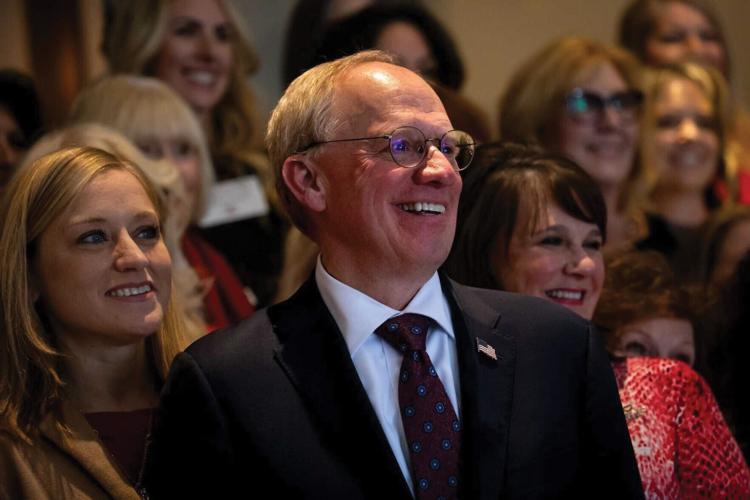
U.S. Rep. John Rose at a Republican Women of Williamson County event in Franklin, February 2025
“ I’ve had the unpleasantness of hiring people who turn around and immediately search for another job,” explains Rose. “Sen. Blackburn just took a six-year job as United States senator — I think Tennesseans are skeptical of that.”
Since rising from the U.S. House of Representatives to the Senate in 2018, Blackburn has avoided public appearances and press. Just last week, she awkwardly avoided questions from NewsChannel 5 outside an elevator at a Nashville event. Blackburn makes frequent appearances on Fox News and flooded airwaves during her last election cycle with campaign ads that focused on culture-war topics like trans people and wokeness.
“ It’s my belief that she ran for Senate simply as a way of raising money and raising her profile,” continues Rose. “I think it has become clear that she has intermingled her effort for Senate reelection and her effort for running for governor and used resources to advance the gubernatorial candidacy that were really probably more appropriately targeted to her Senate reelection in 2030.”

Congressman makes his official announcement in Wilson County
In the months after she won reelection in 2024, Blackburn spent more than $3 million in Senate campaign money on ads, travel and political consultants, prompting a formal complaint from Knoxville Republican activist Gary Loe alleging misuse of funds. The public relations runway set up the August 2025 announcement of her gubernatorial campaign.
Rather than discussing D.C., Rose is more comfortable borrowing business terms to describe his CEO qualifications, his résumé for governor and voters’ task of hiring the state’s next executive. It’s a message he hopes draws in like-minded Democrats too, though Rose warns about the state’s bona fide test — a misdemeanor penalty introduced in 2024 meant to eliminate cross-party meddling in primaries. An IT entrepreneur by trade, Rose served as the state’s agriculture commissioner for six months under Gov. Don Sundquist more than 20 years ago, the happenstance result of a last-minute phone call after a sudden resignation. Rose’s personal life has been the subject of criticism regarding the significant age gap between himself and his wife — who was 17 when she met Rose, then in his 40s and on the board of the Tennessee FFA.
He stitches together farm chores and CEO experience in ads that mimic the outsider-common-sense approach that propelled Lee’s 2018 winning campaign. He describes his campaign with three words (“faith, family and freedom”) and casts himself as the conservative problem-solver who will help preserve the nature and character of Tennessee — a key issue he says he’s heard from voters at events across the state.
On the campaign trail, Rose touts his own vote against certifying Joe Biden’s 2020 presidential victory — part of Republicans’ failed soft coup accompanied by Capitol riots on Jan. 6, 2021 — in an attempt to peel hardcore Trump voters from Blackburn in the party’s ongoing primary. He still doubts the integrity of the 2020 election based on what he calls “irregularities” in six swing states that sealed Joe Biden’s election victory. Intense public scrutiny from a raft of investigations, audits, reporting and probes have all failed to substantiate the so-called Big Lie that persists with Rose and a major faction of the Republican Party.
“ In my view, it was very easy to come to the conclusion that I should still vote the way that I believe the facts indicated,” Rose explains. “Now, you know, people ask me sometimes to dig deeper into that and what would have happened — there was a whole process laid out in law for how that should have worked, and had enough members objected, it would have set in motion a set of processes and procedures for how we then determine who the next president of the United States would be.”
Rose, who frequently praises the country’s Founders and Framers throughout his half-hour interview with the Scene, calls the associated violence that resulted from a Trump rally at the Capitol on Jan. 6 “very terrible.” He briefly discusses mail-in ballots and election administration laws and expresses confidence that history will vindicate his vote.
As Rose travels Tennessee trying to catch up with Blackburn’s statewide name recognition, he has built a bit of momentum in the uphill primary. Blackburn recently started attacking him in ads, a badge he wears proudly. Big-picture poll numbers still cast his campaign as a looming failure that has come at great personal expense — Rose loaned his campaign some $5 million — likely marking the end of his patchwork career in politics. Rose takes some comfort in imagining his own political end: There is plenty of work waiting for him on his farm.

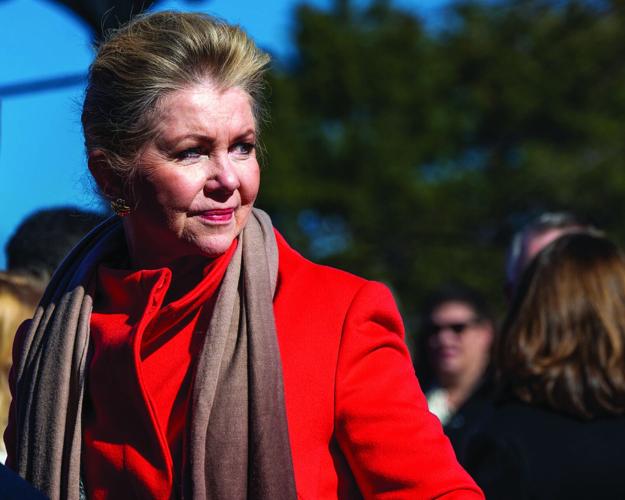
U.S. Sen. Marsha Blackburn at the second inauguration of Gov. Bill Lee, January 2023
Jerri Green sits on the other side. Raised poor in Memphis, Green has spent a career outhustling the competition, notching stops at the University of Tennessee and Georgetown University Law Center before returning south in the early 2000s. After a few years as a Nashville public defender, she moved back to Memphis, where she has raised her family and segued into politics.
In 2020, Green took on incumbent Republican state Rep. Mark White for a state House seat that spans purple Memphis suburbs. She lost, but her upstart energy and closer-than-expected results turned into a phone call from Shelby County Mayor Lee Harris, who recruited Green into his administration. She won her next race, a nonpartisan city council contest, by 56 votes. She’s turned the razor-thin margin into a core lesson of a budding political career.
“During that race, the last house that I knocked on, I saw the guy was standing in line in front of me when I went to go vote the next day,” Green tells the Scene in late June, hours before an evening event in Clarksville. “In addition to living in all three major Tennessee cities, I’ve worked in the executive branch, the judicial branch, and I’m on city council. Then I have my full-time job of being the chief public defender with 150 attorneys and staff, and I have three kids — that’s my most important job.”
The experience and political appetite set Green up for this year’s gubernatorial run. Tennessee Democrats have taken loss after loss in statewide elections, and it will take more overachieving to beat any Republican in November — much less a proven winner like Blackburn. Blackburn won her 2024 Senate reelection campaign by nearly 30 percentage points over Democratic state Rep. Gloria Johnson of Knoxville. Based on recent cycles — 2018, 2020, 2022, 2024 — Green has to find at least 800,000 more votes than any Democrat running statewide in the past decade, including presidential candidates.
“ I’m 48 — I remember having a Democratic governor, and I remember having Democratic senators,” says Green. “It’s just not that long ago. We are not a solid-red MAGA state. We’re actually really purple.”
Democrats’ preferred explanation for more than a decade of GOP dominance has avoided policy debates or introspection. Instead, the state’s disaffected and elusive non-voters have become the party’s hope and cope.
“Truthfully, Tennessee is a non-voting state, right?” Green continues. “We rank one of the last in the country for voting. People have given up because they feel like their voice doesn’t matter.”
The numbers back that up. About half of Tennessee’s 4 million registered voters regularly vote, placing the state among the nation’s least active in terms of voter participation. Green insists that Democrats do not have a damaged brand in Tennessee.
“ The damaged reputation is on the GOP,” Green says, shifting into stump-speech mode. “Ask anybody, ‘Is your life better than it was 20 years ago?’ That’s how long they’ve had a stranglehold, a trifecta, in our government. Are your groceries cheaper? Is your gas cheaper? Are your wages higher?”
Her affordability message mirrors the successful formula that has elevated the political stature of national figures like Nebraska mechanic Dan Osborn, Iowa auditor Rob Sand, Texas upstart James Talarico, party star Alexandria Ocasio-Cortez, and New York Mayor Zohran Mamdani — he might be a poor political match for Tennessee voters, but he’s a useful model for his clarion politicking. All are mold-breaking politicians who have defeated or significantly eroded established political power by finding new axes on which to engage voters; all have been honest and critical about the Democratic Party’s missteps. Green instead mentions Virginia Gov. Abigail Spanberger and New Jersey Gov. Mikie Sherrill, who have prevented backsliding in historically Democratic states, as instructive for her campaign.
“ I’m not here to deprogram anybody out of their cult, and I’m not gonna change my progressive values,” Green says. “We want to end the grocery tax and put taxes back on corporations and billionaires where they belong, and freeze the gas tax while Trump’s playing war games in the Middle East. We want to make healthcare more accessible and more affordable by taking Medicaid expansion money. Vouchers are hugely unpopular across the state. I have concrete plans, people get that.”
Newly gerrymandered congressional districts have boxed Democrats out of representing longtime liberal strongholds Nashville and Memphis. But more than a million Tennesseans still vote for Democrats, especially under a scandal-ridden Republican president. Blatant transgressions, like the recent special session that sliced Memphis into three new congressional districts to benefit Republicans, may provoke an even stronger backlash from voters. Democratic state Rep. Aftyn Behn, a progressive in East Nashville, proved valuable party momentum during a December special election that brought Democrats within 10 percentage points of a nationally significant upset. Even in the loss, all types of voters — rural, suburban, urban — moved toward the party. Keeping that momentum, says Green, is a victory in itself. She quotes voting research off the top of her head.
“ Hamilton County, home to Chattanooga, has been Republican for 20 years, and this year Democrats outvoted Republicans for the first time in decades,” Green says. “There is a sea change happening — people just aren’t paying attention to it in Tennessee.”




Post a comment as anonymous
Report
Watch this discussion.
(0) comments
Welcome to the discussion.
Log In
Welcome to the discussion.
Keep it clean. Please avoid obscene, vulgar, lewd, racist or otherwise abusive language. Comments featuring hate speech or threatening or violent content will not be tolerated.
PLEASE TURN OFF YOUR CAPS LOCK.
Be truthful. Don't knowingly lie or mislead.
Be proactive. Use the “report” link on any comment that violates our comment policy.
Share with us. We'd love to hear your feedback.