

Politics has earned a reputation for slow and unwieldy changes. Laws, precedent and arcane rules of democracy calcified over centuries often require careful work and scrutiny to untangle. Last week, the Tennessee General Assembly proved it can work quickly under the right pressures — namely Republicans’ imperious leader President Donald Trump and Tennessee’s senior U.S. Sen. Marsh Blackburn, the state’s odds-on next governor — to slash through codified protections, statutory rules and arguments made by the GOP just a few years ago.
Shortly after the close of this year’s regular legislative session, Trump and Blackburn urged their fellow Republican, Gov. Bill Lee, to reconvene the legislature and redraw Tennessee’s congressional map — to redistrict Memphis and gerrymander the state out of its sole remaining Democratic seat in Congress. Lee did so in a matter of days.

Protests from demonstrators and Democrats mark heated final day of whirlwind special session
“Before us is whether we think democracy is serious or not,” state Sen. Jeff Yarbro (D-Nashville) told Republicans in a committee meeting on May 7. “Citizens ought to be able to see what their district is, see if they got support, get signatures and qualify to represent their community and try to make their country better. This legislation turns it all into a game.”
Democrats’ many passionate and well-reasoned arguments about last week’s abrupt Republican-led redistricting process failed to stop the bills sponsored in each chamber by state House Speaker Cameron Sexton (R-Crossville) and Senate Majority Leader Jack Johnson (R-Franklin) that eliminated Memphis’ majority-Black congressional district. Throughout committees and floor sessions, Black legislators like Sens. Charlane Oliver (D-Nashville) and London Lamar (D-Memphis) and Reps. Justin Jones (D-Nashville), Antonio Parkinson (D-Memphis) and Justin Pearson (D-Memphis) made the racial consequences clear to white Republican leadership.

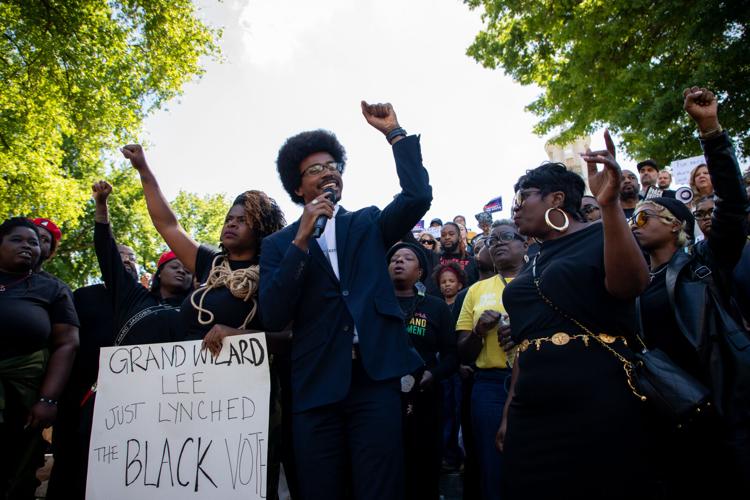
Rep. Justin Pearson rallies activists and fellow Democratic lawmakers on the steps of the Capitol, May 7, 2026
“It doesn’t matter what you pass, how you draw maps, you can do it any way you want to,” said Rep. Johnny Shaw (D-Bolivar), a Black minister who has represented West Tennessee since 2001, on May 7 — the session’s final day. “There’s a man that’s higher than all of us, and he’s looking down on us right now. Just remember that this old Black guy told you, before you leave here, that you are hurting nobody but yourself.”
Parkinson put words to his district’s existential frustration with the chamber’s longtime double standard against Memphis.
“Let Memphis secede from the state of Tennessee,” Parkinson said, directing his words at Sexton. “I’m dead-ass serious. You’re constantly beating on us, let us out.”
Waves of booming protesters delayed various committees, deliberations and votes, with Tennessee Highway Patrol clearing chambers and arresting civilians. But Republicans easily commanded the votes at every turn. Sexton, often with organizational help from House Majority Leader William Lamberth (R-Portland), kept a full schedule of meetings for members of his ruling party in the session’s short 72 hours. Rank-and-file legislators frequently spilled in and out of his sixth-floor office and conference room, saying little as the party organized its slate of votes. With no one to answer to, the GOP offered little in the way of explanation throughout the week, vaguely gesturing to population changes from the dais.
Tennessee’s 9th Congressional District, the state’s only congressional seat represented by a Democrat, was protected for decades under Section 2 of the Voting Rights Act of 1965 — a towering policy victory won by the civil rights movement. The Supreme Court gutted these protections in its April 29 ruling in Louisiana v. Callais, tipping political dominoes that fell from the White House to Blackburn to Lee to the Tennessee State Capitol. Tennessee law, including one statute that explicitly prohibits mid-decade redistricting, proved flimsy obstacles repealed with little discussion in Republicans’ five-bill series. Lawsuits — led by the NAACP’s Tennessee chapter and candidates scrambling to adapt ongoing campaigns — have followed in state and federal courts.

Suit focuses on bills removing state law prohibiting congressional district changes between census years
Beyond the blatant dilution of Black voters’ political power, the special session risks voter disenfranchisement via its stunted timeline. Candidates have a matter of days to sort out paperwork. New ballots could spell a logistics disaster for county election commissions. Having redrawn maps as recently as 2022 — when the Republican supermajority drew out Nashville’s congressional seat using 2020 U.S. Census data — lawmakers have now introduced another variable likely to stoke additional voter confusion in a state that consistently ranks near the bottom in election turnout. A federal lawsuit challenging the maps, filed by the Tennessee Democratic Party, throws Tennessee Attorney General Jonathan Skrmetti’s words back at him to make this point.
“Changing the rules on the eve of an election would wreak chaos upon the electoral process and would unnecessarily risk voter confusion and disenfranchisement of Tennessee’s military and overseas voters, causing irreparable harm to the Defendants and to the public interest,” Skrmetti argued just four years ago.
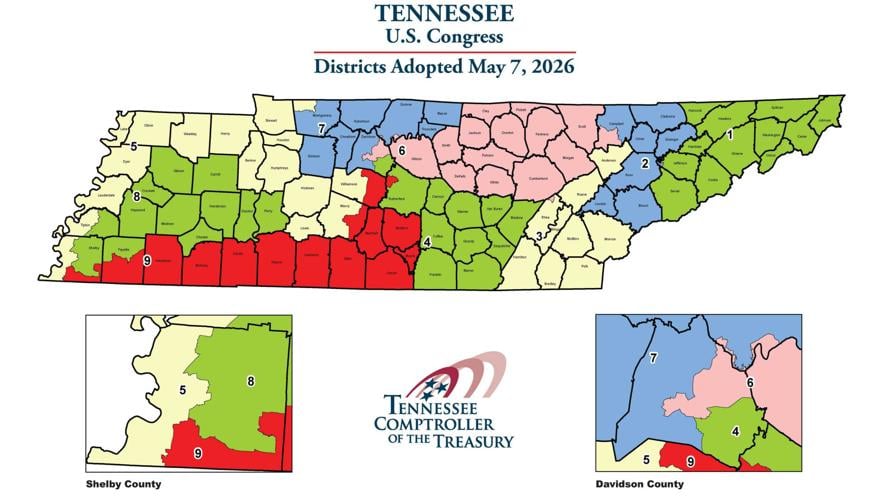
Republicans face slim odds to retain the U.S. House of Representatives in November, and Trump has leaned on his party to draw new districts in states with seats held by Democrats. Tennessee’s three-day special session carved new political terrain that drew Memphis into three meandering districts, two of which stretch nearly to Davidson County, comfortable padding margins for Republican candidates from the Mississippi River to the Great Smoky Mountains. While two East Tennessee districts survived intact, population-balancing from cracking Memphis had additional effects on Nashville, now split into Tennessee’s 4th, 6th and 7th Congressional Districts.
“They really didn’t leave us anything,” state Rep. Aftyn Behn (D-Nashville) muttered to herself, making sense of a vote-share spreadsheet from national Democratic analysts on dual monitors in her Cordell Hull office.
Down the hall, Pearson’s office was buzzing with staff, friends and family. Next steps fall on Democrats with the resources and vigor to campaign — like Pearson and Behn — despite lopsided numerical disadvantages across sprawling geography.
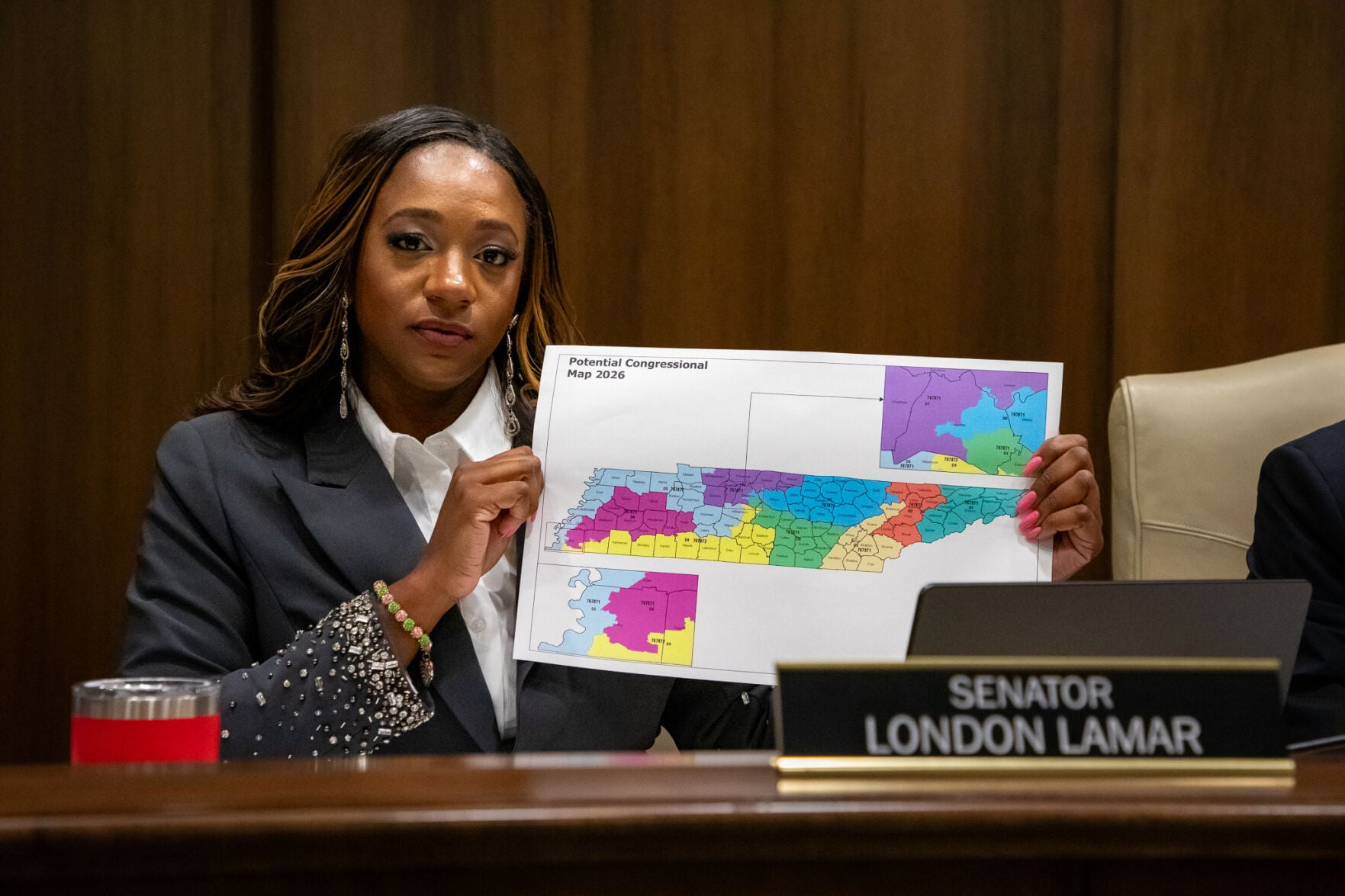
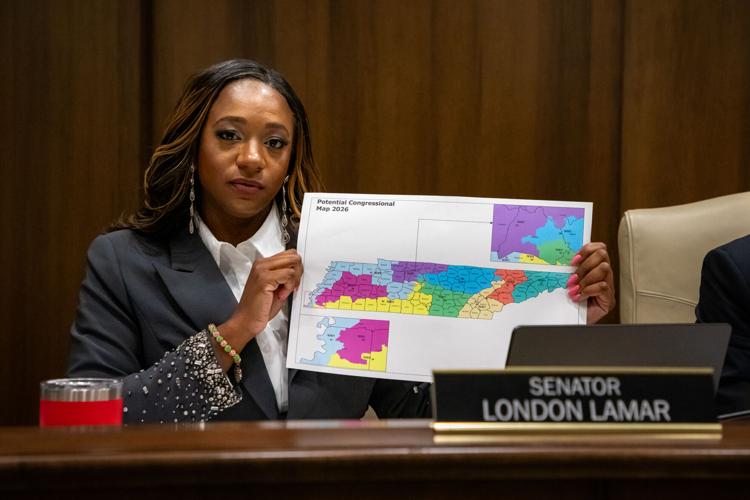
Sen. London Lamar holds a copy of Republicans' proposed congressional map, May 6, 2026
According to federal voting history, the six most competitive congressional districts now favor Republicans by between 10 and 20 percentage points when compared to voting in Joe Biden’s 2020 presidential victory — Democrats’ best showing in the past three statewide elections. Models put the new 9th Congressional District, which favors Republicans by 12 to 15 percentage points, as the state’s most competitive, followed closely by the new 5th Congressional District, where Behn competed in December’s special election to replace retiring Republican U.S. Rep. Mark Green. Democrat Chaz Molder, the clean-cut Columbia mayor who has raised seven figures for his congressional challenge primarily by slamming incumbent U.S. Rep. Andy Ogles, has joined court challenges to the new maps and vowed to continue his campaign. Nothing has united Democrats like the special session. During one particularly powerful floor protest, House representatives — some of whom spent the year clashing — actually joined arms.
As soon as he announced a primary challenge to reigning U.S. Rep. Steve Cohen — a Democrat who has represented Tennessee’s 9th Congressional District since 2007 and claims nearly 50 years in Tennessee politics — Pearson began reshaping the state’s Democratic Party. Now co-plaintiffs on a federal lawsuit against the new districts, the two had promised a generational clash that would showcase key divisions in a party that has struggled to find unity. Cohen showed off his ample rhetorical skill as Democrats’ invited guest during special session hearings. But in a gold Vanderbilt baseball cap in the tunnel between Cordell Hull and the state Capitol, Cohen, 76, paced slowly with the aid of a cane, stopping every few steps to greet a familiar face. Republicans’ appetite has forced rapid change in the state that will likely end his long political career one way or another. Southern Democrats are already rethinking large-scale party strategy to meet the moment’s new challenges. Real questions linger about how rural and suburban voters will use their outsized voting power in Tennessee and whether any candidate can chart a popular path across hundreds of miles against an unpopular president and unpopular policies in just a few months.



Post a comment as anonymous
Report
Watch this discussion.
(0) comments
Welcome to the discussion.
Log In
Welcome to the discussion.
Keep it clean. Please avoid obscene, vulgar, lewd, racist or otherwise abusive language. Comments featuring hate speech or threatening or violent content will not be tolerated.
PLEASE TURN OFF YOUR CAPS LOCK.
Be truthful. Don't knowingly lie or mislead.
Be proactive. Use the “report” link on any comment that violates our comment policy.
Share with us. We'd love to hear your feedback.