
For the second time in roughly four years, Tennessee lawmakers have redrawn the state's congressional map — this time, just over a week after a historic U.S. Supreme Court ruling and calls from President Donald Trump and U.S. Sen. Marsha Blackburn to make the state’s congressional representation fully Republican.
Democrats protested on the House and Senate floors Thursday, approaching the well of each chamber before walking out in protest.
“The protesters were the most aggressive, violent and vile we have seen,” House Speaker Cameron Sexton told the Scene. “We are reviewing all individuals who were in the gallery today. We are also investigating the actions of several members on the House floor who intentionally disrupted the House session, brought banned items on the floor, broke decorum and jeopardized the safety of others. Appropriate action will be taken in the very near future.”

New map would also keep Nashville split into three districts
After the Senate and House votes, protesters marched to the Beth Harwell Plaza, expressing intense frustration. By 3 p.m., Gov. Bill Lee had signed the redistricted map into law.
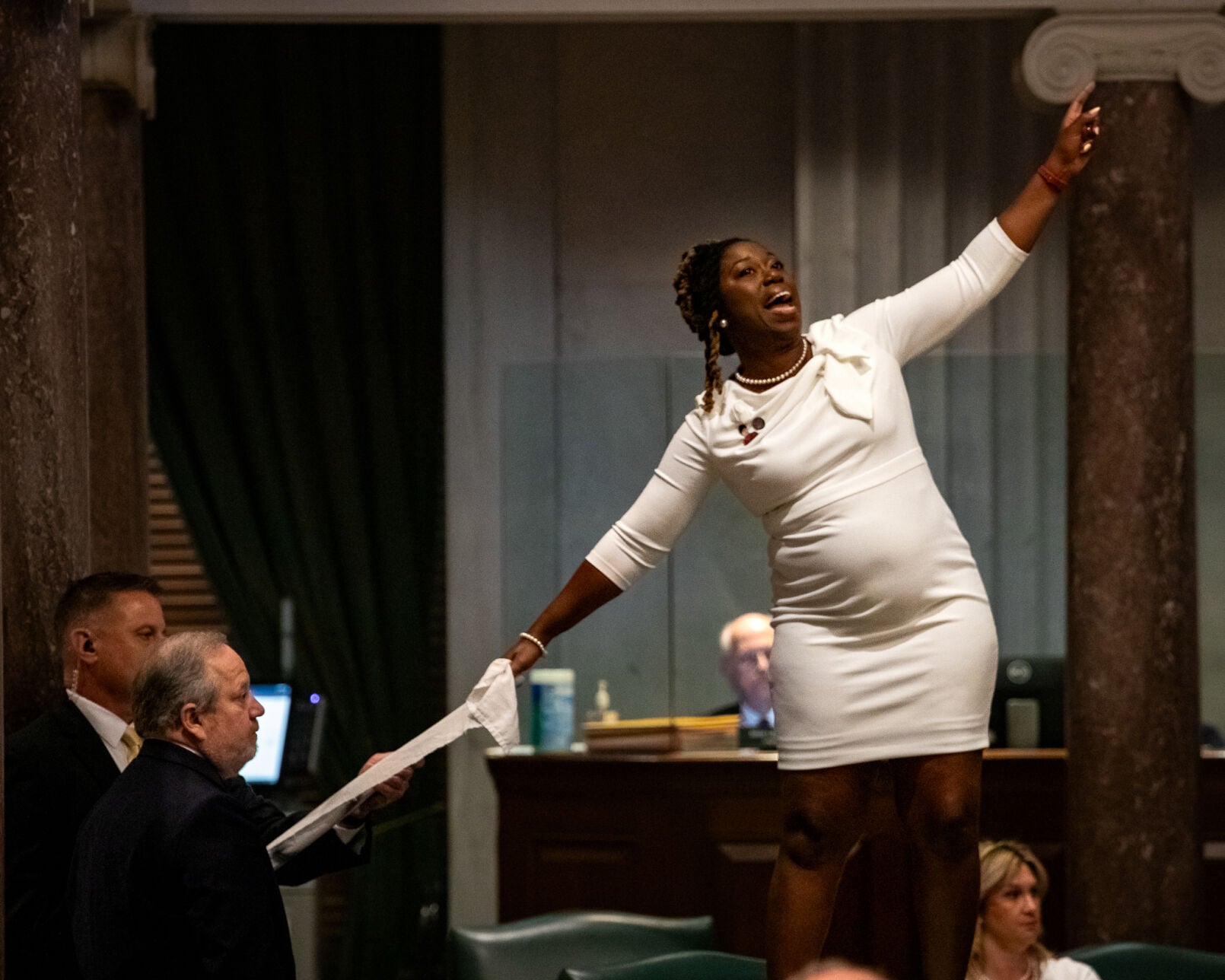
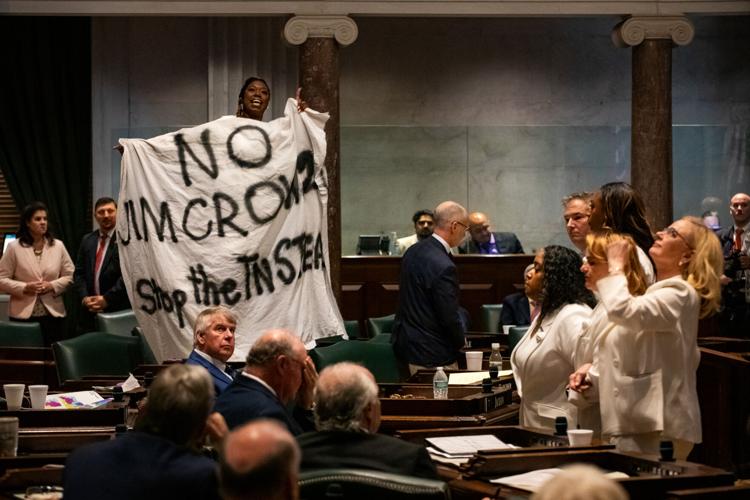
Sen. Charlane Oliver (D-Nashville) was the last to speak on the Senate floor, with her mic cut when she went over her allotted time. She then stood on her desk and unfurled a sheet reading “No Jim Crow 2.0” and “Stop the TN Steal.” The sign was pulled away by Senate Clerk Russell Humphrey.
Oliver said she made her family and ancestors proud by standing up for what she believed was right.
“I had something to say today,” Oliver told the Scene.“I needed my words to be on the record, because this was history that will go down in infamy, the day that democracy died in Tennessee. The speaker cut me off from speaking. I was going to continue and stand on that table so everyone could hear me.”

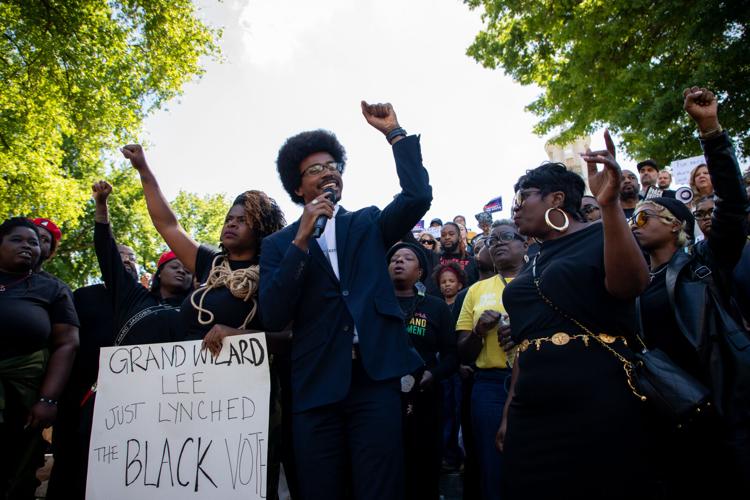
Rep. Justin Pearson rallies activists and fellow Democratic lawmakers on the steps of the Capitol, May 7, 2026
Lt. Gov. Randy McNally (R-Oak Ridge) later said Oliver’s actions were “unbecoming of a senator.”
“Senator Oliver’s outrageous and unprecedented display on the Senate floor today was disgraceful,” McNally said in a statement Thursday. “She disrespected her colleagues, her constituents and this state. There is simply no excuse for what she did. The Senate floor is for deliberative debate not calculated performative disruption. It was conduct unbecoming of a Senator — pure and simple."
Meanwhile in the House, the Tennessee Highway Patrol removed protesters from the gallery while Democrats read aloud their amendments designed to stop the redistricting efforts. KeShaun Pearson — the brother of 9th Congressional District candidate and state Rep. Justin Pearson (D-Memphis) — was arrested for not leaving the gallery. The Scene followed state troopers to a white van, in which KeShaun Pearson was to be taken to the Davidson County Downtown Detention Center for booking. He was later released.

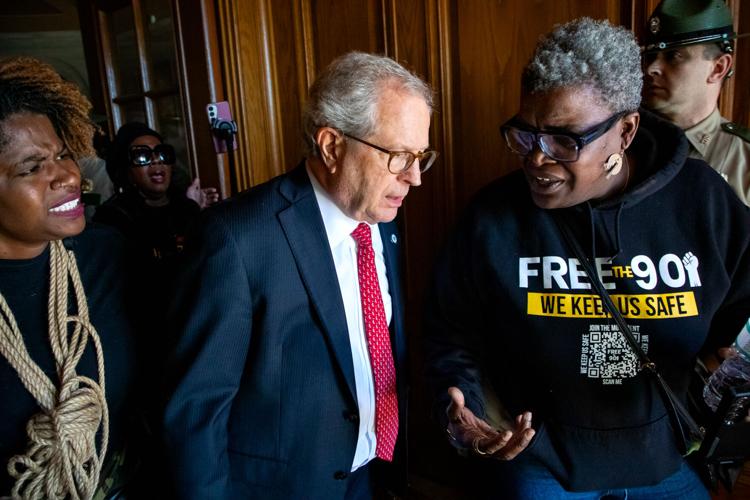
Rep. Mark White (R-Memphis) is questioned by protesters in the Capitol following the passage of a new congressional map, May 7, 2026
Rep. Pearson was present in the gallery during his brother’s arrest, yelling at troopers about their actions.
Meanwhile, Democrats continued to present their 37 amendments to House Bill 7001 — the bill removing residency requirements for the 2026 primary elections — on the House floor. The amendments were one of few avenues Democrats had amid a Republican supermajority to voice their opposition. All of the Democrats’ amendments failed. Democrats said repeatedly that they believed the process was rushed and failed to consider public input.
“There are people in this body already running for these districts,” said Rep. Jason Powell (D-Nashville) after presenting one of his amendments. “I have an entirely new congressional district. How absurd is that? This is about making sure the people have time. We are setting a dangerous precedent in the state. Everyone in this room should stop and think about that. The president doesn’t control the state of Tennessee. We are telling people not to have confidence in representative democracy.”

Sen. Charlane Oliver (D-Nashville) stands on her desk and displays a banner in protest of congressional redistricting, May 7, 2026
Arguments Over the Maps
According to the now-passed map, Davidson County would once again be split into three districts — the 4th, 6th and 7th Congressional Districts, with the 5th Congressional District no longer containing a portion of Nashville. The new 4th Congressional District would stretch from Nashville to rural parts of Middle and East Tennessee, including Grundy and Sequatchie counties.
Shelby County would be carved into three pieces, split between the 5th, 8th and 9th Congressional Districts. With the proposed lines, Williamson and Shelby counties would be joined together in the 9th Congressional District.
During the process of HB 7003, the bill that officially draws the new congressional lines, Rep. Jason Zachary (R-Knoxville) said the Senate was the primary mapmaker for the new lines. He said the map was drawn based on politics and population. Rep. Brent Taylor (R-Memphis) has already announced he will run for the redrawn 9th Congressional District.
“This gives us the first time to have an all-Republican delegation,” Zachary said. “This gives us the first time in history to send a Republican delegation from Tennessee.”
During the discussion, Rep. Antonio Parkinson (D-Memphis) had a suggestion for the legislature.
“Let Memphis secede,” he said.
He said if the legislature is going to “pound on Memphis,” then the state no longer needs their tax dollars.
“Black representation was not given freely,” Parkinson said. “Some of you say that you’re my friend. But the shame is all over your face. Perhaps the legislature should explain why Memphis should be part of the state of Tennessee. Don’t hide behind the maps. Let Memphis secede from the state of Tennessee. Let my people go. I am dead-ass serious. Allow us out.”
Republicans brought up no talking points during the debate and asked no questions of the maps.

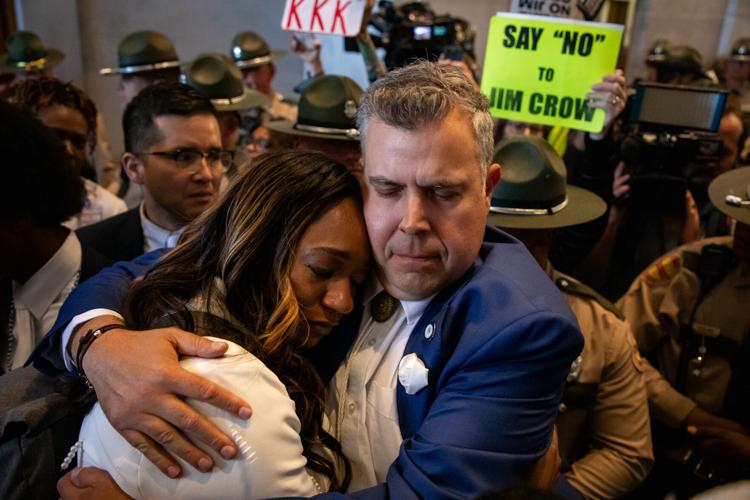
Rep. Jason Powell (D-Nashville) hugs a tearful Sen. London Lamar (D-Memphis) in the Capitol, May 7, 2026
Democrats and Protesters React
Wesley King, associate pastor at Vine Street Christian Church, stood in the Capitol rotunda Thursday alongside his fellow protesters.
“I'm here because you can't love your neighbor if you're stripping their vote away,” said King. “I think that all of these people in this legislature claim to be a Christian, and so if they truly believe that, then they know that the basic rule is to love God and love neighbor, and you can't love your neighbor if you are stripping away their rights, if you're stripping away their votes, if you are stripping away their representation that helps advocate for their basic needs.”
“Our most important thing is to make sure that the voices of our constituents are heard,” Sen. Raumesh Akbari (D-Memphis) told the Scene. “I think this cuts a little deeper because of the magnitude of what happened. But we always have to find a way to be resilient and work our way around it.”
Both Akbari and House Minority Leader Karen Camper (D-Memphis) said what happened Thursday wasn’t the end of bipartisanship from Democrats — at least from their perspectives.
“Strategy may have to change,” Camper told the Scene. “I mean, a lot of the legislature is built on relationships. People know who we are at our core. We understand, they understand how politics play … and so do we. We have to work with the other side to get things done.”

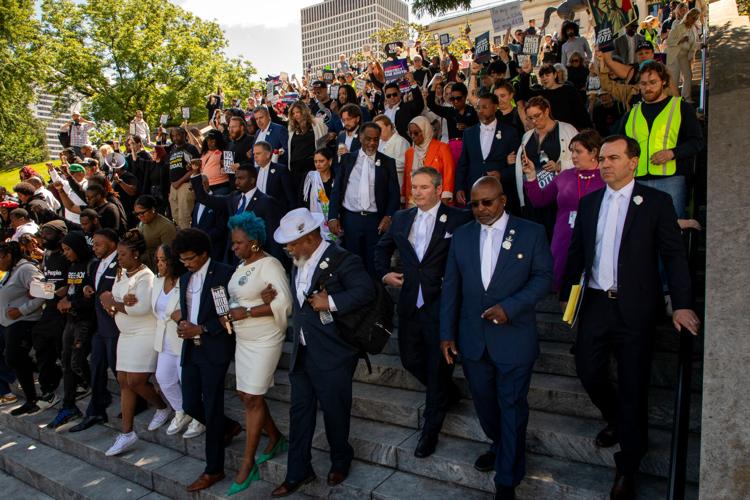
Democratic lawmakers and activists walk down the steps of the Capitol, May 7, 2026
What Bills Were Passed
HB 7001 removed the residency requirement for the 2026 primary election, which includes candidates for the current election season.
The qualifying deadline for candidates is May 15 at noon. The parties have two days following the deadline to validate bona fide candidates.
House Bills 7002, 7003 and 7004 prepared the state statute to redraw the congressional map. These allowed lawmakers to redraw the map even though it’s not following a federal census — the last redistricting efforts took place following the 2020 U.S. Census.
HB 7005 will cover $3.1 million to pay for the special session and pay for the costs local election commissions will incur in holding new primaries.
Julianne Akers and Hamilton Matthew Masters contributed reporting.





Post a comment as anonymous
Report
Watch this discussion.
(0) comments
Welcome to the discussion.
Log In
Welcome to the discussion.
Keep it clean. Please avoid obscene, vulgar, lewd, racist or otherwise abusive language. Comments featuring hate speech or threatening or violent content will not be tolerated.
PLEASE TURN OFF YOUR CAPS LOCK.
Be truthful. Don't knowingly lie or mislead.
Be proactive. Use the “report” link on any comment that violates our comment policy.
Share with us. We'd love to hear your feedback.