
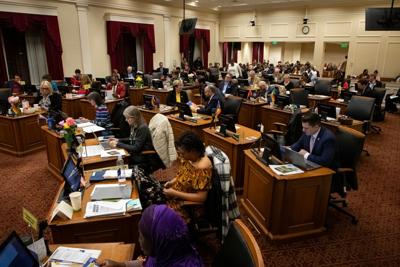

Vice Mayor Angie Henderson gaveled in Metro Council’s off-rhythm meeting Thursday night, but pastor Davie Tucker really set the tone.
“You became more important today, because this is the last representative body for the 800,000 Nashvillians,” said Tucker, a frequent civil rights voice and executive director of the Metro Human Relations Commission, to the 41-member chamber. “You are still representative of the people who sent you here. Nowhere else in our state — or even federal government — do we have that anymore. That ought to be untenable. That ought to be something that makes us mad.”

Protests from demonstrators and Democrats mark heated final day of whirlwind special session
This week's council meeting was pushed back two days to accommodate Tuesday's Metro primary elections. Tucker’s comments came hours after state legislators hastily redrew voting maps to split up Tennessee’s 9th Congressional District, a Memphis seat previously protected by the Voting Rights Act of 1965 and the state's last (and only) congressional post held by a Democrat. Many councilmembers had spent time at the Capitol throughout this week’s special session, called by Gov. Bill Lee after pressure from U.S. Sen. Marsha Blackburn and President Donald Trump following a Supreme Court decision striking down provisions to protect majority-Black congressional districts.
Tucker’s weighty words and the week’s heady implications for democratic governance set a serious tone for the evening’s otherwise tedious legislating.
“I passed my sandwich board legislation,” reflected a proud Councilmember Jordan Huffman. “That’s a pretty big deal.”
The Hermitage councilmember got involved in sidewalk politics when a business owner in his district got into a spat with Metro Codes over a folding A-frame advertisement in the public right-of-way. Huffman crafted a permitting process with regulations and struck a compromise between small businesses, Metro’s Traffic and Parking Commission and the Metro Legal Department.
“If you walk in downtown Nashville, there are hundreds of signs, and they’re all illegal," Huffman says. "Now we’re actually able to create some regulations around these and make some money. It’s proven to increase traffic, and businesses downtown see it as an opportunity too. I know it’s funny and sounds silly, but it’s a meaningful piece of legislation. Local government can work.”

Nashville Department of Transportation faces off with citizens who want to reinstall seating on Korean Veterans Boulevard
Councilmember At-Large Quin Evans Segall found common ground between the Nashville Department of Transportation and Multimodal Infrastructure and community bench-builders who have furnished city bus stops with hand-painted wooden seating.
Segall, who has a niche in transit and quality-of-life policy, withdrew legislation that would have protected privately installed benches from city removal with warning labels. For now, the city won’t remove the benches unless they draw specific complaints — a rare truce.
Thirteen board appointees will instantiate the new Midtown Central Business Improvement District drawn around parts of Demonbreun, Division and (upper) Broadway. The committee oversees a slight property tax fee that will fund additional beautification and policing. The MCBID contributes to a growing, interwoven network of tax redirects and contracting arrangements that are set to expand next year as the city’s two other BIDs — which cover Lower Broadway and The Gulch — are set to merge.



