
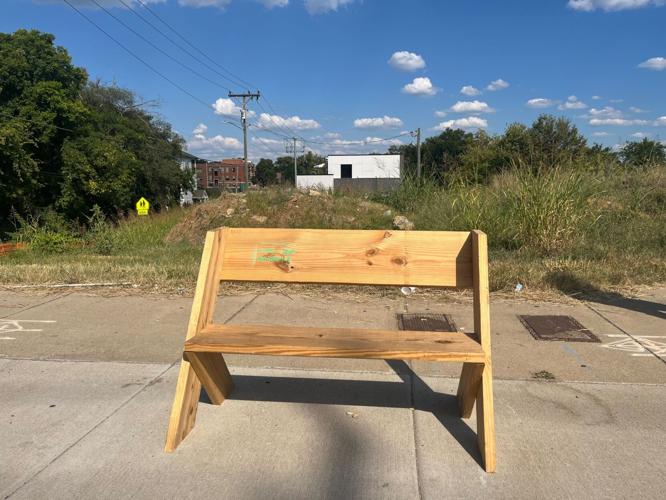
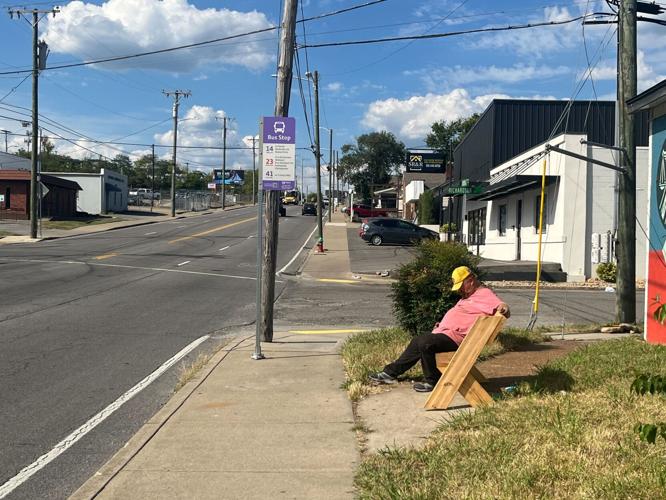

Days after the city methodically replaced popular metal seating along Korean Veterans Boulevard with large concrete spheres, new wooden benches appeared in their place. Soon after, the new benches were also taken by the Nashville Department of Transportation, relocated to a city warehouse. Concerned citizens — who identify their efforts as “guerrilla urbanism” — recovered the simple wooden furniture Thursday evening with the help of downtown Councilmember Jacob Kupin.

Strip along Korean Veterans Boulevard frequently brought together tourists, residents and unhoused people
The streetscape struggle has become a proxy fight for citizens against what they characterize as city hostilities toward people living outdoors. Many relied on the centrally located benches as a place to rest, sleep or congregate, often toting belongings and survival gear. The Nashville Department of Transportation abruptly began uprooting the makeshift plaza in August, citing unspecified beautification efforts in collaboration with nonprofit business organization the Nashville Downtown Partnership.
City efforts to disrupt and hide visible homelessness downtown have ramped up in recent months. Many service providers also report a strained relationship with Metro’s Office of Homeless Services, particularly Director April Calvin, which was further tested by disorganized city efforts to relocate residents out of the densely populated downtown encampment known as Old Tent City in June. Homelessness remains a widespread problem in Nashville, where a housing shortage has led to out-of-reach rental and home prices, despite big-dollar allocations in the Metro budget.

Wooden bench currently relocated to Dickerson Pike
Against this tense backdrop comes NDOT’s bench removal, a perceived act of aggression toward those who rely on public infrastructure to live. While the city taped off KVB, local advocate Manaen Hall asked Mayor Freddie O’Connell about the benches during a recent This Is Nashville call-in segment. The mayor said he would check on the situation, but has not yet offered further details.
Meanwhile, Lutheran pastor Robin Owen got busy. The benches were already made, Owen explains on her Substack, Jesus Urbanist — she had built them with friends intending to furnish under-resourced bus stops. They’d already put up a few on Clarksville, Dickerson and Nolensville pikes.
“When the benches were taken away on KVB, I still had one and went down and installed it,” Owen tells the Scene. “I did it anonymously, as a form of nonviolent protest for taking away the benches in the first place. You know, people need places to sit.”
Spray paint emblazoned on the benches sends simple messages: “To Nashville with love” on one, “have a seat Nashville” on another. Materials cost about $35 a bench, Owen says, and builders plan to gather at Memorial Lutheran Church on Sept. 20 to build more.

Exploring the work of Metro's Office of Homeless Services and rapid rehousing nonprofit Safe Haven
Within 48 hours, all of the wooden benches had been removed from KVB at the direction of NDOT Director Diana Alarcon. Kupin — caught between the passionate community effort and explicit orders of a city administrator — tracked them to a downtown Metro storehouse. He negotiated their release to Hall and Kelly Chieng. Alarcon was worried about the bench wood causing splinters, Kupin explained. Alarcon and NDOT did not respond to the Scene’s request for comment.
“I was part of rescuing the benches that NDOT removed, mainly because I have a truck — I am not the one making the benches,” Chieng tells the Scene. “A lot of the people involved are pro-bike and transit people [and others are homelessness advocates]. It’s bringing us together to actively help people, and it’s a middle finger to the city, who should be doing this. It’s really taking off and spreading farther than Korean Vets. In the next couple weeks we’re going to see a lot more.”
The four rescued benches will likely be redeployed soon around the city. Chieng says volunteers have built out a citywide bench map to bring public seating to city corridors where they think it’s most needed.



Post a comment as anonymous
Report
Watch this discussion.
(0) comments
Welcome to the discussion.
Log In
Welcome to the discussion.
Keep it clean. Please avoid obscene, vulgar, lewd, racist or otherwise abusive language. Comments featuring hate speech or threatening or violent content will not be tolerated.
PLEASE TURN OFF YOUR CAPS LOCK.
Be truthful. Don't knowingly lie or mislead.
Be proactive. Use the “report” link on any comment that violates our comment policy.
Share with us. We'd love to hear your feedback.