
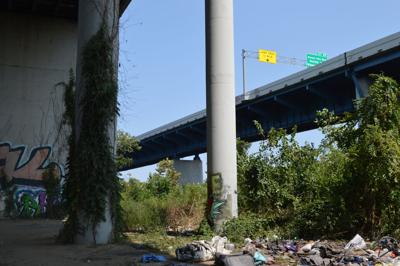

Nashvillians walk dogs and bike up and down Anthes Drive on a cool Monday morning at Old Tent City, one of Nashville’s longest-standing encampments, right on the Cumberland River. Word spread last week that the city planned to clear the site within 60 days.
More than 100 people live on 20 acres here according to estimates from residents. It’s been a particularly precarious six months — in the fall, the state demolished several shelters built by residents, including a two-story home constructed from salvaged wood. At the time, the city set and changed several timelines, emphasizing that no residents would be forced out.
![Six Homes at Old Tent City to Be Demolished [Updated]](https://bloximages.newyork1.vip.townnews.com/nashvillescene.com/content/tncms/assets/v3/editorial/a/57/a57717a4-7151-11ef-b80b-c7ba759bd427/66e3632f67706.image.jpg)
City says structures in encampment are unsafe, residents ask for more time
On March 31, Metro’s Office of Homeless Services announced plans to concentrate outreach efforts at Anthes Drive in a “housing surge.” The city’s outdoor homelessness strategy is a knot of interdependent decision-making from different groups. The Homeless Planning Council’s 25 members help guide the city’s Continuum of Care, another web of groups and members with its own committees. One of these, the Local Prioritization Team, chose Old Tent City as the next site for clearance, preceded by concentrated efforts to meet and house those who lived there. This decision followed guidelines set by the council’s Coordinated Entry System and the separate Shelter, Weather, Outreach and Prevention Committee. Direct deliberations about which sites to choose for closure are shielded from the public.
“The Continuum of Care has a scorecard they evaluate: danger to individuals, urgency for housing, other criteria to select camps, do a housing surge, then start over and do it again,” says Metro Councilmember Jacob Kupin, whose District 19 includes Old Tent City. “This one has been on the radar for some time. The flooding this weekend is an example of why it’s unsafe to live right on the riverfront.”
Residents say drugs, too, affect many people at the site. Chris, a combat veteran originally from Ohio, has lived at the camp on and off since being released from prison in October.
“It’s just a bad situation,” says Chris, who asks the Scene to use only his first name. “Some people fall on hard times, for some people it’s a drug thing. Some people have been here for years, how are they going to pack up and leave in 60 days? I just don’t believe that they’re gonna have housing for everybody. I carry my tent with me. Soon I’m going to get my VA check. My plan is to buy a camper and travel across the United States.”
Chris also mentions a string of recent deaths at the site. He speaks with the Scene next to a tent staffed by two city outreach workers taking residents’ contact information and handing out muffins and juice. Every so often, a Metro Nashville police officer patrols Anthes Drive, the camp’s main artery stretching from Second Avenue to campsites on the river.

Says Learotha Williams, the historically significant building’s ‘future will reflect Nashville’s priorities’
Chris says residents are trading rumors about pending real estate plans along Anthes Drive. Under former Mayor John Cooper, the city bought the old Tennessee School for the Blind at 88 Hermitage Ave. for $20.3 million in 2022. The site, just uphill from Old Tent City, completes the footprint necessary for Wharf Park, another aspiration under Cooper that would see the current encampment developed into a scenic riverfront centered on a recreational boathouse.
Kupin says any real estate plans are separate from the housing surge. Metro’s priority here, he says, is to concentrate services here to get as many Old Tent City residents into housing as possible. Mayor Freddie O’Connell also backs the city’s ability to get housing for those who need it.
“We want to ensure housing for every person staying in this encampment, so closing an encampment is not a quick process,” the mayor says in a press release. “Our prioritization committee identifies areas that need attention, and then there is outreach to residents of the camp, and each one will receive temporary housing assistance and the social supports they need.”
Nashville’s 2024 Point-in-Time Count found 2,094 people living outside on Jan. 25, 2024. This year’s count took place overnight on Jan. 23; the city has yet to release the finalized report. These reports, often understood as a minimum estimate of the outdoor unhoused population, have hovered around 2,000 for the past decade. The same reports estimate that around half of the Nashvillians living outside live within an encampment.



Post a comment as anonymous
Report
Watch this discussion.
(0) comments
Welcome to the discussion.
Log In
Welcome to the discussion.
Keep it clean. Please avoid obscene, vulgar, lewd, racist or otherwise abusive language. Comments featuring hate speech or threatening or violent content will not be tolerated.
PLEASE TURN OFF YOUR CAPS LOCK.
Be truthful. Don't knowingly lie or mislead.
Be proactive. Use the “report” link on any comment that violates our comment policy.
Share with us. We'd love to hear your feedback.