
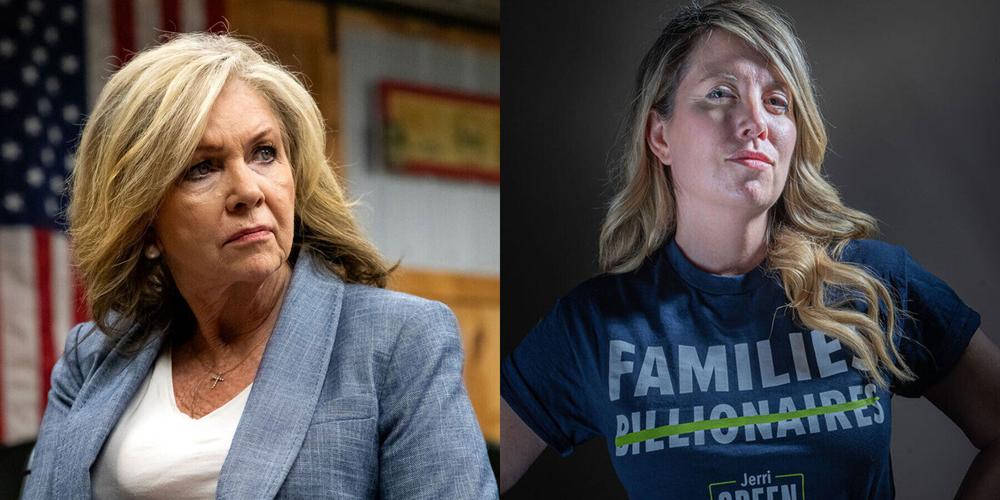



Tennessee should attract young families supported by stable jobs. These jobs should pay well enough that these families can buy houses and raise children who, in turn, have access to a good education that leads to their own stable and well-paying futures.
Candidates for governor agree on this simple premise, which is also mostly the American Dream. Major party nominees Marsha Blackburn, a Republican, and Jerri Green, a Democrat, build stump speeches around it. From there, they diverge quickly.
Blackburn, a former state senator, comes back to state politics after eight terms in the U.S. House and eight years in the U.S. Senate. She won a second term in 2024, and if she’s successful on Nov. 3, would vacate her seat — then likely tap her own replacement as the newly minted governor. With Gov. Bill Lee gone, no one could dispute Blackburn’s perch atop Tennessee’s GOP heap.

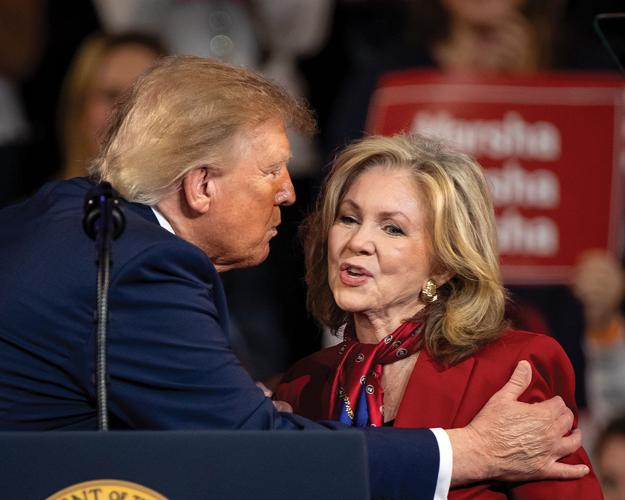
U.S. Sen. Marsha Blackburn with President Donald Trump at a rally in Clarksville, Oct. 10, 2026
Once elected senator in 2018, Blackburn quickly aligned her national brand with Trump and Fox News, where she has made frequent appearances praising the president. Her campaign rhetoric matches his with patriotic platitudes, its frequent focus on villains — Democrats, China, minority groups, taxes — and a broad deflection of the country’s current economic woes despite Republicans’ ruling trifecta in D.C.
“One of our goals is to make certain Tennessee is the freest state in the United States of America,” Blackburn told a Clarksville crowd at an Oct. 12 rally, where she shared the stage with Trump. “There is only one conservative Republican in this race for governor, and it is me. So as we get ready for this election, President Trump needs you. I need you. And we need to make certain that we get everybody to the polls to vote.”

Trump-loving John Rose and liberal Jerri Green share one thing: wanting to beat Marsha Blackburn
Polls and predictions have Blackburn firmly leading the field by 10 to 15 percentage points. While she’s stayed clean from major personal scandals through 30-plus years of politics, Blackburn’s reputation has suffered recently after awkward run-ins with local media, whom she typically avoids, and opponents’ increasingly effective portrayal of Blackburn as a beltway creature. Republican U.S. Rep. John Rose landed this attack often during a bruising primary that left Blackburn with 44 percent of the GOP vote. Pivoting offices so quickly into her second Senate term, close ties to the increasingly unpopular Trump administration, and a career fueled by corporate donations (and a pro-corporate voting history) don’t mesh well with a current political climate championing everyday Americans over industry giants.
That is exactly Democrat Jerri Green’s pitch to both highly engaged Democrats and disaffected Republicans. She serves as both the Shelby County public defender and a Memphis City Council member, went to college in Knoxville and practiced law in Nashville. She reminded a packed house of her bona fides at a campaign event on a recent unseasonably warm Wednesday evening on East Trinity Lane. Scoring an upset for Democrats will take all of Tennessee — East, Middle, West, red, blue, rural, urban. The last Democrat to win statewide office was Gov. Phil Bredesen in 2006. Bredesen lost to Blackburn in a race for one of Tennessee’s two U.S. Senate seats 12 years later by 10.8 percentage points — about 250,000 votes.

Jerri Green at a campaign event in Nashville, Oct. 14, 2026
Green has sharpened her conversational stump speech during a whirlwind state tour with more than 200 campaign stops. She hits national talking points on affordability, healthcare access and corporate greed, all topics that poll well across both parties. She goes local, vowing to protect public school funding against Lee’s voucher push and to tap millions in dormant Temporary Assistance for Needy Families (TANF) money. Big tech becomes “Big Data” as Green experiments with new national fervor against data centers, corporate data collection, privacy concerns, and an artificial intelligence panic. Data center debates have roused communities across the state. They also contrast with controversial plans previewed by Sens. Hagerty and Blackburn to lure tech companies to East Tennessee with the state’s nuclear-powered computing potential.
Green also freely labels Blackburn with names like “Mississippi Marsha,” a reference to her opponent’s birthplace. She also references Blackburn’s track record of protecting pharmaceutical companies during the opioid crisis.
“ We are fighting for a more affordable Tennessee, we are fighting for a Tennessee where we have better health outcomes, we are fighting for better public schools, we are fighting for fundamental freedoms,” Green told a cheering Nashville crowd this month. “We’re also fighting to end Marsha Blackburn’s career forever.”
Green has a strong tailwind and sharp message, but Blackburn has more money, name recognition and the dominant party’s ticket. Two other independent candidates — Lauren Pinkston and David Hatley — poll in the low single digits but will likely pull from would-be Republican voters, a small X factor in the race. The race is still Blackburn’s to lose, but an unpopular president, household economic strain, a confused war in Iran and developing political fronts like data center backlash could show the pendulum swinging back to Democrats ever so slightly.

With early voting now open in the Nov. 3 election, we break down what’s on the ballot



Post a comment as anonymous
Report
Watch this discussion.
(0) comments
Welcome to the discussion.
Log In
Welcome to the discussion.
Keep it clean. Please avoid obscene, vulgar, lewd, racist or otherwise abusive language. Comments featuring hate speech or threatening or violent content will not be tolerated.
PLEASE TURN OFF YOUR CAPS LOCK.
Be truthful. Don't knowingly lie or mislead.
Be proactive. Use the “report” link on any comment that violates our comment policy.
Share with us. We'd love to hear your feedback.