
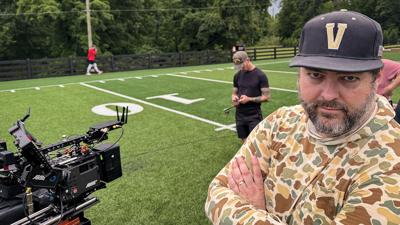
Hollywood is not dying, but it is shrinking — and fast. The Los Angeles motion-picture workforce fell nearly 30 percent from 2022 to late 2024, while major projects fled overseas and traditional film and television lost eyeballs.
As one Warner Bros. executive put it to me, “YouTube is eating everyone’s lunch.”
Georgia has felt the pinch too, with production spending falling almost 50 percent from 2022 to 2025 and Disney’s Marvel the most visible loss in the state, which previously experienced a rapid increase in film production. AI has added uncertainty.
The 2024 study Future Unscripted estimated that tens of thousands of California entertainment jobs could be affected by AI within three years. It did not predict all those jobs would vanish, but warned they could be consolidated, replaced or eliminated, with visual effects, concept art, animation and postproduction hit hardest.
Bob Raines, executive director of the Tennessee Entertainment Commission, sees AI as a pivotal disruptor with the potential to “flatten out the marketplace.” It raises a question: Do companies need to be in L.A. for high-end effects, postproduction and animation? This shifting landscape creates an opening for Nashville. Raines notes that while L.A., New York and Atlanta have deeper infrastructure, a trajectory is emerging.
“Nashville is moving toward being a strong secondary market, but there’s a lot that goes into becoming a billion-dollar production hub,” says Raines.
Some of that challenge is scale. The greater Nashville metro area has about 2.15 million people — far smaller than Atlanta, Los Angeles, or New York. But scale is not the only measure of strength. Since COVID, creative types have relocated to the region. According to U.S. Census Bureau data, between 2023 and 2024 alone, some 20,000 Californians moved to Tennessee, bringing musicians, producers, writers and crew.
The Tennessee Entertainment Commission’s 2025 report backs this up, citing $8.2 billion in music and video production. That momentum is visible in locally shot TV series like 9-1-1: Nashville and Scarpetta, which keep Nashville crews busy. Still, Raines warns against viewing that growth as permanent. This is a transient industry with a natural ebb and flow.
That ebb and flow is familiar on set. Peter Kurland — a Nashville-based production audio mixer, Grammy winner, four-time Oscar nominee and business agent for the local branch of industry union IATSE — says success should be measured by whether productions sustain stable careers for local crews, not simply by the projects Nashville attracts. He hopes people can lead good lives, with healthcare, while working in production.
As Kurland points out, Nashville’s film scene has two identities: the professional world, where pay, benefits, safety and working conditions determine whether people build careers; and the art-driven world of indies and passion projects that rarely provide a living wage but remain vital to developing talent and culture.
Max Butler, a local producer and informal archivist of Tennessee film history, views Nashville’s film scene as a system building on itself for decades. He points to local filmmakers who birthed everything from Jim Varney’s Ernest franchise to the transgressive indie work of Harmony Korine.
Butler maintains a Letterboxd list of more than 180 films shot in the state, but he cautions against overstating Nashville’s momentum. He says the city has let major talent slip away, most recently filmmaker $ECK, who left Nashville for New York and whose debut feature So Far All Good debuted this month at the Tribeca Film Festival. Butler believes Nashville does not need to become Hollywood, but rather needs a healthier model for the talented people already here.

Council approves $3.8 billion spending plan that includes Barnes Fund funding, grocery tax relief, return of entertainment commission
Recent breakout hits like Obsession and Backrooms have sharpened that point. Both films were made by 20-something directors and emerged from modest, creator-driven origins rather than the traditional studio pipeline, suggesting that Hollywood’s next durable model may come from backing distinctive filmmakers before the market validates them. For Nashville, a city packed with creative people, the lesson is less about copying those projects than recognizing the path to production they reveal, such as smaller teams, clear voices, direct audience relationships (often built through YouTube) and local support to keep the value of success from leaving town.
Butler says the obstacle for indies is always capital. He says the scene needs a stronger base of backers and institutions willing to finance work before it leaves Tennessee. Too often, he suggests, people want the benefits of culture without supporting the conditions that enable it.
This paradox surfaced at a recent meeting of the state’s entertainment oversight body, where Raines confirmed that Tennessee’s 25 percent rebate program prices out many smaller-budget filmmakers. Raising the minimum spend to $500,000 — up from earlier cycles closer to $250,000 — favors larger out-of-town productions while leaving smaller local features behind.
Raines defended the threshold to create better jobs and reduce administrative costs, noting that states like Georgia and the Carolinas use similar minimums. Still, he said a tiered system is being explored, leaving open the possibility of easing the threshold for local projects.
Brock Starnes, executive producer of The Wingfeather Saga and an advocate for family entertainment, sees another path. Nashville’s future, he suggests, may depend on producers who think entrepreneurially about audience, ownership and distribution. His series — streaming through Utah-based Christian media company Angel Studios — grew out of Nashville-based author Andrew Peterson’s work, and its production relationships and intellectual property have remained largely rooted in Tennessee. In an industry where projects are constantly pulled toward Hollywood, Wingfeather points to locally grown entertainment that builds an audience without exporting its core value.
Skylar Wilson, co-owner of the animation shop Skybone Studios, also views Nashville’s animation future with optimism. He traces the city’s shifting creative atmosphere to around 2009 or 2010, with the arrival of the television show Nashville and the film Country Strong, which Wilson also appeared in. Wilson says “the world’s eyes gazed on us as an untapped treasure,” creating new production opportunities. With 9-1-1: Nashville alongside independent shops, he believes the local scene is positioned for a breakthrough.
“I’m an optimist by nature,” Wilson says. “I think it’s only getting started from an animation perspective.”
Together, The Wingfeather Saga and Skybone suggest Nashville does not have to build its screen economy by imitating Hollywood. It can grow from locally rooted intellectual property, family entertainment, independent animation, music-adjacent media and small shops whose value lies in taste, craft and ownership. Hollywood’s contraction has exposed the fragility of centralized production economies. Nashville’s strength lies in its diversified community of culture makers across music, sound, postproduction, animation and commercial work.
The challenge is turning gig work into something durable. Incentives matter, but so does local investment. The talent, crews and history are already in place, says Butler; what Nashville needs is a dedicated base of backers to help them take root.
In an unstable production economy, Nashville’s next move may not be to become the next great studio town, but to build a smaller, diversified film and media economy that can last.



Post a comment as anonymous
Report
Watch this discussion.
(0) comments
Welcome to the discussion.
Log In
Welcome to the discussion.
Keep it clean. Please avoid obscene, vulgar, lewd, racist or otherwise abusive language. Comments featuring hate speech or threatening or violent content will not be tolerated.
PLEASE TURN OFF YOUR CAPS LOCK.
Be truthful. Don't knowingly lie or mislead.
Be proactive. Use the “report” link on any comment that violates our comment policy.
Share with us. We'd love to hear your feedback.