


Thanks in part to Music City's biggest export of late — pint-sized pop-country starlets — Hollywood's interest in the epicenter of country music seems to have spiked a bit recently. It's about time. Past Robert Altman's 1975 opus Nashville, the 1993 River Phoenix vehicle The thing Called Love and (if you count it) Hannah Montana: The Movie, we haven't seen a lot of major motion pictures about Nashville music shot in Nashville.
For example, Crazy Heart, the country-music drama that just won Jeff Bridges his first Oscar, might sound like a natural fit for Music City. But it wasn't filmed anywhere on this side of the Mississippi. Instead, it was shot mostly in incentives-rich New Mexico. It beats Vancouver, but still.
It may be, though, that Nashville's luck is starting to change. First, last fall, came a Nashville-set TV pilot called Tough Trade with a good cast (Lucas Black, Cary Elwes, Sam Shepard), a director with an Oscar-winning foreign film to his credit (Tsotsi's Gavin Hood) and an impressive offscreen pedigree of Weeds, True Blood and Mad Men veterans.
Now a feature just wrapped that not only makes use of Nashville locations, but also of contributions both onscreen and off by Music City songwriters and performers. And unlike, say, The Thing Called Love — set at an unrecognizably roomy Bluebird Cafe — this one just might have gotten the whole "authenticity" thing right.
Written and directed by Shana Feste, Love Don't Let Me Down is the story of a troubled country-music superstar (portrayed by Gwyneth Paltrow) who wages her comeback on a three-city tour. Tim McGraw co-stars as her manager and husband, and Paltrow's onscreen backing band features established Nashville players and songwriters including Jim Lauderdale, Doug Frasure, John Deaderick, John Bohlinger, Chris Clark, Amanda Shires, Neal Casal and Bucky Baxter — first-call players whose credits span the Dixie Chicks to Bob Dylan. Even her tour manager is portrayed by a local legend, singer-songwriter Marshall Chapman.
But it's the young session players and performers involved in the production that really indicate Feste's intention to get it right. After all, when you're looking to breathe realism into a story about hard-touring, hard-drinking, hungry young music hopefuls, where better to look than Music Row?
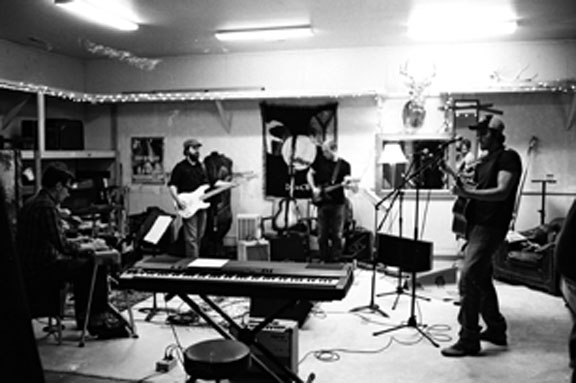
It's a Thursday night at Skyline recording studio, just off Eighth Avenue, a recording and rehearsal space much like any other in Music City. A few 12-packs of Coors Lite sit nearby, casually offered to visitors. A crop of young studio players has gathered to practice some songs. They're cruising through a pop-country number called "Words I Couldn't Say," no sweat. It sounds like it could be a Taylor Swift or Carrie Underwood tune — the sort of sugar-sweet, radio-ready gem these guys could track in a pass or two on any given day.
But they aren't playing it live. They're playing along to a track. All the pristinely pre-recorded parts are issuing forth from the P.A. speakers: drums, steel, bass, guitars, keys, a crystalline female lead vocal. The boys are just miming along.
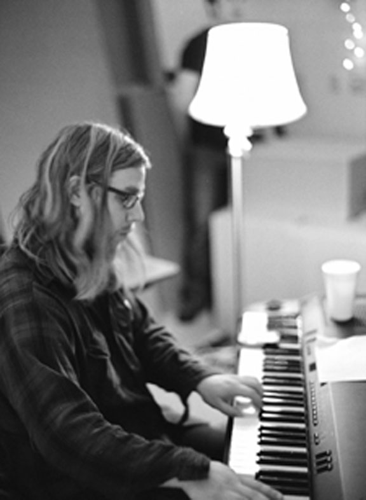
Skylar Wilson barks out chord changes in the Nashville number system. This is his family's studio, and, though he's playing drums on these numbers, he seems to know every chord. He's typically more of a keyboard guy, but like most everyone else in the room, he can get by pretty well on just about anything he picks up.
So why are they playing along to tracks? They've been cast as the backing band for two of Love Don't Let Me Down's lead characters, and they're making sure they have all the changes just right for when they film a performance scene in the morning. This song, penned by Greg Becker, Tammi Kidd and Steve Robson, is to be performed by Chiles Stanton, a somewhat Taylor Swiftian up-and-coming singer played by Gossip Girl's Leighton Meester.
As the boys finish running through "Words I Couldn't Say," in walks a tall, rugged guy in a baseball cap and a plaid jacket who immediately commands the room. Though 25-year-old Garrett Hedlund isn't yet a household name, his face is more than vaguely familiar. He's played supporting roles in Friday Night Lights (alongside Tim McGraw there, as well), Four Brothers, Eragon and Troy. Come December, you and just about everyone you know will recognize him as the lead from Tron Legacy, the highly anticipated sequel to the 1982 cult classic.
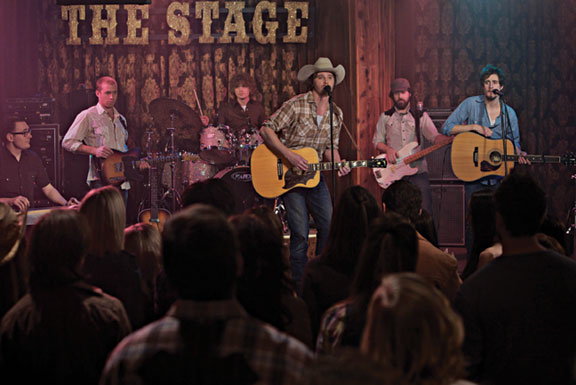
Here Hedlund plays Beau Hutton, a Nashville country singer who's been tapped (along with Meester's character) to open for superstar Kelly Cantor (Paltrow) on her comeback tour. His backing band also serves as Meester's in the film. Because she wants Hedlund and his band to have the unforced camaraderie and comfort of dudes who've logged long hours together in close quarters, director Feste nudged them into the rehearsal space.
Wilson puts on "Hard Out Here," one of three "Beau Hutton originals" penned by Texan songwriter Hayes Carll — who, coincidentally enough, bears a slight physical resemblance to Hedlund. (In fact, director Feste later explains that much of the Hutton character's appearance was modeled after Carll.) "Hard Out Here" is an old-school honky-tonk shuffle in the vein of the two King Georges, Jones and Strait.
The gravelly baritone coming from the speakers, though, is Hedlund's. He, Meester and Paltrow all performed their own vocals, and Hedlund's here to make sure his performance is natural in a scene with Wilson & Co.
"I thought it would be so cheesy if we had to replace these actors' voices," says Feste, who made her debut with last year's drama The Greatest, starring Susan Sarandon and Oscar nominee Carey Mulligan. "Talk about inauthentic. Who wants to see a musical where the actors are re-voiced? It was incredibly important that all the actors sing, and sing really well, and sing within this world where you could actually buy that they were country-music stars."
Despite never having sung in a role before, Hedlund passes. His gruff, idiosyncratic timbre is world-weary beyond its years, channeling influences like Kris Kristofferson and Merle Haggard — which Hedlund cops to immediately. He later explains that Feste accompanied him to a karaoke session at Brass Monkey in Los Angeles' Koreatown to check out his pipes.
"Because she had to report back and say [that I could sing]," says Hedlund, "I took her out to karaoke. ... I think it was so bad, though, at the time." Apparently it wasn't quite as rough as Hedlund recalls. After that meeting — along with a reading and a guarantee that he'd be willing to put in the work — Feste was all too happy to cast him.
An earnest, disarmingly enthusiastic filmmaker whose youth manifests mostly as energy, Feste calls her film a "high-stakes love story" set against what she considers to be the purest musical genre for traditional storytelling. Growing up in L.A., she says, she would take long rides to Texas to visit her father. The soundtrack for those rides was usually country music, the soundscape of America's blue highways.
The world of country music thus seemed a natural fit for the subject she wanted to explore in Love Don't Let Me Down — the incompatibility of love and fame. As Hedlund puts it, the tagline for the script he was pitched was something along the lines of "a love triangle in the country-music world that takes place on a 10-city tour." Turns out, it's more of a love square — or perhaps a love rhombus — with McGraw, Paltrow, Hedlund and Meester each representing a respective corner.
Growing up a country fan, coupled with the opportunity to work with McGraw again, hooked Hedlund on Feste's script. The only trouble was, he'd never played an instrument. To hone his chops, Hedlund began working with a guitar coach: singer-songwriter, photographer and Ryan Adams sideman Neal Casal.
Casal is at the rehearsal space this Thursday evening as well. He's making sure Hedlund's fingering looks natural, not that he needs too much help with that anymore. Hedlund is singing along to his own voice, glancing about the acoustic-tiled rehearsal space at his cohorts.
Cory Younts is on acoustic guitar, Josh Graham plays lead. Across the room, Loney Hutchins is on bass, Ian Fitchuk plays keys and Wilson mans the drums. Between them all, they've produced, recorded with and/or played with local country, indie and punk artists including Old Crow Medicine Show, Justin Townes Earle, Jimmy Duke and the Riot, Tim Chad and Sherry, The Mattoid, Caitlin Rose, Chelsea Crowell, Natural Child, De Novo Dahl, Bobby Bare Jr., Amy Grant and countless more.
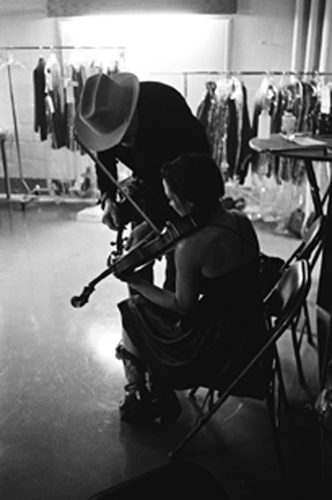
The only player missing from the lineup tonight is the staggeringly versatile Chris Scruggs, who's gigging out in Gallatin. In the film, Scruggs plays steel. In reality, the former BR549 member and solo performer plays just about every instrument known to man (see "The Duke of Music City," March 11). He was even featured as the primary entertainment at Love Don't Let Me Down's wrap party at Mercy Lounge, channeling the vocal performances of greats like Hank Williams with stunning offhand ease.
The inclusion of Scruggs & Co. in the film came somewhat serendipitously, largely thanks to Nashville native Travis Nicholson. Nicholson, who spends much of his time in L.A. and recently landed a role in Harmony Korine's Trash Humpers, initially auditioned for a role in Love Don't Let Me Down in addition to seeking a gig as an office P.A. He was given a small role in the film, but also went to meet with Hedlund at the behest of the producers, who hoped he could serve as the star's assistant and de facto local guide.
"That's been a nightmare," jokes Nicholson, with Hedlund flashing a grin bright as the Hollywood 27's marquee in the seat next to him. "I wouldn't have taken the job if I'd known the terrible hijinks he would be putting me through in the months to come."
Hedlund and Nicholson were in fact fast friends. When Feste and veteran music supervisor Randall Poster began looking for locals to cast in Hedlund's onscreen backing band, they happened to ask Nicholson. "I just had the good fortune of knowing these guys, and I started showing [Poster] pictures from my Facebook," Nicholson says. "They were casting from my Facebook friends page, basically."
"I trust [Poster] 100 percent," explains Feste, "and he was integral in the casting process. We both wanted to create something real. First of all, I fell in love with all the guys' faces, and they're musicians. They love music, and you can tell when they play. So much of the time, I didn't even have to give them direction ... and [playing with them] helped Garrett feel like he was in a real band."
Poster is an incredibly tenured music supervisor — the one with the "most excellent taste in music," according to Feste — and he's worked with directors including Wes Anderson, Martin Scorsese, Todd Haynes, Harmony Korine, Sam Mendes and countless others. In addition to helping cast the backing bands, Poster also played an enormous role in selecting songwriters and producers for the tunes featured in the film. It's a list that reads like BMI or SESAC's Songwriter of the Year nominees, from Liz Rose, Nathan Chapman and Lori McKenna to Frank Liddell, Byron Gallimore and myriad others, with still more contributions by McGraw and the Warren Brothers. Gallimore, Chapman and Liddell also produced the Cantor, Stanton and Hutton tracks, respectively.
"With this movie it was particularly important to work with the actors and get them to perform, and to make them convincing not only as performers but as star performers," Poster says. "We wanted [the Beau Hutton character's] backing band to have a little bit more of a clear peerage with Beau, and to reflect a rooted and organic repertoire. Whereas with [the Kelly Cantor character], we wanted to have a band that looked like a frontline band that would be supporting a star artist."
Skylar Wilson genially equates a film's production to that of a traveling fair or carnival. Droves of fascinating, creative professionals swarm into town and, with astounding efficiency, use the resources at their disposal to swiftly turn out a product. It's a whirlwind that draws people in, enthralls them, and leaves as swiftly as it came.
But unlike many country music features of the past, Wilson, Loney Hutchins and the rest of the onscreen performers agree that this one feels true. Hutchins explains that the songs and the characters performing them feel like the real deal — like songs these guys might help create in a session.
If Feste's organic approach translates onscreen, the realism she hopes to convey will keep her film far from the pitfalls of country music cinema — a chasm of pain with Sylvester Stallone and Dolly Parton in Rhinestone crumpled at the bottom. Feste and Poster chose a handful of old standards as covers for the film and cast roles intuitively, using the locals as a resource. They used Nashville locations like The Stage on Broadway and Municipal Auditorium for performance scenes.
As for the actors, Hedlund heeded Tim McGraw's advice to "live and breathe country music" — approaching the role from the perspective of a singer trying to make it in the business, not an actor tackling a role. He and his onscreen backing band even playfully wrote a handful of originals. Feste was so set on extracting natural chemistry from Hedlund and his backing band that Wilson and a couple of his pals ended up with some unforeseen lines in the film — meaning a handful of session players who had never been on film ended up acquiring SAG cards.
Initially, Feste had considered shooting the bulk of the film in Austin. But she says talks with Tim McGraw, combined with the urging of the local film commission and her ensuing love for the city, changed her mind. When she refers to Nashville, she does so affectionately, saying that the energy and talent she found here played a considerable role in growing the story.
Fact is, Nashville audiences, more than most, can tell the visual difference between a D major and an A minor, and they can tell a steel player from an actor. Feste knows that, and so do the folks she used to make her picture. And that's why she's hoping it will pass with the locals. If you can get somewhere in Music City, as the Kelly Cantors and Beau Huttons of the world know, everyplace else is a snap.
Email editor@nashvillescene.com.



Post a comment as anonymous
Report
Watch this discussion.
(0) comments
Welcome to the discussion.
Log In
Welcome to the discussion.
Keep it clean. Please avoid obscene, vulgar, lewd, racist or otherwise abusive language. Comments featuring hate speech or threatening or violent content will not be tolerated.
PLEASE TURN OFF YOUR CAPS LOCK.
Be truthful. Don't knowingly lie or mislead.
Be proactive. Use the “report” link on any comment that violates our comment policy.
Share with us. We'd love to hear your feedback.