
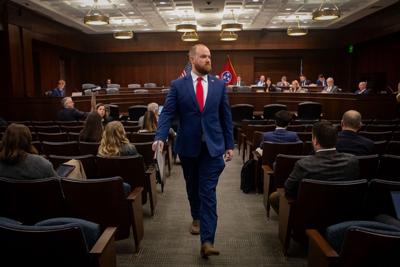

Two days after the Tennessee General Assembly gaveled into session, Republican leadership rolled out a suite of immigration bills crafted with the help of the Trump administration. Most notably, the state’s GOP leaders received assistance from Stephen Miller, who works as President Donald Trump’s deputy chief of staff and homeland security adviser and has led Trump’s immigration crackdown.
Senate Majority Leader Jack Johnson (R-Franklin) called the legislation a “once-in-a-generation opportunity.” In March, Gov. Bill Lee and state House Speaker Cameron Sexton (R-Crossville) praised Miller and Trump during an appearance in Memphis. At the event, Miller called Trump’s immigration actions — which have led to the deaths of protesting American citizens at the hands of federal agents — a “national miracle.”

Verification, reporting requirements part of proposed bills filed
Some of the legislation passed by the state’s Republican supermajority this year imposes new criminal penalties or expands law enforcement powers. One bill requires sheriffs’ offices across the state to enter into agreements with the U.S. Immigration and Customs Enforcement Agency’s 287(g) program — opening the door to housing more immigrant detainees in county jails or having local cops actually assist in arresting immigrants.
A bill that makes it “illegal to be illegal in the state of Tennessee” has already been signed into law by Lee and will go into effect July 1, imposing a class-A misdemeanor for any undocumented adult who intentionally enters or attempts to enter Tennessee, or is present in the state following a final order of removal.
One bill requires state and local governments to verify work authorization status of prospective employees under the threat of loss of state funds, with another requiring verification of legal status for public funds. Yet another piece of legislation makes certain immigration information confidential, including the names of immigration officials, with the threat of a felony and removal from office for public officials who “dox” immigration agents or officials. Another bill requires local judges to cooperate with immigration officials.
Commercial vehicle drivers could also have their licenses suspended if law enforcement officials determine the driver is not able to “sufficiently” speak or understand English during a safety inspection. Another bill makes it a crime for an undocumented person to operate a commercial vehicle. Non-commercial drivers will also face new hurdles after lawmakers passed a bill that requires temporary driver’s licenses for people who don’t speak or read English, with additional requirements to take an English-only written examination after 18 months and prove legal status in the U.S. The latter bill received concern from Shinji Watanabe, the consul-general of Japan in Nashville, who noted that the legislation might negatively impact Japanese investment in the state.
Rep. Aftyn Behn (D-Nashville) pledged to erect billboards and write op-eds in Japanese newspapers to shame those who voted for the bill, including bill sponsor Rep. Kip Capley (R-Summertown).
“The era of niceties is over,” Behn tells the Scene. “We are under siege and occupied by a hostile government that thinks there are no economic consequences to their bigotry. We welcome opportunities like this fall’s [Tennessee Department of Economic and Community Development] Japanese Summit and Super Bowl 2030 to draw international attention to the plight of Tennesseans.”
Democrats sponsored several of their own immigration bills this year, most of them crafted to ensure accountability for immigration officials and uphold the rights of the public. Those included the “Stop American Gestapo Act,” which would have prevented law enforcement agents from wearing masks, and a bill that would have prevented immigration officials from using schools, churches and public parking lots and garages. Both of those bills died.
“People want us to solve their problems,” said House Democratic Caucus Chair John Ray Clemmons (D-Nashville) during a press conference at the end of the session. “We didn’t do any of that. … We limited rights, and that’s unfair. That’s a failure of state government.”
Despite sounding the alarm for weeks, Republican leadership didn’t even utter the word “immigration” during their end-of-session press conference — something that may signal their acknowledgement of the growing unpopularity of Trump’s immigration policies. But regardless of public sentiment, Tennessee is set to enter a new era of policing power and legal pressure targeting undocumented people.

We recap what the state legislature did — and didn’t do — this year at the Capitol



Post a comment as anonymous
Report
Watch this discussion.
(0) comments
Welcome to the discussion.
Log In
Welcome to the discussion.
Keep it clean. Please avoid obscene, vulgar, lewd, racist or otherwise abusive language. Comments featuring hate speech or threatening or violent content will not be tolerated.
PLEASE TURN OFF YOUR CAPS LOCK.
Be truthful. Don't knowingly lie or mislead.
Be proactive. Use the “report” link on any comment that violates our comment policy.
Share with us. We'd love to hear your feedback.