
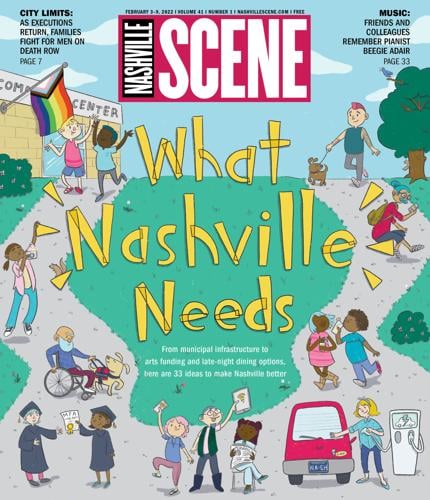

Back in May 1990, a scrappy little publication by the name of the Nashville Scene — not quite a year old, at least not in its current form as an alternative-weekly newspaper — published a cover story by the name of “A Master Plan: The 30 things Nashville needs & the people to do them.”
Looking back now, some of the entries on that list are downright charming: “A Bakery”; “More Shopping”; “Something for Tourists to Do.” Needless to say, we’re good to go in those departments. Other, more specific items on the list managed to come to fruition as well. We opined that something needed to be done about the bare stretch of land east of the Cumberland River. “How about putting the stadium there?” we asked. Done and done. “A High School for the Performing Arts”? Nashville School of the Arts arrived three years later. “A Jazz Club”? Now we’ve got a couple. Other items on the list have been accomplished, but with an asterisk: “Curbside Recycling,” for instance. We’ve got it, of course, but glass pickup isn’t included, and we all know about the recent snafu Metro experienced with contractor Red River suspending curbside recycling pickup for a number of weeks.
A quarter-century after that list was published, we revisited it with another cover story: “A (Re)Master Plan: Looking back at a Scene list of 30 things Nashville needed in 1990 — and forward to 30 things we need today.” We’ve accomplished some of the goals we laid out in that 2015 list — opening the National Museum of African American Music, most notably. But vexingly enough, some of the same issues remained, just as they do today: a lack of affordable housing, for instance, as well as a need for better public transit.
Now, 32 years after that first list and six years after our update, we’ve decided to once again put our heads together and come up with a list of what Nashville needs. Some of the items included here cover perennial frustrations (transit, housing and infrastructure, duh), while others are brand-new. Try as we might to once again limit our list to 30 items, we went over a little bit. Cut us some slack.
Dive in, and drop us a line to let us know what we missed.
D. Patrick Rodgers
Editor-in-Chief, the Nashville Scene
1. More diversity on boards and commissions
Thanks to the laudable efforts of recent mayoral administrations and a Metro Council that’s not afraid to push back on mayoral appointments, Metro’s boards and commissions have grown increasingly racially and ethnically diverse. But this is just the beginning. These bodies, often operating without much public scrutiny, can be incredibly powerful — just consider how the Board of Zoning Appeals can change the entire face of a neighborhood, one case at a time — and it’s important that they reflect all the ways Nashville is diverse. Think fewer corporate lawyers from Green Hills and more gig workers from Antioch. NICOLE WILLIAMS

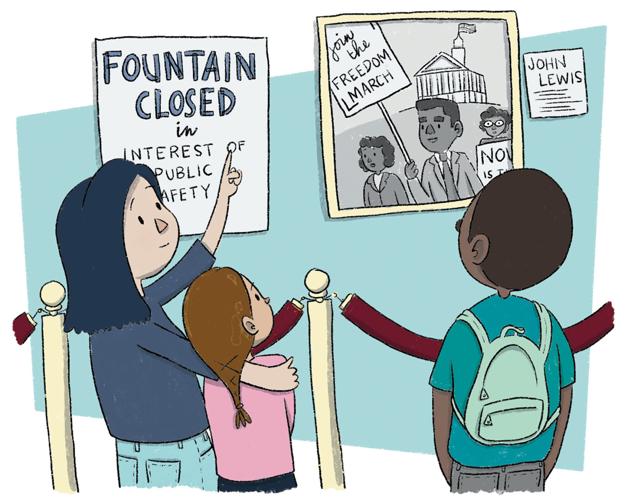
2. A civil rights museum
Every other city with a civil rights history as important as ours — Memphis, Birmingham, Atlanta — has a museum dedicated to civil rights. We have the Civil Rights Room at the Nashville Public Library downtown. We need to take the experts we have in that room and give them a building in which to tell the story of Nashville’s long trek toward freedom. BETSY PHILLIPS
3. An LGBTQ community center
In 2019, Nashville Pride embarked on a plan that seeks to collect information about what the queer community wants and needs to thrive. At one meeting I attended, residents discussed the need for affordable and nondiscriminatory health care, employment resources and opportunities for “storytelling moments” that build a sense of belonging and preserve history. Conversations kept leading back to something physical we lack: a central location where LGBTQ folks can gather, access support and share resources. A community center — whether staffed by paid workers or volunteers — would require a lot of funding and rent well below market rate. But it would give us queer folks the place of belonging that other cities have so we can thrive. ERICA CICCARONE
4. More housing
The mayor’s own affordable housing task force, made up of more than 20 experts, said we needed new housing in a 2019 report. In fact, to meet the housing needs of our quickly growing city, we will specifically have to build 53,758 units of housing — including 18,000 units for low-income families — by 2030. The task force laid out nine pressing recommendations, and the city has met two of them: doubling Barnes Fund money and establishing a catalyst fund for housing. Other recommendations include bolstering PILOT programs and figuring out new zoning ordinances — all work that requires political willpower, especially with a state legislature that has proven itself ready to preempt local zoning laws. ALEJANDRO RAMIREZ
5. One-stop shop for housing resources
Nearly a decade ago, Metro created a one-stop shop for developers at the Richard H. Fulton Campus. You can find a representative from nearly every department involved in permitting at this location, from public works to the urban forester. This has made life easier for people who want to build housing. Now we need to do the same for people who want to find housing. With record investments in affordable housing and the creation of a Housing Division within the Planning Department, now is a great time to invest in a centralized housing hub for Nashvillians of all income levels. NICOLE WILLIAMS
6. An office for disability services
While Metro does monitor ADA compliance through the General Services Department, we don’t have an office for disability services. Such an office could do a lot of things: assist various city departments in evaluating their programs and activities to ensure that they are accessible to disabled Nashvillians; conduct training for Metro employees in disability awareness and accommodations; connect disabled residents with resources, job opportunities and health care; support caregivers; advocate for disabled people in infrastructure planning; coordinate with the Office of Veterans Services and much more. The creation of such a hub could help us both enforce compliance and move beyond it. ERICA CICCARONE
7. Local mass transit aside from buses
Here’s a perennial one. If you’ve ever driven I-24, you know we need another way for people to get from Murfreesboro to Nashville. If people could get on a train from Dickson or from Ashland City to Nashville, a lot of our discussions about affordable housing would be a lot different. Buses are great, but buses are in traffic. We need ways to move people around the city and the region that keep them out of traffic. BETSY PHILLIPS
8. Bring Amtrak back
No, intercity train travel in general is not terribly fast or efficient, and Amtrak specifically has plenty of problems. But not everything has value that can be expressed with formulae and displayed in the cold arithmetic of a spreadsheet. Trains are the most romantic mode of transportation ever devised by humans, and Nashville’s been without passenger service since Amtrak ended the Chicago-to-Miami Floridian route in 1979. The Biden administration’s infrastructure plan included a Nashville-to-Savannah, Ga., Amtrak route with stops in Chattanooga, Atlanta and Macon, Ga. Access to the broader network would be made via the Washington, D.C.-to-New Orleans Crescent route via Atlanta. With so much of New Nashville sucking the romance from the city, wouldn’t it be nice if there was a romantic way to get out of town? J.R. LIND
9. More international flights
For years, Nashville International Airport was international in name only — but with direct flights to London now departing BNA, it’s an honest title again. What should come next are more trans-Atlantic routes, at the very least a direct flight to Paris and either Frankfurt or Rome. Flying straight to the Continent opens the traveler up to all the passport-less wonders of the Schengen Area (which flights to Heathrow no longer do — thanks, Brexit) and the intriguing spider web of the European rail system. Oh, and it’d probably be good for Nashville in boring business and tourism ways too. J.R. LIND
10. More bridges over the river
There are 10 automobile bridges over the Cumberland in Davidson County. In 1926, there were two automobile bridges and four permanent ferries. Our population has increased exponentially in a century, but we’ve only added four river crossings. It’s no wonder we all sit in traffic. BETSY PHILLIPS
11. Citywide Wi-Fi
Here’s another infrastructure item we suggested the last time we did one of these issues — a citywide Wi-Fi offering that’s billed as a public utility, just like water and electricity. But hell, why stop there? Cities around the world have free municipal wireless networks available to locals and visitors — including Boston, which named its free outdoor network Wicked Free Wi-Fi (yes really). Public Wi-Fi hotspots give residents easy access to the internet, whether they need it for work, education, health care or, you know, just doom-scrolling. Use it for whatever you like, we’re not here to judge. D. PATRICK RODGERS

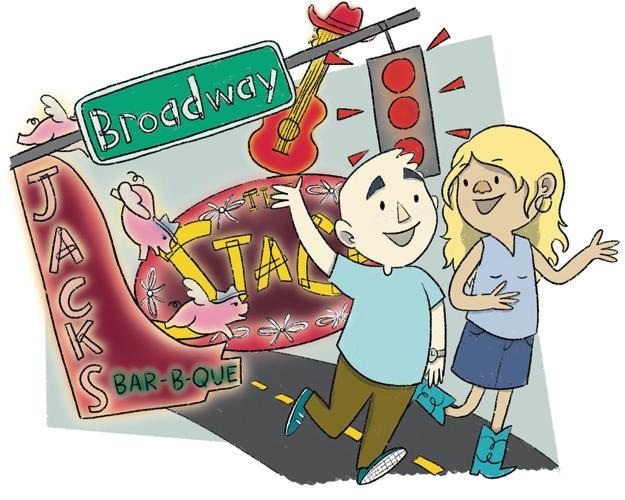
12. Make Lower Broad pedestrian-only
Consider it a quarantine of sorts. Or an acceptance of what Lower Broadway is. This is not a street that should be treated as a throughway for any vehicle that isn’t a pedal tavern. Making Lower Broad pedestrian-only would make it safer for the tourists stumbling about down there — and perhaps make it easier for locals to avoid it altogether. STEVEN HALE

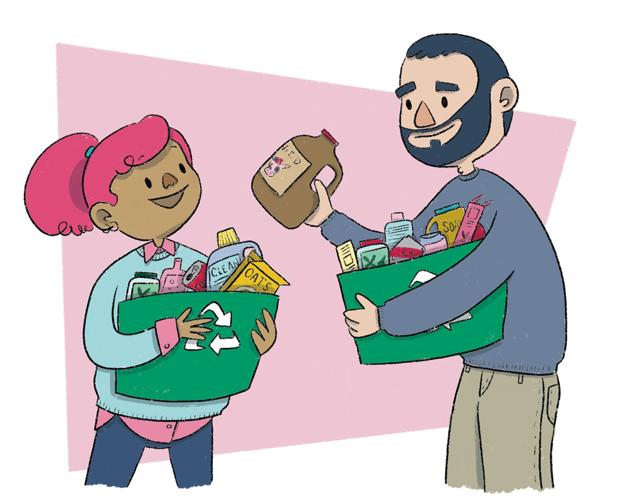
13. A recycling solution
The good news is that recycling has officially resumed after a several-week hiatus. So that’s nice. But this situation was inevitable — notably, councilmember Jeff Syracuse filed a resolution trashing the city’s waste collection contractor Red River back in 2020. But the fact is, Nashvillians aren’t great recyclers regardless of who’s been picking up the cans and cardboard, and who’s been stuffing our landfills to the brim. Just one-sixth of residential waste actually gets recycled, as the Scene has previously reported, and we have no dedicated glass recycling program. The city is exploring more progressive models, and will argue to a judge to reroute Red River’s contract to a new entity. Hopefully pickup isn’t just more reliable, but more expansive and frequent as well. ALEJANDRO RAMIREZ
14. People-driven park upgrades
Nashville has a great system of parks — every one of them, from the tiny pocket parks to the gargantuan ones that rival state parks in nature and expanse, with their clutches of supporters and lovers. Even a little green space goes a long way in an evermore paved-over city. Metro has done a better job at maintenance and upgrades and long-term planning for parks (Centennial Park is going to be Tricentennial Park before all its upgrades are done), but every park has its little problems — places where Richland Creek overruns the greenway when it rains, or where the slides are too hot to use in July. A drilled-down but Metro-wide park improvement plan, modeled on the participatory budget process used for Bordeaux and North Nashville this year, would be a boon. J.R. LIND
15. A dedicated grants team
Nashville is one of few large cities without a specialized team dedicated to seeking out and applying for grants and other funding opportunities. Our current Office of Grants Administration works mostly downstream, monitoring grants once they’ve been awarded to ensure compliance. And in the absence of a more robust grants division, the arduous task of finding and securing new funding sources falls to Metro departments, which themselves don’t have the resources to invest in grant seekers. We need a team of professionals with the experience and expertise to find money we’re leaving on the table. NICOLE WILLIAMS

16. More late-night dining options
Stumble out of a bar at last call in New York City and you can find virtually any cuisine your heart and stomach desire — foldable pizza slices, cartons of lo mein, piping-hot empanadas. In Nashville? Not so much. Sure, we’ve got some pretty solid bar food and a downtown diner (The Diner) that stays open 24-7 in busy season, and I’d be a bad lifelong Southerner if I didn’t acknowledge Waffle House’s glorious 24-hour offerings. But Music City could use a lot more than that, especially now that the iconic Hermitage Cafe is shuttered (RIP). D. PATRICK RODGERS
17. Fewer hotel restaurants, more neighborhood ones
Scanning local business news, you’ve probably noticed that most of the major new restaurant openings lately are in hotels. We get it. Hotels need to offer food as a guest amenity, and spots like Drusie & Darr, Carne Mare, Yolan and The Continental are welcome additions to the dining scene. However, hotel restaurants usually end up spending an inordinate amount of resources chasing local customers who really don’t like paying $40 to park in a hotel garage before even sitting down to a meal. Please, developers, invest in the neighborhoods we actually live in, like Audrey, Carey Bringle’s Smoking Oasis and Emmy Squared did. We promise to reward you with our patronage! CHRIS CHAMBERLAIN
18. Bolster CSA and community garden programs to combat food insecurity
Getting healthy food to people who need it requires lots of simultaneous approaches. One that could be expanded is providing more resources to community gardens where folks grow their own food, like The Nashville Food Project’s Growing Together program or Nella Pearl Frierson’s Brooklyn Heights Community Garden. Another way to get more healthy ingredients into fridges and pantries: provide a food benefit that covers the cost of enrolling in a community-shared agriculture program. The up-front investment can be difficult to budget for when you don’t have a big income, but the rewards — both in delicious produce and in the adventure of learning to cook whatever shows up in your box — are great. STEPHEN TRAGESER
19. More stages for Black theater makers
It’s no secret that Black theater makers have been creating art in Nashville for generations with projects like SistaStyle Productions, The Destiny Theatre Experience and TSU’s American Negro Playwright Theatre. But Nashville needs more than that — physical spaces for Black theater makers that are on par with the quality of their visions and capabilities. A prime example of doing this innovatively? The Nashville Shakespeare Festival’s collaboration with Black-led local company Kennie Playhouse Theatre brought a full — and exceptional — run of August Wilson’s Jitney to the stage in August. We need more chances for Black artists to take the lead in ways that don’t tokenize or pander but clear the way for them to reach the broadest audience possible and welcome the next generation of innovators. ERICA CICCARONE
20. A Black-owned music venue in North Nashville
The rich, deep history of live music in historically Black North Nashville was dealt a major blow when I-40 was built in the 1960s. It’s long past time to revive it, whether that happens on Jefferson Street, where clubs were historically located, or on Buchanan Street, where arts activity is bubbling. While there are nightclubs, bars and restaurants owned by Black or brown people in communities across the city, there should be a venue whose primary source of income is ticketed shows, owned and operated by Black music-biz folks. Eric Holt and his partners in concert promotions group Lovenoise have the experience to make it work — someone ought to give them the cash to make it happen. STEPHEN TRAGESER
21. Give tourism dollars to the arts
In Nashville, income from tourism often goes to fund … more tourism. But in other cities, hotel occupancy tax revenue is often earmarked for arts and cultural programs. Take Chattanooga. Last year, the Chattanooga Tourism Co. used hotel tax collections to award $302,500 in grants to arts, culture and heritage programs, including 26 grants to artists. In 2018, San Franciscans voted to dedicate 1.5 percent of the base hotel tax to support arts and culture programs throughout the city. Even humble Round Rock, Texas, does this! For all that our local artists do to draw tourists to Nashville, we propose that Music City follow suit — call it Room Nights for the Arts. ERICA CICCARONE
22. An art museum with a permanent collection
With a permanent collection, a museum can build equity by purchasing work from local artists, and more local artists can have the chance to exhibit museum shows. Nashville has two historic institutions with collections — the Parthenon and Cheekwood. While the Frist is a venerable art museum, it doesn’t have the infrastructure to support a permanent collection. Despite that, the Frist is currently hosting a stellar exhibition from LeXander Bryant, a Nashville-based artist who has never had a solo museum show. The quality of the exhibition and the strength of its museum context make a good argument that Nashville can support a collecting museum — what else might be possible if more local artists were afforded the chance to stage museum shows? LAURA HUTSON HUNTER
23. Cheap art-studio and musicians’ rehearsal space
If you want to be a dynamic destination renowned for art and culture, you’ve got to have places where people can afford to, y’know, make art. The single-family homes and underused commercial buildings that were once within the reach of artists and musicians for these purposes command premium prices in today’s red-hot real estate market, and it seems likely they’ll become more scarce. One partial solution to this complex issue: expand or modify existing grant opportunities like Metro Arts’ Thrive community grants program to channel dollars into dedicated spaces for people to engage in the messy, noisy business of cultural expression. STEPHEN TRAGESER
24. Get rid of PSC Metals
This eyesore on the Cumberland has been around long enough to come up time and time again, including in multiple versions of this Scene issue. The argument remains the same. PSC Metals is a big, ugly trash heap in the middle of the city, even if Mick Jagger decided to take a photo there back in October. (Yes, he really did.) Billionaire Carl Icahn sold the company — but not the land — in November. It won’t be easy, but we ought to do whatever it takes to get rid of it. STEVEN HALE
25. Support for small-business owners to own their property
The pandemic has exacerbated the pressure from rising real-estate prices that Nashville small-business owners have been facing for years. One way to protect a whole range of cafes, bookstores, venues and other enterprises that contribute so much to the city’s culture and economy is to get the property in the hands of the people running the operation — see crowdfunding campaigns launched in 2021 by East Nashville record store The Groove and historic venue Exit/In to buy their buildings. When he spoke to the Scene last year, Councilmember Jeff Syracuse pointed out that Metro has few tools to help proprietors stay in place. The Metro Council approved a resolution from Syracuse that could eventually create some tools; the faster that process can move and the more types of small businesses it can serve, the better. The purchase plan Exit/In’s Chris Cobb outlined includes backing from a North Carolina development firm that established a fund specifically designed to get venue proprietors to own their property, and we’d be well-served if more of them took on a similar attitude — think of it as angel investment in culture. STEPHEN TRAGESER
26. More support for efforts to address the overdose crisis
2020 was the worst year for drug deaths in Nashville — until 2021 set a new record. The city (like the state and the country) is in the midst of a devastating epidemic of overdoses driven primarily by fentanyl. And the Metro team dedicated to tracking it and coordinating the city’s response consists of six people. Nashville needs more investment in harm-reduction efforts both within Metro and through organizations like Street Works. STEVEN HALE
27. More news in different languages
More than 140 languages are spoken in Nashville, but finding news outlets in those languages feels like it requires some digging. Many outlets operate on social media, which is savvy and certainly gets results — just look at Nashville Noticias and its founder Vero Salcedo, who was inspired to launch the outlet due to a lack of Spanish news in the city. Facebook has been the main medium for the outlet, with frequent live broadcasts pulling more than 270,000 followers, but partnerships with WPLN and Univision hint at ways Nashville Noticias could grow. Let’s be honest: English-speaking outlets like ours could step up more to get important stories translated. This work feels all the more pressing following the recent death of Eliud González Treviño, who founded the Spanish-language newspaper El Crucero de Tennessee. ALEJANDRO RAMIREZ
28. More affordable day care options
For years, Nashville has had a day care shortage — and like so many things, the problem was exacerbated by the pandemic. As more people move to Nashville, providers can’t keep up, yielding long wait-lists for day care that can be prohibitively expensive for some families. Metro Nashville Public Schools provides pre-K services at a sliding scale, but it also has a wait-list. In September, the Tennessee Department of Human Services announced its plan to increase child care payment assistance for eligible families, which is great. But unfortunately, that doesn’t open up more spaces for the families who need them. KELSEY BEYELER

29. More staff and support for public schools
A shortage of school staff isn’t just a Nashville problem — it’s a national one. Addressing a staffing shortage on a limited budget is no easy task, and we don’t envy the folks in that position. But Nashville is a city famous for its creativity, and it’s time to get creative and address these shortages. Current staff and the local teachers union surely have ideas to retain current staffers and attract new ones. Hundreds of millions of dollars of recently approved COVID-19 relief funds should help supplement these costs. KELSEY BEYELER
30. A contemporary art nonprofit
Nashville needs a dedicated space for contemporary art exhibitions that can push boundaries, change minds and cause fights. That’s not going to happen at the Frist. That’s not a criticism — the Frist exists in a high-culture paradigm that allows it to bring in important, relevant shows by Picasso and Kara Walker and Nick Cave. But there’s a growing audience for artwork that unsettles and makes waves, and Nashvillians shouldn’t have to leave town to see it. LAURA HUTSON HUNTER
31. A visual arts MFA program
The paradox about Nashville and an MFA program in visual art is this: The world needs fewer MFA programs, but Nashville needs more. The main benefit of having a local graduate program in studio arts is that talented locals won’t have to leave town to further their education, but an MFA would also raise the caliber of artwork that’s part of Nashville’s visual environment. Imagine the changes that might be possible if locals — not just students and art lovers, but ordinary residents — were exposed to as many senior thesis shows backed by years of formal training and a diverse education as, say, decorative guitars and Johnny Cash murals. The mind reels. LAURA HUTSON HUNTER*
32. Public EV charging stations in low- and middle-income neighborhoods
Even the E.U., which has a substantial network of public charging points for electric vehicles, is behind schedule in serving its population, per an audit published last year. While electric vehicles are making some strong gains here (one close-to-home sign is the massive Ford Motor Co. plant coming to West Tennessee), we’ve got some catching up to do on the charging stations that make EVs a viable alternative to gas-powered cars. Federal funding for this purpose is coming to states as part of President Biden’s infrastructure bill. When some of that gets to Music City, we’ve got to make sure that the wealth spreads further than the Brentwood Target parking lot. Start by identifying the low- and middle-income neighborhoods where at least some EV owners live and take a shot at increasing ownership by installing some rapid chargers. STEPHEN TRAGESER
33. A new flag
Don’t get it twisted: Metro Nashville’s seal is amazing. Inscrutable? Absolutely. Why is that Indigenous man pondering a skull and standing next to some tobacco? Who can know? It rules. Though it features said seal, Metro’s flag nevertheless stinks. Simply sticking a seal on a contrasting background is lazy vexillology. Flags should be bold, distinctive and recognizable at a distance. Gather a working group of artists, designers, community leaders and (ahem) someone who knows something about heraldry, and who might be a beloved local reporter, and fix the flag. J.R. LIND
Correction: No. 31. on our list of things Nashville needs is "A visual arts MFA program." This constitutes an oversight on our part. Watkins College of Art at Belmont University offers an MFA in Visual Art, and its inaugural class graduated in 2020, not long after the merger between Watkins and Belmont. We regret the error and apologize. Find more information at this link.




Post a comment as anonymous
Report
Watch this discussion.
(0) comments
Welcome to the discussion.
Log In
Welcome to the discussion.
Keep it clean. Please avoid obscene, vulgar, lewd, racist or otherwise abusive language. Comments featuring hate speech or threatening or violent content will not be tolerated.
PLEASE TURN OFF YOUR CAPS LOCK.
Be truthful. Don't knowingly lie or mislead.
Be proactive. Use the “report” link on any comment that violates our comment policy.
Share with us. We'd love to hear your feedback.