
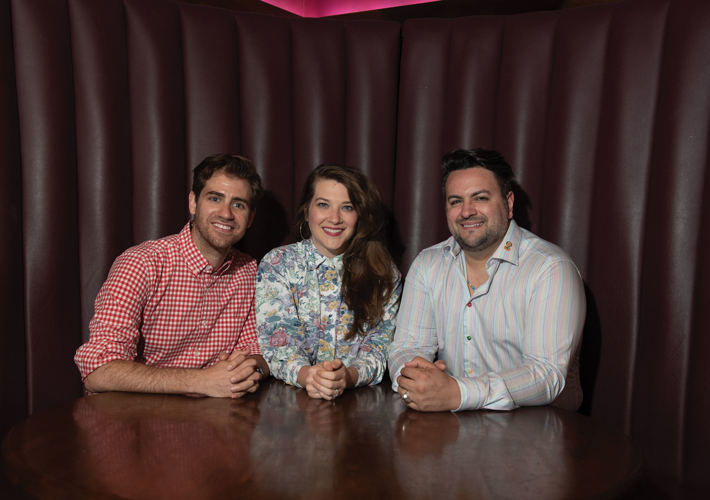


From left: Robert Marx, Kassie Patterson-Smithmier and Phil Cobucci of the Community Visioning Project
Any good strategic plan relies on observation and data collection. But what if your goal is to ensure a thriving, stable future for a diverse group of people who are not always invited to decision-making tables?
The folks behind Nashville Pride knew they wanted to look ahead to ensure the stability of the LGBTQ community in Middle Tennessee, but data is scarce. Pride has embarked on a plan that it’s calling the Nashville Community Visioning Project, which seeks to collect information about what the community wants and needs to thrive.
“I think that there’s [plenty of] organizations here in Nashville that work with the LGBTQ population,” says Phil Cobucci, a member of the Nashville Pride executive board. “We all have email addresses and names and how much we’ve donated, but I don’t think that we get a true picture of what [the community] wants for the future. And that is the critical piece, right?”
The organization’s goal is to hear from 2,000 people through formal “world cafe community” conversations featuring about 60 people apiece, as well as small-group “kitchen table” conversations and a community-wide survey that launched online this week. A consulting firm will synthesize the information in a report that LGBTQ-friendly organizations can use to address the community’s concerns. A summary will be available to the public in the fall.

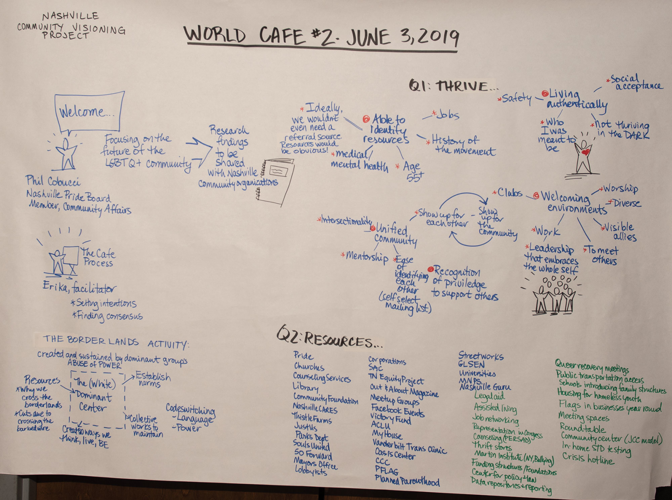
Notes from the Community Visioning Project
About 60 people attended the second of the large conversations earlier this month. It was facilitated by Erika Burnett of The Burnett Group, who directed participants to form small groups and discuss the following questions: What does it mean for you to thrive? What assets or resources do you see in Nashville that help you to thrive? What resources do you need in the community to live a satisfying, meaningful life? What barriers exist that prevent you from accessing those assets and resources?
The conversations were varied, but some common threads quickly surfaced. Many cited the need for affordable and nondiscriminatory health care. Some discussed wanting opportunities for “storytelling moments” that build a sense of belonging and preserve history. Others said LGBTQ people older than 55 often feel left out of social interactions and lack a peer support structure. Another common concern was the need for streamlined communication among groups to promote unity in the community. Still others were no different from issues on the minds of many Nashvillians — transportation, economic growth and affordable housing.
Burnett says the large-group conversations were encouraging, and the second one had a very diverse turnout. People of color, nonbinary people, transgender people and people with disabilities attended.
“If you are self-identifying as a member of a population and entering into a space because of a function of your identity,” says Burnett, “I think the general consensus is you want to be there, you want to show up, and you want to exist in a way that is affirming to that place. And I feel like that’s the space that we’ve been able to create.”
The issue of finding a permanent safe space came up often during the evening. Many expressed the need for a central location where people can gather under one roof. Last year, the LGBTQ community center OutCentral closed. Jaime Combs, a Pride executive board member, says the expenses to operate a volunteer-run facility in Nashville proved too challenging. “It’s imperative that there be grants or funding,” says Combs, “and ideally to have people there full time.”
For her part, Combs would like to see safe, affordable housing for elders and families, as well as resources for trans people in danger of being denied access to health care, and a way for LGBTQ people to be of service to others and to Nashvillians as a whole.
“I think that there’s going to be a lot that comes out of these meetings, and a lot that comes out of the data that’s collected, that we can say: ‘Our community as a whole needs these things,’ ” says Cobucci. “Who’s going to step up to the plate and help create this? What organizations are going to step up to the plate and say, ‘We see that there’s a need in this specific arena and we are best charged to carry that torch.’?”
To participate in the Nashville Community Visioning Project survey, visit lgbtqcommunitysurvey.org.



