
It is the most awful secret in Nashville history — so terrible that generations of Nashville mayors have made certain very few people know about it.
Historic homes like The Hermitage, Carnton and the Belle Meade Plantation have had to come to terms with the system of slavery that built them and made them profitable. If you visit The Hermitage, you will see markers that describe the lives of the enslaved people who used to live there. If you go to the websites of Carnton and Belle Meade Plantation, you will see content for teachers and students about what slaves once did there.
Meanwhile, the government of Nashville used to own slaves — at least 33 of them, by my count. If you want to know what their lives were like, consider this: Two of them were infants; at least three were teenage boys (one with scars on his back made by a whip); at least three of them tried to escape (and were caught); five of them died of cholera (when their job was picking up garbage in the streets of Nashville during a cholera pandemic); and one of them spent the last 30 years of his life blinded by an explosion that took place when he was enslaved by the city.
The government of Nashville still will not acknowledge that it owned slaves. And to the best of my knowledge, there is no historic marker describing the fact that Nashville used to own enslaved people, nor has there been a government-funded attempt to figure out what became of the 33 people — and possibly more — who were once “owned” by Nashville’s taxpayers.

The fact that Nashville used to own slaves has been written about in at least three books. Wilbur Creighton wrote about it in a 1969 volume called the Building of Nashville. In 1999, Bobby Lovett mentioned it in the African American History of Nashville: 1780-1930. I wrote about it in Runaways, Coffles and Fancy Girls: A History of Slavery in Tennessee, which came out in 2018.
Since I had read Creighton’s and Lovett’s books, I knew the government of Nashville once owned slaves. But when I was researching the topic, something I found on microfilm at the Tennessee State Library and Archives made me decide to write a book on the subject.
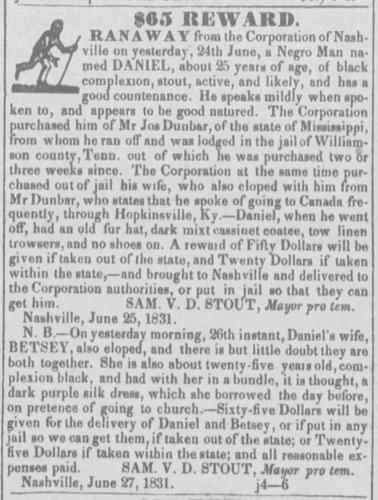
It was a paid advertisement that ran six times in summer 1831 issues of the Nashville Banner and Nashville Whig — a publication, like all other Nashville newspapers of that era, that depended on slave-related advertising and was therefore supportive of the institution of slavery. The runaway slave ad was signed by Samuel Van Dyke Stout, who was Nashville’s vice mayor at the time and later became the mayor.
The ad offered a reward for the return of a runaway slave named Daniel, and it explained how Daniel came to be owned by the Nashville taxpayers. “The corporation purchased [Daniel] of Mr. Joe Dunbar, of the state of Mississippi, from whom he ran off and was lodged in the jail of Williamson County, Tenn., out of which he was purchased two or three weeks since.” The ad went on to say that Daniel’s wife Betsey has also run away from her owner — also the Nashville government. “Sixty-five dollars will be given for the return of Daniel and Betsey,” the ad stated.
Daniel was later captured, probably beaten (since slaves were usually beaten when they were captured) and returned to Nashville. We know this because on Aug. 3, 1831, the Nashville board — the equivalent of today’s Metro Council — appointed a committee “to dispose of negro Daniel.” That probably meant Daniel was sold to a trader who probably took him southwest, to Mississippi or Louisiana, to be sold for more money than he would sell for in Tennessee — the fate of thousands of slaves who tried to set themselves free and were captured.
Nashville’s government had reason to make sure Daniel and Betsey were captured and beaten. A few weeks before the couple ran away, the taxpayers of Nashville hired a slave trader to purchase 24 more enslaved people.
All local governments in the Old South used slave labor. Local governments did this to keep taxes low, since free people had to be paid more than slaves.
However, most governments in the South leased slaves.
This is how leased slave labor worked: A business or government would sign a contract with the slaveholder for a certain period, typically a year. During that time, the slave would work for the government or business that leased him or her. The business would pay the slaveholder, not the enslaved person.
Through this arrangement, slaves worked for construction companies as stonemasons, bricklayers and carpenters. Enslaved people were leased out to work on steamboats. There were slaves working alongside free workers in cotton mills and nail factories. There were even leased slaves employed at the Nashville Inn and the University of Nashville.
The business of leasing slave labor was in fact such a big deal in Nashville that there were people who made their living running agencies that hired out slaves. In 1826, a Nashville man named Edward Ward advertised he would soon be hiring out “NEGROES, men, women, boys and girls” on yearlong work contracts. By 1832, an agency known as Webb & Co. regularly published a list of available jobs for slaves. On June 23 of that year, Webb & Co. posted seven different “slave wanted” ads, many for people wanting to hire enslaved people as domestic servants.
The business of leasing slave labor bred the business of insuring slaves. That’s why firms such as the Merchants’ and Planters’ Municipal Insurance Company ran front-page newspaper ads encouraging slaveholders to insure slaves who were working in factories, mines, steamboats and other potentially dangerous places.
In any case, though it was very common for local and state governments in the South to lease slaves, it was unusual for local and state governments to buy slaves. But the government of Nashville did just that — first by purchasing Daniel and Betsey for $700 out of the Williamson County jail in June 1830 and then by contracting with a slave trader named William Ramsey to go to Virginia and Maryland to buy 24 slaves. The board must have trusted Ramsey, because they wrote him a $12,000 check in advance, before he left on his journey on Dec. 4, 1830.
In the spring of 1831, Ramsey brought the enslaved people he had purchased for the city of Nashville back through Virginia and East Tennessee and across the Cumberland Plateau. The slaves would have been chained together and force-marched in what was then called a coffle (a word that vanished from the American vocabulary after slavery was abolished). After Ramsey marched the 24 slaves to Nashville, the government of Nashville took charge of the enslaved people.
About the same time the 24 slaves arrived in Nashville, Daniel and Betsey ran away. That’s why it was so important that Daniel and Betsey be found, punished and sold, which they were. The Nashville government sold Daniel for $440 in August 1831 and Betsey for $305 in January 1832, so the taxpayers made a $45 profit off of Daniel and Betsey’s purchase and sale.
At the Aug. 3, 1831, meeting of the board of the corporation of Nashville, town recorder Edwin Dibrell was given the job of creating a detailed account and description of the newly purchased 24 slaves — so the city would have details of them if any of them ran away.
Incredibly, this document still exists.
It could be the most remarkable local government record in the United States: a handwritten description of the 24 slaves purchased in 1831 by slave trader William Ramsey on behalf of the Nashville government. It is held in a logbook in the Metro Nashville Archives.
Their 24 names were (in order that they were listed): Ben, Emanuel, Jim, Frank, Lewis, Moses, Salem, Anthony, Charles, Lucinda/Lucy, Lilburn/Laban, Allen, Jim, (another) Moses, (another) Allen, Isaac, Vincent, Peter, Bob, Granville, John, (another) Isaac, (another) John and (another) Jim.
According to the handwritten log, 22 were male and two were female. (The physical traits of the enslaved women aren’t given — probably because women were less likely to run away than men.)
According to the log, the ages of the 22 male slaves ranged from 14 (Allen) to 45 (Frank). The men varied in height from 4-foot-7 and three-fourth inches to 6 feet. Eight of the 22 male slaves were “black,” three were “dark brown,” three were “brown,” one was “dark yellow,” one was “dark,” three were “yellow,” and three were “light yellow.”
Among the previous home counties of the enslaved people were Washington, Isle of Wight, Campbell, Henrico, Sussex, Wythe, Prince George, Montgomery, Randolph and Stafford counties in Virginia, and Anne Arundel and Baltimore counties in Maryland.

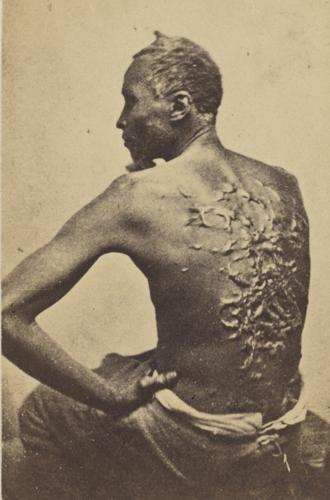
An escaped slave named Gordon, also known as "Whipped Peter," showing his scarred back at a medical examination; Baton Rouge, La., April 1863
In the description, the presence of scars and irregular teeth are noted. According to the log, 14-year-old Allen’s back was “much scarred with the whip,” and 17-year-old Charles had “all toes on the right foot ... injured by being frost bitten.” Bob, 15, had “large front teeth, small scar near the corner of the left eye.” Sixteen-year-old Moses had “considerable space between front teeth, small (burn) scar on his right arm.” Anthony, 21, had a “small scar under his left eye,” and was “apt to smile when spoken to.” Thirty-year-old Jim had “a scar on the inside of the right knee, also two scars on the right arm, one below, and one above the elbow.”
During the past seven years, I have asked Metro officials several times to research what happened to these enslaved people and to publicly acknowledge the fact that Nashville’s government once owned slaves. Since the Nashville mayor used to write slave-related ads, I approached the mayor’s office three times — first David Briley and then Freddie O’Connell, twice. Both told me they were interested.*
In the spring of 2024, I brought this up via email with the Metro Historical Commission. That also didn’t do any good. (When asked about acknowledging the history of Nashville owning enslaved people, MHC’s current interim director tells the Scene that the commission would be interested in sharing the history of these enslaved people and “still considers this a worthy and important project.” The MHC is currently searching for a new executive director.)
A few months ago, I finally decided to re-research this topic myself.
I found two sources of information in recent months that I didn’t know about when I researched Runaways, Coffles and Fancy Girls. The first: the minutes of the meetings of the corporation board, as reported in the newspaper. The second is a wonderful, massive Excel file found at the Nashville City Cemetery’s website. The file lists nearly 20,000 burials between 1845 and 1979, citing date of burial, name of deceased, sex of deceased, race, age (if known) and cause of death (if known). The last column is labeled “remarks.” In 10 cases, a deceased person is described as both Black and as a “slave of the corporation” or “a corporation hand” in the last column.
A look through these sources reveals undeniable evidence that the government of Nashville owned slaves right up until the U.S. Army forced it to free them, at gunpoint, at the end of the Civil War.
Here’s what I’ve learned about the slaves that the Nashville government used to own, in sequential order.
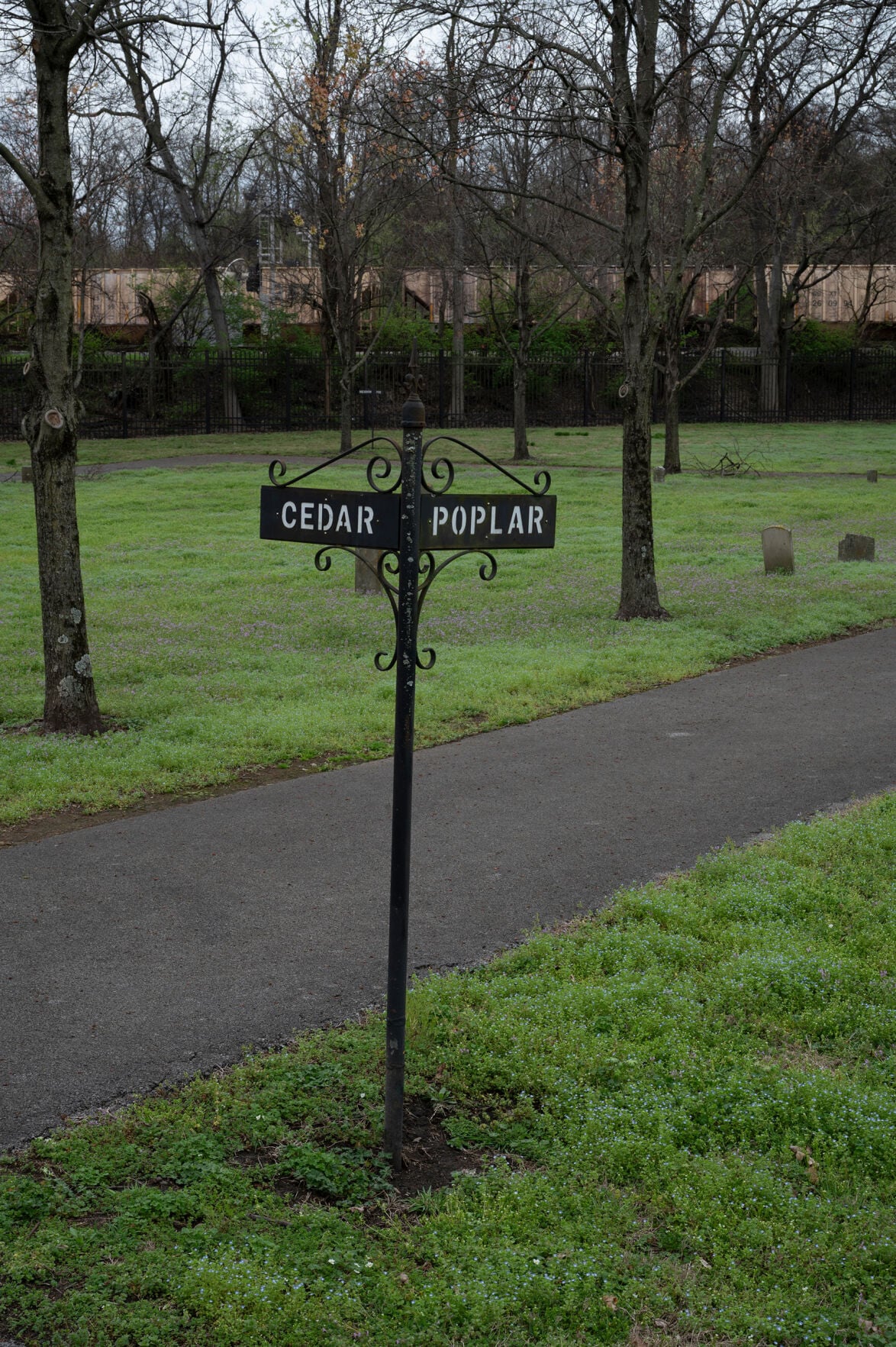
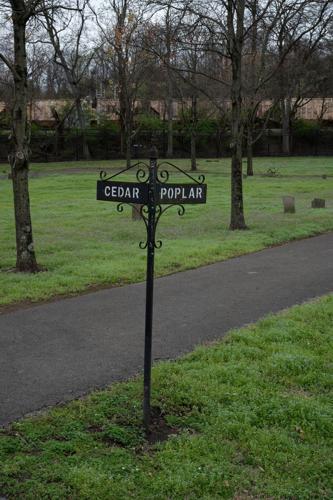
A portion of the Nashville City Cemetery where slaves owned by the city government were buried
On Aug. 3, 1831, the board reported that the “committee on slaves employ a physician at a salary not to exceed $100 per annum, to attend to the hands belonging to the Corporation.”
Two months later, the board made it the duty of the recorder to “purchase all articles of clothing for the Corporation negroes.”
By Nov. 2, 1831, the city had hired a full-time slave overseer named James McLaughlin and ordered him to “move with his family to the lot occupied by the Corporation negroes.”
At a board meeting on Jan. 18, 1832, it was reported that the “expenses of Corporation negroes and horses” would be $1,500 for the year — at a time when all city revenue totaled $9,000.
At a board of health meeting on Feb. 4, 1833, it was reported that “a negro child, belonging to corporation” was taken to the hospital for cholera, which probably means that either Lucinda or Lilburn had a baby. That same month, The National Banner and Daily Advertiser ran several paid items advertising the fact that the city was looking for another overseer “to superintend the Negroes belonging to said Corporation.”
On June 3, 1833, The National Banner and Daily Advertiser reported that “Moses, slave of the corporation,” died of cholera. (Moses was one of the enslaved teenagers listed in the detailed account written by Edwin Dibrell two years earlier.) Eighteen days later, the paper reported that “John Simmons, negro man, slave to the corporation” died of cholera the previous day. Since two of the enslaved people on Dibrell’s list were named John, we can conclude that John Simmons was one of them.
In August 1834, a paid advertisement published in The Nashville Republican and State Gazette indicated that another of Nashville’s slaves ran away. “[Emanuel] is about 35 years old, is five feet three inches high, dark yellow complexion, rather a sulky countenance, a small scar on its left eyebrow,” wrote John M. Bass, mayor of Nashville, in the ad. Also that month, the Nashville government hired Thomas McLaughlin to be its new full-time slave overseer. (I don’t know if Thomas and James McLaughlin were related.)
We know that by mid-December 1834, Emanuel was captured and returned to Nashville, because the board adopted a resolution to sell him. (Again, this means Emanuel likely ended up either in West Tennessee, Mississippi or Louisiana.)
In January 1838, Henry Hollingsworth became at least the third Nashville mayor to write a slave-related ad on behalf of the taxpayers. “WANTED, For the present year, 15 or 20 stout and healthy negro men, and 5 or 6 boys, for use of the corporation,” the ad said. This makes it clear that the Nashville government owned and leased enslaved people.
In November 1841, the Daily Republican Banner reported that “the hands belonging to the corporation” were doing work on the roads, specifically Union and Broad, and that after they were done with those streets they would move onto others, including Cedar Street (now Dr. Martin Luther King Jr. Boulevard).
According to City Cemetery records, a Black man named Noah, described as a “slave to the corporation,” died of dropsy and was buried on Jan. 11, 1847. (Since none of the slaves purchased in 1831 had that name, we can add Noah to the list of humans who were owned by the Nashville taxpayers.)
Two years later, in the spring of 1849, five enslaved people owned by the Nashville government died in the cholera pandemic and were buried in the City Cemetery. Their names were Bob, Anthony, Delmus, Frank and Jud. (Bob, Anthony and Frank were on the 1831 list, but Jud and Delmus were not.)
On July 3, 1850, when cholera was raging again, the Republican Banner and Nashville Whig described what the enslaved people were doing on behalf of the city government. “As the scourge is now upon us ... there should be adopted the most strenuous measure to cleanse the city,” one article read. “The places which abound in filth in the lanes and alleys should be visited by the corporation hands with their carts, and there should be followed by a distribution of lime at the expense of the city.” (The fact that Nashville’s slaves were ordered to clean up filth during a cholera pandemic might explain why five of them died of the disease a year earlier.)
Three months later, The Nashville Union and American reported that David H. Ware had been rehired as “overseer of the streets and corporation hands.”
Lucy, “slave to the corporation,” died at age 40 and was buried at City Cemetery on Nov. 26, 1852.
Sticking with cemetery records, three enslaved people owned by the taxpayers were buried in 1854 and 1855. However, none of the three were listed in the 1831 document, because they include a man named John (age 25), a man named Henry (age 24) and an infant (unnamed). These three people bring the number of enslaved people owned by the government to at least 33.
In June 1858, it was reported that the “corporation hands had finished cleaning the reservoirs — had worked on the streets near the lower landing, and had medaled parts of Spring Street” (now Church Street). Two months later, the board passed a measure authorizing the “corporation hands” to help build a sewer on Printers Alley, between Deaderick and Union.
In March 1859, the Republican Banner reported that “in addition to slaves owned by the Corporation, 31 slaves had been hired, making in all 41.” That indicates two things: Firstly, only 10 slaves remained alive of the 24 who had been purchased by the city 28 years earlier, and secondly, by 1859, Nashville was leasing 31 slaves in addition to the 10 owned by the taxpayers.
Starting in 1846 and continuing until 1861, Nashville’s government had a line item in its budget labeled “Slave Department” that included the salary of the overseer and the cost of clothing, feeding and quartering slaves. In 1847 the Slave Department got $2,769.14; in 1853 it received $3,481.35; in 1861, the Slave Department got $3,502.87. The Nashville government had a Slave Department until October 1864, which was the last time (I have found) that it was mentioned in a Nashville newspaper.
Slavery was made illegal in Tennessee in February 1865, as a result of a referendum that amended the Tennessee Constitution of 1834. In that referendum, Gov. William “Parson” Brownlow made certain that people who supported the Confederacy were not allowed to vote — for which he was hated by many Tennesseans.
As far as post-Civil War, the only two times (that I have found) when newspapers referred to the slaves Nashville’s government owned are two small articles in the Nashville Union and American. The first was in 1869; the second in 1872.
The articles have some contradictory information. Here is the second in its entirety.
March 13, 1872
A Corporation Veteran Dead
An old negro man named James Henderson, and familiarly known about the city as “Corporation Jim,” died last Monday night at the city workhouse, after an illness of about two weeks duration. The deceased was about 73 years of age, and for something more than 30 years past was in the service of the city government, having been purchased for that purpose at an auction sale of Virginia negroes.
A few years after becoming the property of the city, Jim was badly injured by a premature blasting of stone and rendered almost completely blind. Since that occurrence, “Corporation Jim” has found that the city in whose service he received these injuries was not ungrateful or unmindful of humane duty as a civilized community. He was provided with a home at the workhouse, where he has continued to live through the various administrations of the city government, and has always been kindly cared for by the keepers of that prison.
“Corporation Jim” was a devout professor of religion, and a regular attendant at the church of his choice. His funeral took place yesterday afternoon and was attended by many who had known and appreciated the virtues which adorned his obscure but upright life.
Samuel Van Dyke Stout, the Nashville mayor who wrote the runaway slave ad for the return of Daniel and Betsey, died in 1850 and is buried at the Nashville City Cemetery. John Meredith Bass, the Nashville mayor who in 1834 wrote the runaway slave ad for the return of Emanuel, died in 1878 and is buried at Mount Olivet Cemetery. Henry Hollingworth, the Nashville mayor who wrote the ad hiring slave labor on behalf of the government in 1838, died in 1855 and is buried at Nashville’s Dozier-Adkisson Cemetery.
James McLaughlin, overseer for the slaves who the Nashville taxpayers owned in the 1830s, died in 1864 and is buried at Rest Haven Cemetery in Franklin. David H. Ware, overseer for the slaves who worked for the Nashville government in the 1850s, died in 1880 and is buried in Nashville’s Spring Hill Cemetery.
Edwin Dibrell — who handwrote the descriptions of the 24 slaves Nashville bought from slave trader William Ramsey — died in 1871 and is buried in Richmond, Va.
Most of the people listed in City Cemetery records as slaves owned by the Nashville government were buried in the Poplar Avenue section of the cemetery. Unlike most of the thousands of other important people who are buried in City Cemetery, however, none of them have tombstones.
Update: After the publication of this story, former Mayor David Briley contacted the Scene to say he was working on a plan related to acknowledgement of this issue but was not reelected.


Post a comment as anonymous
Report
Watch this discussion.
(0) comments
Welcome to the discussion.
Log In
Welcome to the discussion.
Keep it clean. Please avoid obscene, vulgar, lewd, racist or otherwise abusive language. Comments featuring hate speech or threatening or violent content will not be tolerated.
PLEASE TURN OFF YOUR CAPS LOCK.
Be truthful. Don't knowingly lie or mislead.
Be proactive. Use the “report” link on any comment that violates our comment policy.
Share with us. We'd love to hear your feedback.