

When Salem Mason died at the tail end of 1899, he had been retired, such as it was, from the water department for — maybe, at most — three years. It’s hard to tell from newspaper stories.
In 1894, Salem was still working as a watchman in the old waterwork ruins up on Rolling Mill Hill, just south of downtown. At that point, he was 100 years old. At some point, he became too feeble and was moved to the hospital to work, where it appears his job was to chase chickens out of the morgue. He hated it and refused to do it. He then collected a $10 a month pension from the city. He had worked for the water department for 73 years. For about 40 of those years, the city owned him.
In the city’s log book, Salem is listed as one of the people purchased out east in 1831 and brought to the city by William Ramsey. But Salem’s own recollection was different. In a Banner story dated Dec. 13, 1894, he says: “To de best dat I can remember it was along about 1824 dat a party of gentlemen came to Richmond [where Salem had been hired out to work for their water department laying pipes] to buy some slaves for the corporation of Nashville.”
He then says: “This committee bought twenty-five slaves and I was the oldest.” If Salem was right about his birthday, he would have been 30. I thought that Salem was misremembering when he came to town, but what he says a little later in the story makes it clear that he was one of an earlier bunch: “I was working then on the streets, but as the town began getting larger, they wanted new water-works. It was along in ’32 or ’33 the city bosses sent to Richmond Va., and got Albert Stein — my old boss — to come and build the new pumps. He seed me on the street, knowed me, and at once got me transferred to his department. Dat, to de best of my recollection, was in ’33.”

33 people were owned by the Nashville taxpayers. Our city has done nothing to acknowledge them.
If late local historian Dr. Bobby Lovett had known Salem’s story, it explains how he came to believe that the city had owned 50 or more people — because there were at least two big purchases, not one. I talked to chair of the Metro Historical Commission — and the reigning official Best Historian in Nashville — Linda Wynn about how one might go about finding out basic details about the people the city enslaved: How many “slaves of the corporation” were there? Who were they? Where did they come from? What were their lives like? What happened to them? Did they have descendants? (Salem had two children with his first wife back in Virginia, who he never saw again after they moved north and he was sold south.) She looked at me and said that was a master’s thesis’s worth of research.
She’s right, of course. Even trying to figure out a very basic thing like “how many people did the city hold in slavery?” would take hours of digging through the city archives and old newspapers.
Metro historian Dr. Learotha Williams Jr. teaches his students about the “slaves of the corporation” every fall. They go see the log book, scan the old handwriting, and look across two centuries at these people, roughly their age, whose bodies already bore the scars of resistance before they got here.
The Nashville City Cemetery is installing a memorial to the enslaved people buried there, including many of the people the city owned. I spoke with Betsy Thorpe, the president of the Board of Directors of the Nashville City Cemetery Association, about the “slaves of the corporation” and the memorial. She stressed that the memorial is for all enslaved people buried there and that she hopes the city will find some way to specifically honor the people it owned, but that she was glad some of them would be honored by their memorial.
I kept finding a similar thing going on all over the city, where people are working to make records that tell us more about the lives of enslaved people more accessible to the general public. You can just walk into the Metro Archives and ask for help, of course. The office of Register of Deeds Karen Johnson has a large database of information about enslaved people that it has gotten from its records. So many more records are digitized that we are on the verge of being able to make connections easily that were impossible back when I first wrote about Allen and the other “slaves of the corporation.”
Allen came to Nashville from Virginia when he was 14. He was slight — slender in body and, at 4 foot 10, not yet fully grown. He had a large s…
Here’s how I found Salem, for instance. I figured some of the people the city owned must have lived through the Civil War, especially if Dr. Lovett’s figure is right. I had the first names of the people in the ’32 batch, and I cross-referenced them with the names of people enslaved by the corporation listed on the City Cemetery’s website. Obviously I didn’t need to look for anyone after the Civil War who died before it. Then I picked the most unusual names and searched the 1870s census on Ancestry.com for that first name in Nashville, but born in Virginia, and probably born around 1810, just based on the ages we know.
I tried Vincent first, no luck. Then Salem — and there was Salem Mason, living with his wife Ann, a woman named Ella Johnson, a girl named Lena Mason and a little boy named William Horton. In 1880, he’s still living with Ann and Ella, and his occupation is listed as “corporation laborer.” Holy shit! I knew this Salem was that Salem then, still working for the corporation. But I dropped his name into Newspapers.com to see if I could be sure.
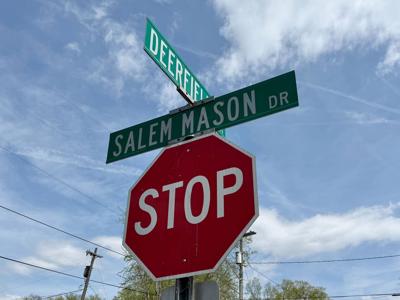
And there were these stories — with these long passages of Salem’s, in his own words — talking about having been enslaved by Nashville. But there were also even more results that included “Salem Mason,” because in the 1960s, a developer was selling homes to Black families in his new subdivision over by Tennessee State University — and one of the streets was Salem Mason Drive. I drove down it on Friday, and it is a regular old street with prominent signage. If having a street named after you is the city honoring you, then Salem Mason has been recognized by the city for six decades. Kind of.
It’s the Mildred Shute problem. Or the Hattie Cotton problem. At some point, the city did know who these people were, enough so to name stuff in their honor. But because we have no space where the history of Nashville is collected and shared (i.e., a city museum), people demonstrably worthy of honor (since they were honored) get forgotten over time, because people have no place to go to learn about them — unless they take Dr. Williams’ class.
I’ll admit, trying to do the whole right thing is daunting. Someone with a lot of time and resources would have to find and analyze as many physical records as might give us some clues about these people’s identities. They will need to use databases set up to answer other questions to try to come at these people from the side. And then, we need to try to find the descendants of those people and let them tell us what would feel like meaningful recognition. And that might be hard to hear, especially since they might find all our well-intended ideas insufficient. It sucks when you mean well and you want to do what’s right if it misses the mark.
But I think it’s still important to try to do right and have it fall short. If we want Nashville to be a better place, then we get there not with one sweeping grand gesture, but with little, insufficient steps. This sounds depressing, but I find it buoying. As much as I’d like to spend months in the Metro Archives researching this, I can’t. But I can tell you about Salem Mason. When the memorial is installed at the Nashville City Cemetery, we can use that as a place to tell the broader story of the people the city owned. And we can try some ways of specifically memorializing these folks.
Then, let’s learn from Salem Mason Drive and figure out how we can ensure that the focus of our efforts won’t be forgotten — again.



Post a comment as anonymous
Report
Watch this discussion.
(0) comments
Welcome to the discussion.
Log In
Welcome to the discussion.
Keep it clean. Please avoid obscene, vulgar, lewd, racist or otherwise abusive language. Comments featuring hate speech or threatening or violent content will not be tolerated.
PLEASE TURN OFF YOUR CAPS LOCK.
Be truthful. Don't knowingly lie or mislead.
Be proactive. Use the “report” link on any comment that violates our comment policy.
Share with us. We'd love to hear your feedback.