
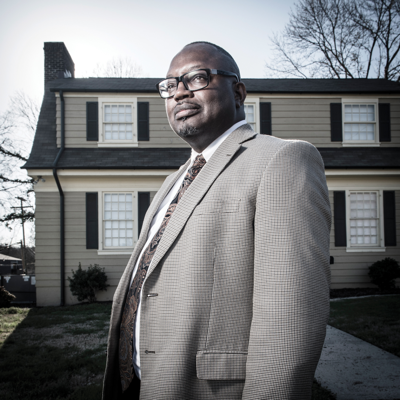


Learotha Williams
When the Scene asks Dr. Learotha Williams for ideas about where we should photograph him, he has no trouble coming up with a few. Soon we’re setting up in front of the James Weldon Johnson Home, a Dutch Colonial on D.B. Todd Boulevard in North Nashville. It was built in 1931 for Johnson, the man whose poem “Lift Every Voice and Sing” would become known as the Negro National Anthem. Johnson lived there while teaching creative writing at Fisk University until his death in 1938. Today it sits in front of a row of new condos, the increasingly crowded Nashville skyline visible from its front stoop.
Williams is a 51-year-old associate professor of African-American and public history at TSU who runs the North Nashville Heritage Project. Over the course of a quiet conversation in a corner of the Avon Williams Library at Tennessee State University’s downtown campus, it becomes clear that the historian sees a different city than most people. He sees an older city, full of beautiful, interesting and painful stories, on top of which several layers of New Nashville have been constructed. He sees a history hidden in plain sight.
After growing up in Florida and attending Florida A&M University and Florida State University, with a stint in the military in the middle of his schooling, Learotha Williams eventually earned his Ph.D. in history. He came up in “a family of storytellers,” he says, with parents who’d grown up in Mitchell County, Ga., and spoke often of life under Jim Crow. He learned the power of preserving history when he assisted an African-American community in South Georgia in getting a historical marker for a schoolhouse that “meant as much to that community as any church in Savannah.” Williams wrote the words for the historical marker — words he’d spent a weekend agonizing over and never felt satisfied with. But when the marker was approved and those words were read aloud at a community ceremony, he felt their true significance.
“When I looked around, people were crying,” says Williams. “And at that moment I realized that I probably would never write anything that moved as many people as that one small sign.”
That experience sowed the seeds of the North Nashville Heritage Project, which Williams started shortly after arriving at TSU in 2009. Its aim is simple and profound: It’s an initiative meant to collect and preserve the stories and artifacts of a history that is already marginalized. The effort has been aided by the older African-American men and women still walking around Nashville with stories to tell, like the late Jesse Fanroy, who used to haul an oxygen tank into Williams’ car and ride around North Nashville with him sharing his memories.
Williams once spoke to a black woman who’d lived through the 1960s and asked her what she did during the civil rights movement. Her answer surprised him: She fried chicken.
“It just blew my mind, because I never really thought about these kids getting hungry over the course of the day,” says Williams. “Or them being arrested and people out here being concerned if they were eating or not. So she talked about making plates for each one of them and then making a plate for the jailer to ensure that they could eat.”
Another man, who Williams met by chance in the downtown public library, told him about his days sneaking a suitcase full of cash — collected by local bookies and numbers runners — down to Alabama and Mississippi to bail out activists who’d been arrested. More recently, Williams has been trying to draw more attention to the history of African-American women in Nashville — women like Nettie Napier, who created day-home clubs that provided care and education for the children of working women.
But Williams’ work also challenges his students, and Nashvillians in general, to look beyond the narratives that can be used to put a glossy, uplifting finish on the city’s history.
“I warn my class that if they really like the city, then I’m gonna mess up certain spaces for them,” he says.
Nashville has tended to be “a bit delusional” about its racial history, says Williams. That history includes important events in the fight for civil rights and equality, but also places like Hadley Park — a formerly blacks-only park, established on land that was once a plantation and then neglected by the city’s white power structure. Williams often tweets documents that shed devastating light on a side of this city’s history that many whites would rather not confront — for instance, old advertisements for the slave auctions that would take place along Charlotte Avenue downtown on Saturday afternoons. He’d like to see a historical marker there one day.
“Those spaces, for me, on a certain level still resonate with black pain and suffering, because I know so much about it,” he says. “There’s no marker for them there. I don’t even know if it’s proper to say that putting something there that acknowledges their presence, that acknowledges that there were people there, would even be a start of healing. ... But ignoring it isn’t.”



Post a comment as anonymous
Report
Watch this discussion.
(0) comments
Welcome to the discussion.
Log In
Welcome to the discussion.
Keep it clean. Please avoid obscene, vulgar, lewd, racist or otherwise abusive language. Comments featuring hate speech or threatening or violent content will not be tolerated.
PLEASE TURN OFF YOUR CAPS LOCK.
Be truthful. Don't knowingly lie or mislead.
Be proactive. Use the “report” link on any comment that violates our comment policy.
Share with us. We'd love to hear your feedback.