
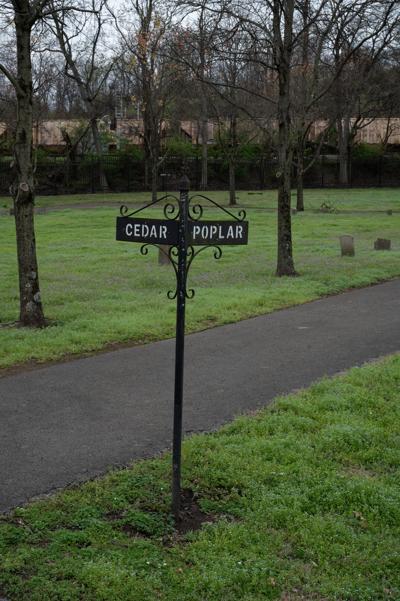

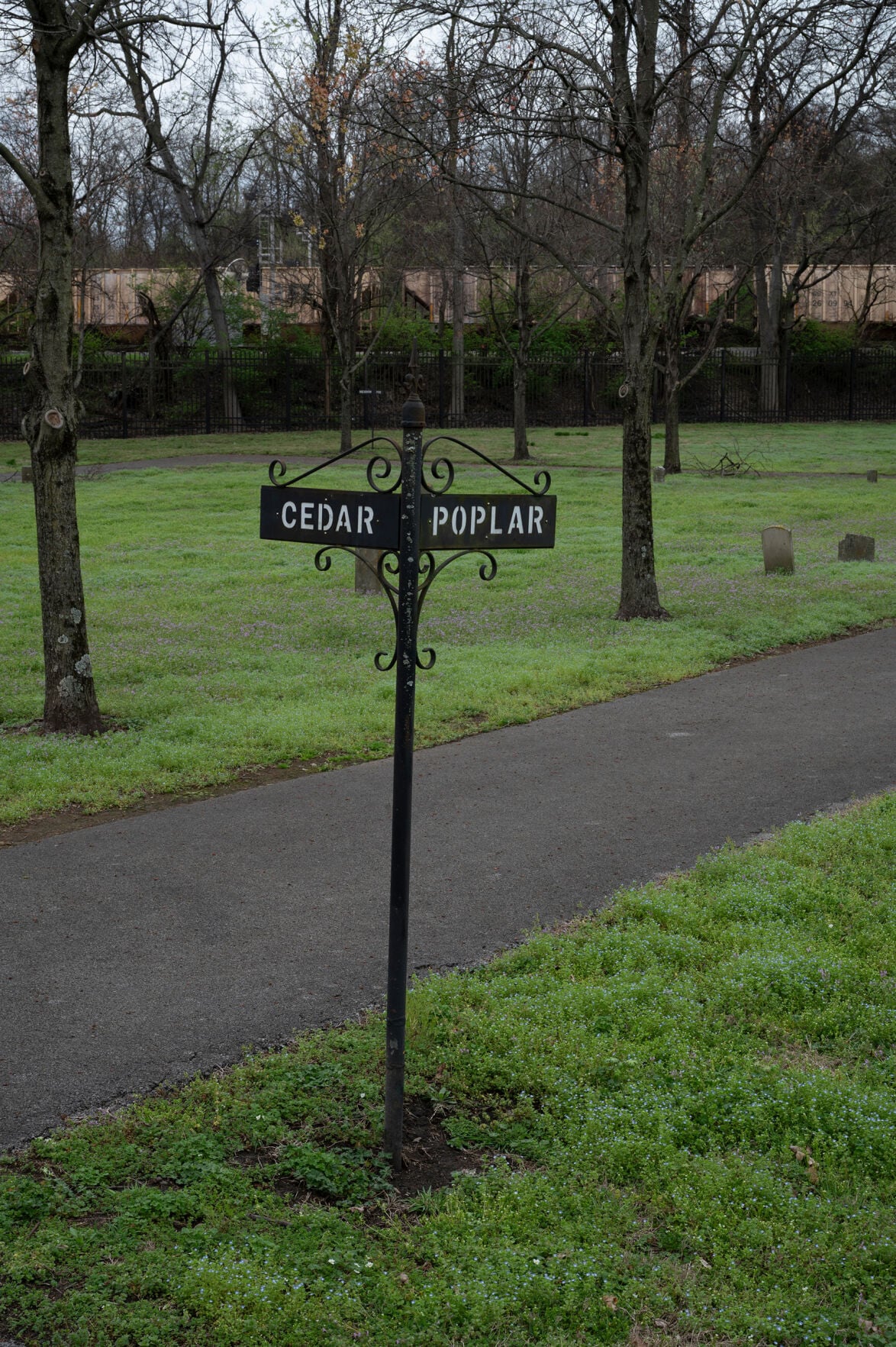
A portion of the Nashville City Cemetery where slaves owned by the city government were buried
We know that three men who had been enslaved by the corporation of Nashville made it to emancipation and were enslaved at the waterworks until then: Salem Mason, James “Corporation Jim” Henderson and Allen Beasley. I already told you about Salem Mason. Bill Carey told you about Henderson. That leaves Allen Beasley.

A man once owned by our city has a small street named for him in North Nashville
I was hoping that Allen Beasley might be that Allen, the kid who has been sitting in the back of my mind for a decade. But I can’t say. Allen, the kid with the scars on his back from being whipped repeatedly, was probably born about 1817. There was another Allen listed as a slave of the corporation though, so he’s as likely Allen Beasley as the kid is.
In a story from the July 31, 1873, issue of The Tennessean about Salem Mason, we learn a version of Allen’s life:
“Mason, together with John [sic] Henderson and Allen Beasley, was reserved when the other negros were sold upon the completion of the waterworks, and has been employed in that department ever since. ... Henderson was employed at the city workhouse for a long time before his death, which occurred last year, at which time he was eighty years old. Beasley died about the same time, and was about the same age. At the time of his death he was also employed by the city, and drove a scavenger cart.”
One slight problem: There’s no death certificate for Allen Beasley — at all. If he died in 1872 in Nashville, it’s weird that he doesn’t have a death certificate. It’s not unheard of, but it is unusual. Another slight problem: There is an alive Allen Beasley in the 1880 census, who was born about 1810 in Virginia — right age and place of origin to be the Allen Beasley who was enslaved by the city.
Judging by the website Find a Grave, there are a lot of Beasleys in Davidson County now, and I would guess that about a third of them are Black. But back in the 1870s, there were maybe a couple of handfuls. In the city directories an Allen Beasley appeared in, there were three Black Beasleys — Allen and two Thomases. The two Thomases were clearly father and son. There never was a time when two Allen Beasleys appeared in the city directory.
Also, while we’re weighing suppositions, I should note that there were no white Allen Beasleys. That may not mean anything, but it was common for enslaved people to share names with their enslavers. There were, for instance, three white William Edmondsons of the right age to be the enslavers of Orange Edmondson — the father of famed Black sculptor William Edmondson, who was alive at the same time as at least four other Black William Edmondsons. If Allen Beasley had been enslaved by a Beasley here, we shouldn’t be surprised to find a white guy older than Allen named Allen in the Beasley family.
The other thing that may mean something or may not mean anything is that the Allen who lived past 1872 was married to Alice, and they had a daughter named Lucy. Lucy married a man named Robert Horton and then died of tuberculosis in 1883 at just 25 years old.

33 people were owned by the Nashville taxpayers. Our city has done nothing to acknowledge them.
In 1870, Salem Mason had a 5-year-old kid living with him named William Horton.
I think most people know that people lost each other all the time during slavery. The myth of the slave owner or the slave trader who was determined to keep families together (usually just meaning mothers and small children) was just that — a myth.
Infamous local rich guy and industrial slave trader Isaac Franklin, for instance, complained about all the “small fry” left in his pens after an auction. The small fry being kids who were supposed to be sold with their mothers. They were not. It was also common for enslavers to sell people’s mothers and to remove the mother from the cabin in the dead of night, so her kids would just wake up without her with no idea where she’d gone.
Other enslaved people took those kids under their wings, as best they could, and tried to provide a sense of family for them. It’s horrific.
But a thing we don’t really talk about as a society: This horror went on in the immediate aftermath of slavery, and there were all these children who had been made (for all practical purposes) orphans. They were too young to be made sharecroppers or servants by their old enslavers, so they were on their own with no place to go and no one to look after them.
A lot of Black adults stepped up and took these kids in. Often they knew the kids from before, or they knew the kids’ family. But sometimes a kid just needed someone, so adults took them in.
It could well be a coincidence that two men who probably worked together at the city waterworks both had young men named Horton floating around their households. Or it could be that there was a Horton family well-known to both men, maybe a person who was also enslaved with them, who left behind some kids, and Beasley and Mason watched out for them. Hard to say, maybe impossible, but maybe someday someone will uncover something that tells us.
So is this Allen Beasley the Allen Beasley who was enslaved by the city and might have died in the early 1870s, unless The Tennessean was wrong? I don’t know.
There’s just so much we don’t know — don’t yet know — about the lives of the people the city enslaved. Hell, we don’t even have a good idea of how many people there were.
But we can say for certain that, after the Civil War, three men who had been enslaved by the city became city employees. And maybe we can find a way to honor them specifically while gesturing toward the history we don’t have nailed down yet.



