
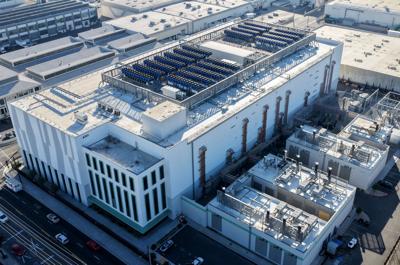

The Tennessee Valley Authority voted on Thursday to create a new rate structure specifically for data centers.
The Aug. 20 board meeting was held in Memphis, where the current load for data centers is the highest in the state. Data centers in Shelby County account for 1,000 megawatts or more of power, according to data from the U.S. Department of Energy.
For comparison, data centers in Davidson County account for less than 25 megawatts, with surrounding counties Williamson, Rutherford and Bedford accounting for between 25 and 49 megawatts each, Montgomery between 50 and 74 megawatts and Sumner between 100 and 999 megawatts.

Gas expansions, nuclear power will service data center boom as utility plans through 2050
Elon Musk's SpaceXAI Colossus supercomputer — which is billed by the company as the world's largest and powers the Grok AI system — is located in Shelby County at the Tennessee-Mississippi state line. The company is currently under construction on a permanent power plant designed to accommodate 1.2 gigawatts.
At Thursday's board meeting, TVA chief financial officer Tom Rice said the new data center rate was designed based on the cost of the service to the facilities, and an average increase of about 10 percent above what those companies currently pay is expected. Data centers that utilize more than 5 megawatts of power will be subject to an additional capacity commitment charge.
Previously, data centers had fallen into the manufacturing category at TVA. The energy company also voted to allow existing manufacturing customers with power loads greater than 5 megawatts to enter a contract that keeps their rate structure for a period of time.
For existing customers who will now fall into the data center structure, there will be a phase-in process to the rate over the next three years.
TVA said the rate changes support the organization's signing of the Trump administration Ratepayer Protection Pledge in July, which recognizes the impact of expanding data centers on electricity demand and requires "hyper-scalers and AI companies" to cover energy and infrastructure costs at the facilities.
"This data center rate is designed to maintain low rates and high reliability for existing residential and other customers, even as we support significant growth of data centers in the valley, by ensuring that data center customers pay for the system builds and updates required to serve their loads," Rice said at the board meeting.
Additionally, the board updated its policy for new power requirements for facilities above 100 megawatts in an effort to improve system reliability for all customers as large loads come online by aligning the onboarding with TVA's capacity and planned priorities.
As the TVA vote loomed, nonpartisan think tank ThinkTennessee published a second report on data center energy usage with a four-part policy roadmap to manage the growth of the facilities.
First, the organization suggests treating large data centers as grid partners and not just customers. The report notes the TVA vote and recommended requiring large data centers to cover costs of transmission and distribution infrastructure needed to serve them, setting up flexible load programs to shift electricity consumption during peak demand or emergencies, and reducing data center impact by generating behind-the-meter power.
The second recommendation addresses creating policies and targets to make the best use of existing grid capacity by emphasizing grid-enhancing technologies, which the report states "can help TVA to deliver more electricity over today's transmission network, sooner and at a lower cost than building new infrastructure."

Mayor’s legislation seeking to use eminent domain to seize zoo-area property advances on second reading
Third, the report notes additional transmission capacity will still be necessary, and infrastructure upgrades should be prioritized to support both grid reliability and consumer savings. ThinkTennessee suggests an investment plan utilizing U.S. Department of Energy financing similar to other large providers' high-voltage projects.
And finally, the organization recommends local governments create the necessary planning tools such as zoning requirements, special permits and overlay districts to help communities determine where data centers are appropriate. Metro recently passed its own such legislation as community pushback for data centers has come to a head over two proposed locations — one near the Nashville Zoo and another on the campus of Fisk University.
The group's initial report, which was released in July, notes that data centers’ electricity consumption has increased by 7.2 times in five years, to more than 9.15 megawatt hours — enough to power more than 661,000 homes today, according to the most recent data on average annual electricity consumption per residential customer. The report highlights challenges such as increased residential bills in counties hosting data centers and pending requests for grid connection that are five times more than existing data center system demand.
This article was first published by our sister publication, the Nashville Post.



Post a comment as anonymous
Report
Watch this discussion.
(0) comments
Welcome to the discussion.
Log In
Welcome to the discussion.
Keep it clean. Please avoid obscene, vulgar, lewd, racist or otherwise abusive language. Comments featuring hate speech or threatening or violent content will not be tolerated.
PLEASE TURN OFF YOUR CAPS LOCK.
Be truthful. Don't knowingly lie or mislead.
Be proactive. Use the “report” link on any comment that violates our comment policy.
Share with us. We'd love to hear your feedback.