
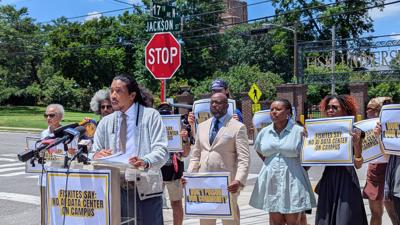

Notable Fisk University alumni and North Nashville community members gathered outside the historically Black college’s campus on Wednesday to speak out against the school’s plan for a data center. While Fisk portrays the project as a way to give students an edge in emerging AI technologies and says the build will be eco-friendly, critics say the potential pollution and strain on local water and energy resources aren’t worth the investment.
“We are standing in a ZIP code that consistently ranks within the top three for the highest rates of asthma prevalence and emergency-department-related visits across the city,” said Winston Wellington Wright, a public health expert who graduated from Fisk in 2017. Wright compared the potential damage of the data center plans to the construction of Interstate 40 in the 1960s, which demolished homes and split North Nashville in half.

Neighbors and alumni are questioning how the university’s proposed data center will impact the community
Eriqua Martin, a rising senior at Fisk, criticized the footprint of the proposed data center — to be housed in a 100,000-square-foot facility — and said the university should invest instead in funding faculty and improving residence halls.
Timothy Hughes, president of the Nashville NAACP, said Fisk was free to pursue advanced technologies but should be more transparent about the project. “The NAACP has long maintained that economic development must not come at the expense of environmental justice,” he said.
“Fisk's vision and community accountability are not competing ideas,” Hughes said. “They are complementing responsibilities.”
“There were no community meetings, no community engagement, and surprisingly these announcements came after the students who are most affected were let out for the summer,” said Karen Johnson, register of deeds for Davidson County.
While data centers have existed for years — used for services like cloud storage — the recent surge in construction of centers for AI usage has increased scrutiny of their environmental impact. AI data centers are particularly demanding of water, generate noise, create a lot of heat and contribute to pollution — Elon Musk’s gargantuan 150-watt XAI center in Memphis has been accused of ruining air quality.
In Fisk’s initial announcement of its $1 billion Quantum Leap master plan, the university said the Innovation and Technology Center housing the data center would be LEED-certified and built with minimal impact to the community. The university also bills itself as a better steward of a data center than corporations beholden to shareholders.
While the 30-megawatt center at Fisk is significantly smaller than XAI and would demand less power, the project manager told the Nashville Banner a third-party commercial partner would also be using the facility.
On the south side of town, the Nashville Zoo has also been rallying opposition to a nearby proposed data center, citing harm that could come to animals and neighbors in the community. A Change.org petition opposing the DC BLOX development has more than 379,000 signatures; a petition opposing Fisk’s data center has more than 6,000. Speakers voiced support for the zoo’s fight but added the same concern was owed to historically Black neighborhoods.

Stormwater runoff from site could run into already-degrading waterways on Nashville Zoo property
“We want to send a very clear message that if this project of AI data centers is not good for a zoo, then it's not good to build out of HBCUs, not good to build in the heart of a Black community,” said state Rep. Justin Jones (D-Nashville), Fisk class of 2017.
Several speakers criticized the university for its lack of transparency about the project’s funding and about what company it would work with to manage the data center. Jones also said a class he was teaching at Fisk about environmental racism was canceled when he began teaching about “the dangers of AI.”
Fisk tells the Scene in a statement it is “in the process of identifying our partner for the Innovation Center and will work with them on all specifics based on our ‘do no harm’ approach, Fisk's immediate need for enhanced digital infrastructure and technology access, and community input.”
Regarding Jones’ canceled class, the university called the rep’s comments an “inaccurate representation of this situation.”
A statement from the university sent Wednesday morning says it will “continue providing the community project updates as more information becomes available.”
At a special-called meeting Tuesday, the Metro Council advanced on the first of three readings a 90-day moratorium on data center construction. Community members are expected to pack a Metro Planning Commission meeting Thursday night as the body considers a piece of legislation that would regulate construction of data centers.



Post a comment as anonymous
Report
Watch this discussion.
(0) comments
Welcome to the discussion.
Log In
Welcome to the discussion.
Keep it clean. Please avoid obscene, vulgar, lewd, racist or otherwise abusive language. Comments featuring hate speech or threatening or violent content will not be tolerated.
PLEASE TURN OFF YOUR CAPS LOCK.
Be truthful. Don't knowingly lie or mislead.
Be proactive. Use the “report” link on any comment that violates our comment policy.
Share with us. We'd love to hear your feedback.