
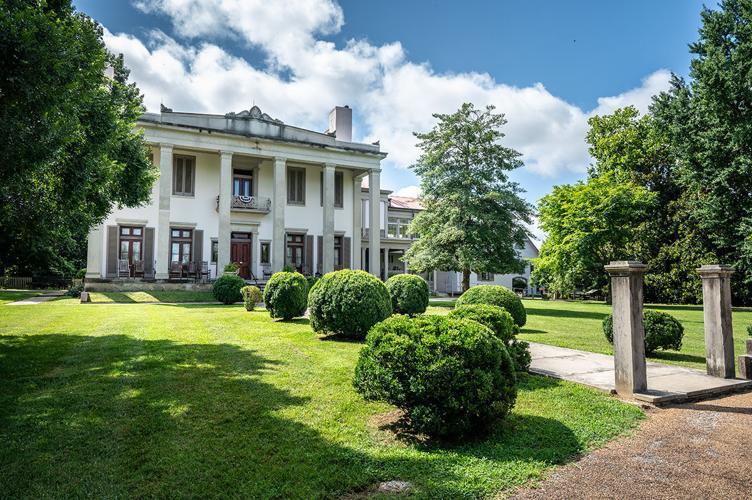
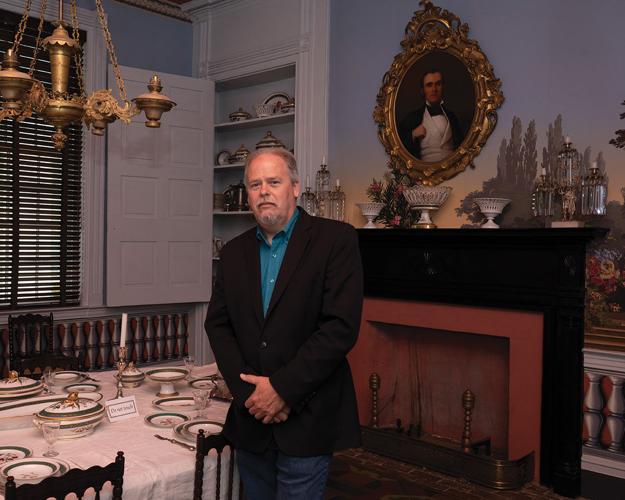


Belle Meade Mansion
There’s no such thing as a good slave owner.
That’s the short answer to the most common question across Nashville-area sites with a history of enslavement. Were they “good” slave owners? None of them were, neither Andrew Jackson at The Hermitage, nor Adelicia and Joseph Acklen at Belmont Mansion, nor John Harding at Belle Meade, nor John McGavock at Carnton, nor John Overton at Travellers Rest. The term “good slave owner” is an oxymoron.
That fact is made clear on the recently reopened In Their Footsteps: Slavery at The Hermitage tour, which takes place on the grounds of the longtime Nashville home of the American president. It was common for slave owners to place ads in the newspaper offering a reward for an escaped slave, but Jackson took it a step further: He would offer an additional reward for each 100 lashes the finder gave to the escapee.
The tour, which was put on pause for a time at the start of the COVID-19 pandemic, begins inside the cabin of Alfred Jackson, one of Jackson’s slaves. There visitors find a showcase of items that were used by the people who were enslaved there. The tour ends in the grounds’ newly discovered enslaved cemetery with a reading of the names of each of those buried there.
“We’re also more honest in this tour,” says Cody Youngblood, director of visitor experience at The Hermitage. “We wanted to make sure that Jackson’s abuses of the enslaved were talked about truthfully, honestly. We don't shy away from that, and we also wanted to highlight the resilience of enslaved people. Despite this terrible degradation, they are building families, they are pushing against this coercion, and they’re able to carve out their own lives within it.”
While the standard house tour does discuss slavery, it does not include a visit to Alfred’s cabin. The Scene overheard a guest on a recent self-guided tour tell a young relative that Alfred “didn’t have it as bad as the others.”
Even with updated context, historic sites still must fight the myth of the happy slave and the kind slave owner. It’s part of the larger “Lost Cause of the Confederacy” myth, which is most famously explored in the 1936 novel Gone With the Wind and its 1939 film adaptation and portrays slavery as a benevolent institution.

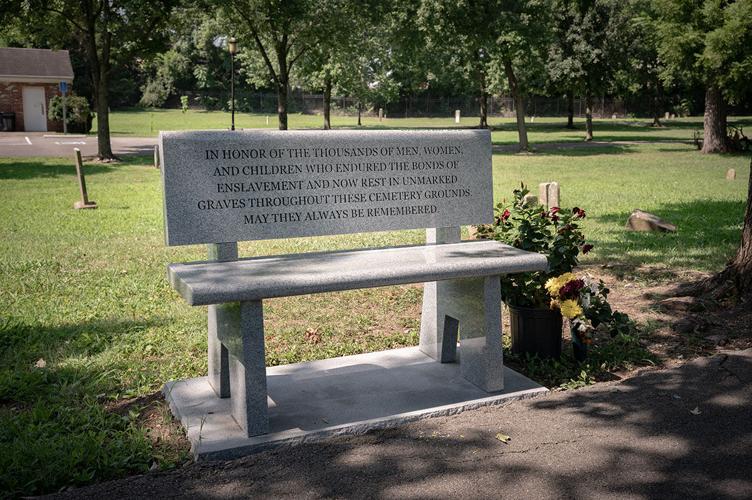
A bench dedicated to enslaved people buried in the Nashville City Cemetery
Alfred was born at The Hermitage and stayed through his emancipation, leading some of the first tours there before he died in 1901. At his grave — which is near Andrew Jackson’s — he’s described as a “faithful servant.” That’s not necessarily a compliment, Youngblood notes.
“I think you could even compare it to what you call a dog that follows around its master,” he says. “This is a dehumanization of these individuals because of their African American descent, because of the racism that has permeated all these public history institutions in the 1880s and 19th up to the mid-20th century.”
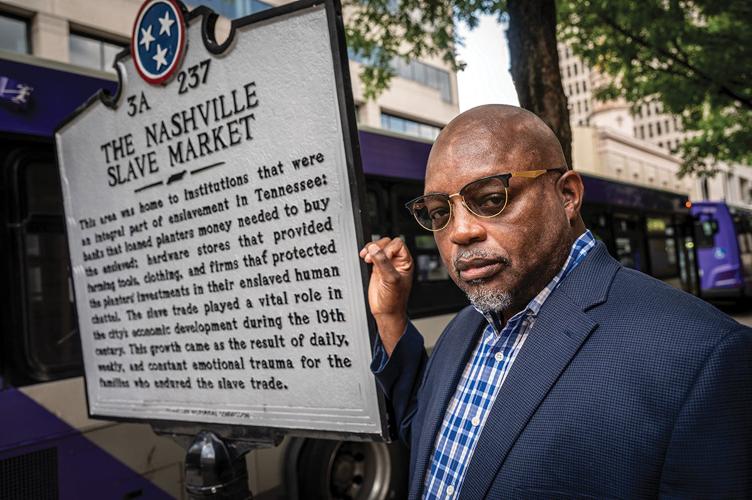
Area historians are painting a more complete picture of the past, and newly named Davidson County Historian Learotha Williams is a part of that. He previously established a historical marker for the Nashville Slave Market and was also on hand when the Nashville City Cemetery recently erected a bench honoring the thousands of enslaved people who are buried there.
“If you’re going to talk about life in these spaces, how are you going to do that and not talk about the people that made up the majority, without the people whose presence made that space valuable?” Williams tells the Scene. “We haven’t really been doing that until very recently in this city.”

Learotha Williams
Historian Brigette Jones, a former student of Williams’ at Tennessee State University, was the only Black docent at Belle Meade Historic Site and Winery when she started there in 2018. Later she led the development of the Journey to Jubilee tour focused on enslavement on the property, which is still offered today.
Jones now works as assistant executive director at Arabia Mountain National Heritage Area Alliance in Georgia. Visitors won’t currently find a Black historian on staff at Belle Meade or The Hermitage, or Travellers Rest, or Belmont Mansion, or any of Nashville’s former sites of enslavement.
Jones says she is very skilled at talking to rooms full of white people about difficult history, but she understands why young Black people may not want to set foot on a former plantation. Even if they wanted to work as a historian there, they might not be able to survive on what she describes as low pay for such positions.
Of her time at Belle Meade Historic Site and Winery, Jones says she remembers people wiping away tears following the Journey to Jubilee tour as well as people stumbling tipsy from a wine tasting.
“There’s this weird energy there that everybody’s not going to be able to handle, because quite frankly, it will piss you off as a Black person.” Jones says. “You’re looking racism in the face every day, but it’s one of those things where if the cause is bigger than the fear, then you do it anyway.”
Belle Meade Historic Site leadership says having Jones around was invaluable to the interpretation of the history as well as the connection to the Black community in Nashville. Williams says he brought his classes to Belle Meade when she was there, and when she left he stopped. It is imperative to have a Black historian not just to consult or sit on the board, but to work on staff, Williams says.
“Culturally, African Americans can bring something to the table that their white counterparts cannot,” Williams says, “and that is a shared ancestry with the people who were in the chains, who bore the violence that was necessary to sow to maintain this system.”
“The well is deep, and if they wanted that sort of interpretation, there’s spaces where they could look and find people that will be very, very qualified to do these jobs.”
Today Williams takes his students to a nearby Civil War site, Travellers Rest Historic House and Museum, which is also a common K-12 field trip destination. Slavery is mentioned in tours for each age group, but it is discussed more in-depth with students in fourth grade and older, says Andy Blair, director of education, interpretation and outreach at Travellers Rest.
“We try to be open and up-front with the teachers so they can be able to relay that information to the parents that we will be taking a visit to a place that formerly enslaved individuals, learn what that was like,” Blair says. “And it’s important to be respectful and to acknowledge the past and the history here.”
The site has also released a public call for descendants of those enslaved at the site through its Travellers Rest Enslaved Persons Documentation Project. In 2024, for the 225th anniversary of the construction of the home, the descendants of those who were enslaved there and descendants of the enslavers met and spent time together.

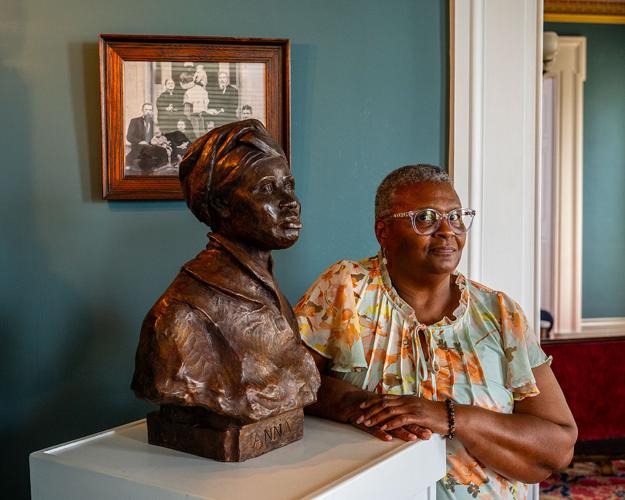
Bridget Stuart
In Bridgett Stuart’s family, she’s the one everyone goes to if they have a question about their ancestors. She already knew she had a connection to Rippa Villa plantation in Spring Hill when she heard from historian Kristi Farrow, director of African and African American History at the Battle of Franklin Trust, which manages the site.
Stuart gave a speech at the 2025 unveiling of a bust characterizing her ancestor, Anna, who continued to work on site as paid domestic staff after she was enslaved there. Stuart says she wishes more Black people were interested in visiting sites like Rippa Villa, and learning about their ancestry. For her, a sense of identity is paramount.
“You have a group of people that are truly interested, and they do tours … but then you have so many people right here in Spring Hill [who] don’t know anything about their family,” Stuart says. “They are not even trying to find out anything about their family.”

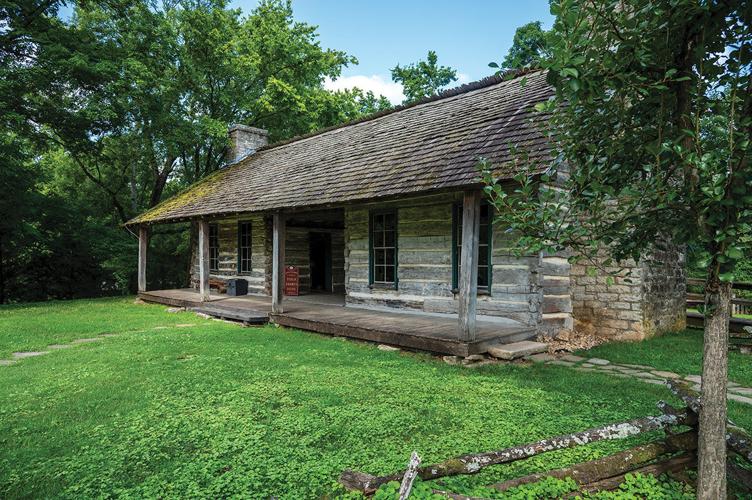
Slave cabin at Belle Meade
The Journey to Jubilee tour at Belle Meade stands out in its invitation to imagine what the people who were enslaved there must have felt like, compared to other sites focused on a lineup of facts from which visitors can draw their own conclusions. For historian Jones, emotion is the most important aspect.
“I think that emotion is the one thing that everyone can understand, whether you are white, Black, rich, poor, green or in the middle,” she says. “I think that by welcoming people into the shoes of a situation that you have no control over, but also have no choice but to be in, it allows people to understand just how heavy the situation of slavery was, the lived experience was.”
During the Belle Meade tour, visitors hear from Susanna Carter, one of the only enslaved people directly quoted — she was interviewed by a journalist during her time as head of the domestic staff after emancipation. Guests are invited to imagine what she meant when she answered a deeply misguided question: When asked, “Do you prefer to be free or enslaved?” she replied, “I do and I don’t.” Did Carter have options to work elsewhere? Did she have access to healthcare? Was she paid enough to afford the things she needed? Was her former enslaver looking over her shoulder when she answered the question?
The Journey to Jubilee tour also addresses head-on the rape that took place in these environments. A census from the era shows a number of people enslaved at the site listed as “mullato” — biracial in modern terms. Enslaved women had children by their masters, and enslaved men often were powerless to stop their wives from being raped. Jones notes that the imbalance of power negates any affection between the two parties.
This type of frankness has turned some tour attendees off. Jones says that during her days as a docent, some people even left midtour.
“When you tell a story that is rooted in both fact and emotion, it holds a mirror to the face of many Southern white people, because God forbid their ‘Papaw’ was a racist,” she says.
Jones says that while some turned away, others looked to her to absolve them of their guilt. Her tours were often followed by an impromptu therapy session, she says. It was a lot of “my child’s best friend is Black, and we treat him just like family,” Jones says.
“There’s this Black person right here, so let me show this Black person that I am not racist,” she says. “Quite frankly, I don’t think we need that. I think the people who need it are the people that you are in direct contact with on a daily basis.”
While it’s important to have the input of Black historians on any such tour, it shouldn’t be entirely on the Black population to try to change minds. That’s where white historians like the Battle of Franklin Trust’s Farrow come in, Jones says.
“I think that it is really important that white people who choose to do this work do it with empathy and accuracy, and do it knowing the privilege that they hold, and also do it within your community,” Jones says. “Don’t just be a white historian trying to tell Black people about Black people — go tell other white people about Black people.”

Eric Jacobson, CEO of the Battle of Franklin Trust
Eric Jacobson, CEO of the Battle of Franklin Trust, argues that you don’t have to defend your racist great-great-grandfather — you didn’t know him, and nobody alive today does. A point he’s also trying to drive home at the sites the trust manages is another one circulated by the “Lost Cause” myth: The Civil War was not driven by states’ rights; it was driven by slavery.
“It does not matter one bit that someone’s great-great-grandfather didn’t own slaves, or that someone’s great-great-grandfather from Michigan wasn’t fighting to free slaves,” he says. “Well, they’re both fighting in a war that’s all driven by slavery. I mean, we were in Vietnam because of communism. We were in Iraq because of terrorism.”
Jacobson says he saw pushback from all directions — staff, board members, guests — when the Battle of Franklin Trust took over two Williamson County historic houses in 2009, Carter House and Carnton. (Rippa Villa was added in 2021.)
In the early days, stakeholders said staff at these sites should “stick to the battle.”
“I was somewhat puzzled, because it wasn’t like it was a super-edgy interpretation,” Jacobson says. “I was simply advocating and promoting and pushing the idea that we had to talk about slavery.”
As part of construction at Carter House, BOFT is also moving the slave cabin on site directly into the path from the visitors’ center — that way people cannot miss it. There’s a refrain among current historic home operators: They don’t want guests to leave the site without hearing how slavery was a part of its history, even if guests didn’t choose a slavery-focused tour.
Michael Hedges is the newly installed CEO of Belle Meade Historic Site and Winery, having previously managed only the winery side. He says he is proud of the Journey to Jubilee tour, but wants to expand physical markers honoring the stories of those who were enslaved. For example, he’d like to better represent Robert Green, the formerly enslaved horse trainer who gained national fame and bred horses whose descendants are still regular Kentucky Derby winners.
“I think you can still come here and squint a little bit and not think about some of the more complicated aspects of the history of Belle Meade,” Hedges says, “and I do think that we need to continue to physically ensconce things that help people to be aware.”
Belmont Mansion docents received the question about “good slave owners” so often that they took the liberty of printing their official answer on one of their exhibit signs. The answer reads, in part: “There were households where physical abuse was not present, and adequate food, clothing and medical care [were] provided. Yet, even then, enslavement meant the denial of basic freedoms including the ability to protect loved ones from harm or separation by sale.”
Adelicia Acklen was the mansion’s original owner, and her first husband Isaac Franklin was the source of her wealth. He was one of the most prolific slave traders of his time.
In an exhibit, Upon the Toils of Many: The Story of Enslaved, Free Black and Immigrant Workers, there is a rare physical depiction of a formerly enslaved woman, Mildred Haley. She’s depicted in mannequin form leaving the mansion after emancipation in 1870, when she attended Roger Williams University in Nashville — a historically Black university that’s now part of Memphis’ Howe Institute.
“When you’re presenting that information in a black-and-white factual sort of basis, it’s a little harder to connect on an emotional level and to begin to feel like you can visualize a person,” says Lauren Batte, deputy director at Belmont Mansion. “That’s why we did the mannequin.”
Jones thinks there should be security implemented on historic sites for guides leading tours about slavery. She’s also called for scholarship funds for descendants with proceeds from ticket costs. None of the historic sites have set up such a fund yet.
Jacobson of the Battle of Franklin Trust says the pushback he experienced at first has nearly dissipated as younger visitors replace the older ones. He’s hopeful for the next generation.
“They’ve grown up in a much different environment, and I think they’re much more open to the idea of talking about politics or race or slavery,” Jacobson says. “They’re not interested in the sort of hero worship of the Confederacy. So we see more of those people, and we see less of the older ones.”
Historians believe history is always evolving, and as we learn more, that information should be implemented into education at historic sites.
“We’re learning new stuff every single year, so our stories should be better,” Davidson County Historian Learotha Williams says. “They should be more informed, because we are getting smarter.
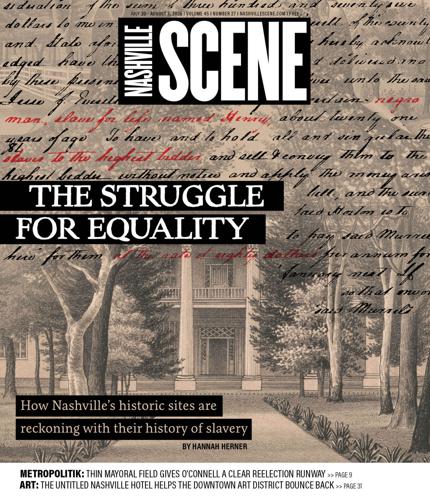
“Slavery is a chapter,” he continues, “but it’s one of the ones that has been most misinterpreted, marginalized and erased. So it’s critical for us to get this right, because it’s the foundation of everything else that we would look at later on, be it the Civil War, or Reconstruction, or Jim Crow — the struggle for equality.”




Post a comment as anonymous
Report
Watch this discussion.
(0) comments
Welcome to the discussion.
Log In
Welcome to the discussion.
Keep it clean. Please avoid obscene, vulgar, lewd, racist or otherwise abusive language. Comments featuring hate speech or threatening or violent content will not be tolerated.
PLEASE TURN OFF YOUR CAPS LOCK.
Be truthful. Don't knowingly lie or mislead.
Be proactive. Use the “report” link on any comment that violates our comment policy.
Share with us. We'd love to hear your feedback.