

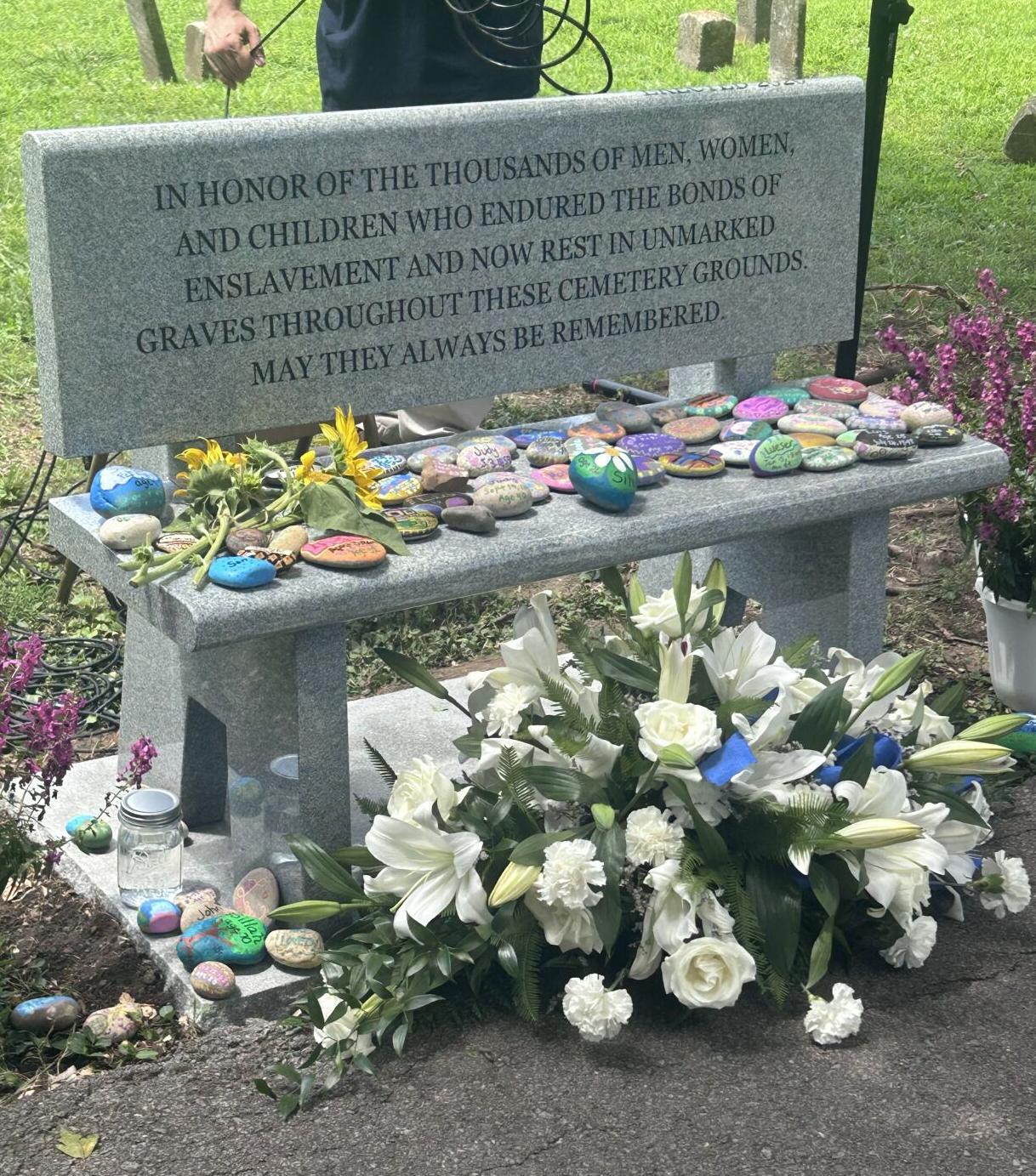
A new bench in the Nashville City Cemetery memorializing the people enslaved by the city of Nashville, June 2026
On Saturday, the Nashville City Cemetery Association held a beautiful dedication of a bench memorializing the enslaved people who are buried in the cemetery. I was one of the speakers on the program, so I didn’t get a ton of pictures, but I did take the one you see here after the commemoration. The stones in the picture are a sampling of the 2,000 stones that people from all over — each one representing an enslaved person buried in an unmarked grave in the City Cemetery, painted with their names, ages and date of death. The jar of water there is from me, because I was asked to say some words specifically about the people the city owned who are buried there.
Afterwards, quite a few people asked me for a copy of my speech, so I'm taking this opportunity to use the biggest platform I have to publish it. That way the people who want it can easily share it. (Bonus: It gets me out of having to write a whole different column when this is all I can think about at the moment.)

What happened to Allen Beasley, a man enslaved at the city's waterworks department?
As a side note, Councilmember Terry Vo and I both ended up reading the names of the "slaves of the corporation" (that is, the enslaved people once owned by the city) who we know are buried in the city cemetery. Between the two of us, I think we said Deimus’ name 50 different ways. Deimos — pronounced like Day-moss — is a Greek name, so I tried to stick with that. But DeMoss was also an incredibly common last name in Davidson County back then, and there’s a chance locals may have said Deimus’ name the way they said DeMoss. If you happen to run into the ghost of Deimus in the cemetery when you go to view the bench, please ask him how he likes his name said.
Anyway, below are the words I shared.
In 1831, the city of Nashville bought 22 men and two women to build the town’s waterworks. Wait. Calling them men is inaccurate. Allen was 14. Laban was an infant — the son of one of those women, Lucy. So let’s say 24 people — men, women and children. Thanks to remaining cemetery records, we know that the city continued to buy people throughout the time slavery was legal, because some of the people commonly referred to as “slaves of the corporation” who are buried here in the cemetery died too late and too young to have been in this initial group.
Historian Dr. Bobby Lovett estimated that the city probably owned 50 to 60 people over the years. We don’t know all their names nor what became of them, though efforts are underway to try to rectify this.
We have too few accounts from the survivors of enslavement, but miraculously, one of the men who built the waterworks — one of the men the city owned, Salem Mason — was interviewed by the Nashville Banner in 1894. Here, in his own words, is his account of the work these people were bought to do:
The committees and engineers hunted around for a site for the new plant and at last they selected the bluff above Broad Street. It was chock full of cedar trees, briars and snakes, but we cleared a road, and also the ground where the old reservoir was built. Just on this ledge of the bluff was the place for the engines and pumps, and I helped put every stone and timber up. Afterwards, when the engines were being put in place, I also worked with Mr. Stein, and can remember as well that whenever he wanted to start the pumps I would go down to the water’s edge and hold my hand over the end of the pipe until she’d commence sucking water. ... When we thought the basin was full somebody would have to go up and holler back how she stood. Bad weather, dark, cold nights, and rattlesnakes, made this a pretty scary job, and none of us liked it. Then we rigged up a float, so that when the water reached the top a string would shoot off a cannon on the reservoir wall, and we would close down the pumps.
These men also laid the pipes that ran from the pumphouse on Rolling Mill Hill down Second Avenue and up as far as the public square. There are likely still stretches of the cast iron pipes these men put in place 200 years ago bringing water to us today. We still drive the streets they laid. We benefit from the public works projects they were assigned to labor at.
Nashville took these people from their spouses, their children, their parents, and we moved them halfway across the country. For our benefit, they were brutalized and worked until some of them got sick and died. Many of them ended up here. As long as water flows from our faucets, no one in Nashville can claim that we don’t benefit from slavery, that it doesn’t have anything to do with us, because it happened so long ago. We are benefiting right now. As a city, we owe these people a continually mounting debt we cannot repay.
Cemetery records are incomplete, but here are the names of the 11 people who were enslaved by the city who we know are buried here:
- Moses, June 3, 1833
- John, June 21, 1833
- Noah, Jan. 11, 1847
- Bob, April 3, 1849
- Anthony, June 15, 1849
- Deimus, June 16, 1849
- Jud, June 16, 1849
- Frank, June 18, 1849
- Lucy, June 1852
- John, June 6, 1854
- Henry, age 24
Seven of the 11 names match names of people the city bought in 1831.
Anthony, Deimus, Jud and Frank died during the same cholera epidemic that killed President James K. Polk, who died the same day as Anthony.

33 people were owned by the Nashville taxpayers. Our city has done nothing to acknowledge them.
They share this sacred space with John, who was enslaved by William Shipp, but who was in the employment of the corporation when he died on May 18, 1862, at the age of 21. President Lincoln issued the Emancipation Proclamation on Jan. 1, 1863 — seven months later.
This fact — that the city of Nashville enslaved people, many of whom are buried here — obliges us to strive to be a city that feels such sorrow and shame over the evil we’ve done that we stop doing it. I won’t preach to you about all of the city’s shortcomings. We know them. Many of us suffer under them. All the ways that the legacies of slavery are still with us. We simply must find a way to stop doing the evil that is so familiar to us that it feels natural. And I’ll admit that often feels — if you’ll excuse the pun — like a pipe dream.
This may be the first time you’re learning that the city owned people. You may not realize that you owe the water in your tap to them. If you’re like me, you may feel overcome with grief. Today, we have a place to come and grieve for the people the city enslaved. But I also want to tell you that, even with the little information we have, we know these 24 people — who were mostly strangers to each other at first — watched out for each other, that they took care of each other the best they could, and we can assume that they were the ones who buried each other here. There’s evidence that, after the end of enslavement, some of these people took in the children whom slavery had orphaned. This, then, is also a space to recognize and honor them and to take inspiration in their ability to retain the best human qualities of care and love in inhuman circumstances.
And I’m deeply heartened to have this space where we can stop and remember them, the slaves of the corporation, our fellow Nashvillians.



Post a comment as anonymous
Report
Watch this discussion.
(0) comments
Welcome to the discussion.
Log In
Welcome to the discussion.
Keep it clean. Please avoid obscene, vulgar, lewd, racist or otherwise abusive language. Comments featuring hate speech or threatening or violent content will not be tolerated.
PLEASE TURN OFF YOUR CAPS LOCK.
Be truthful. Don't knowingly lie or mislead.
Be proactive. Use the “report” link on any comment that violates our comment policy.
Share with us. We'd love to hear your feedback.