
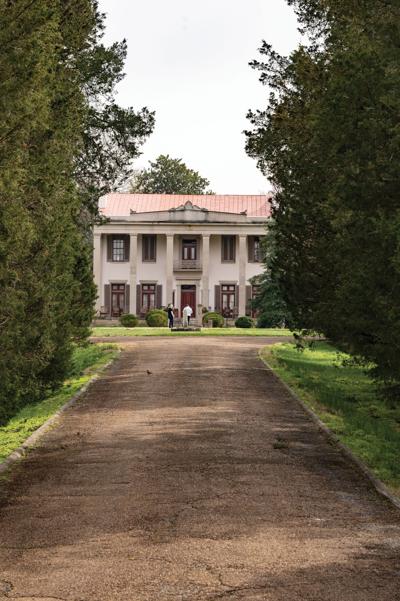


Belle Meade Historic Site, March 2023
The pillars of an antebellum-era mansion are decreasing in popularity as backdrops for Nashville weddings. In fact, several of the area’s historic sites that have a history of slavery no longer offer private events at all.
The Hermitage, the Nashville home of President Andrew Jackson, stopped offering events of any kind in 2024, shortly after president and CEO Jason Zajac stepped into the role. That decision wasn’t focused solely on weddings, but rather on any private events on the property, Zajac tells the Scene. It was a small piece of the overall business in terms of revenue and guests served, he says. To make up the difference, they sold more tickets and tours.
“I didn't feel we had the staff bandwidth to do it well, and it's not really mission-critical for us,” Zajac says. “We love people to use the site in lots of ways, but it's not core to our work.”
According to wedding-planning platform The Knot, 76 percent of weddings take place between May and October, with October and June being the most popular months.
At the four Civil War historic sites owned by the Battle of Franklin Trust, weddings and events were halted in 2021, as were ghost tours. CEO Eric Jacobson says he understands why places offer such events if the money is necessary to the site’s survival.
But it’s problematic to have a party at a former site of slavery and combat, he says, going on to make a hypothetical comparison: It’d be like if Ground Zero of the 9/11 attacks one day hosted parties.

How historians at sites like The Hermitage, Belmont Mansion and Belle Meade fight the ‘good slave owner’ and ‘happy slave’ myth
“We just decided that we didn't want to do it anymore,” Jacobson says. “Not just weddings. We stopped doing basically all social functions — no concerts or anything like that. We try to treat all the sites with a 365-day-a-year degree of sanctity. It just didn't fit into what we were doing any longer.”
Belle Meade Historic Site hosts around 40 weddings per year, charging $8,000 to $12,000 to hold a wedding in the garden on site. But events take place after hours so attendees don’t interact with historic tours, and guests cannot wander the grounds of the site, says CEO Michael Hedges. Events make up roughly 10 percent of Belle Meade’s budget, he says, and are necessary to the site’s survival.
“We intentionally keep them time-gated so that one doesn't infringe upon the other,” Hedges says. “From the historic standpoint, that's the core mission. Weddings and events are a secondary thing. The only reason we do them is to help pay our bills. It would be hard in the current era, I think, to fund all of the historic programming and preservation without events, unfortunately.”
At another historic site, Travellers Rest, third-party rentals account for between 15 and 18 percent of the nonprofit’s overall revenue. The site charges $5,500 to $6,000 for 11-hour event rentals.
“We regularly offer the site for rental for a variety of events, including weddings, corporate retreats and gatherings, memorials and celebrations of life, graduation parties, baby showers, community group meetings,” Travellers Rest executive director Katie O’Bryan tells the Scene via email.
In the past several years, more dedicated event spaces have popped up, leaving historic sites like The Hermitage to fall by the wayside, Zajac says. After all, The Hermitage didn’t have a commercial kitchen for catering.
The site does, however, often get requests about commercial production, or engagement or graduation photos. They don’t allow the slave cabins to be part of any shoot, or some areas of the land that formerly hosted slave housing.
“There are elements of the property, historic structures, very specific historic landscapes, that are directly tied to the history of the people who were enslaved here, and those are never available to be commercialized,” Zajac says. “You can't use former slave quarters as a backdrop for a commercial activity. We certainly believe it's not appropriate to exploit or monetize those very specific elements of the story.”
However, even on a site of historic oppression, Zajac points out that The Hermitage puts on some events that are joyful. The difficult parts of history don’t prohibit the possibility of coming together in celebration, but there has to be honesty about the history, he says. In the future, new spaces yielded from the site’s $132 million overhaul could be open to the public.
“We want to make the place available for ways people choose to engage with it, but we always want to do that in a way that's honest and respectful of the history and candid about this being a place of some suffering and a place of oppression,” Zajac says. “We don't gloss over that even in our own events and programs.”



Post a comment as anonymous
Report
Watch this discussion.
(0) comments
Welcome to the discussion.
Log In
Welcome to the discussion.
Keep it clean. Please avoid obscene, vulgar, lewd, racist or otherwise abusive language. Comments featuring hate speech or threatening or violent content will not be tolerated.
PLEASE TURN OFF YOUR CAPS LOCK.
Be truthful. Don't knowingly lie or mislead.
Be proactive. Use the “report” link on any comment that violates our comment policy.
Share with us. We'd love to hear your feedback.