
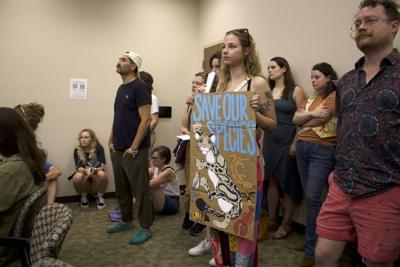

A long line of impassioned Nashvillians formed outside the Howard Office Building downtown on Thursday to voice their support for rigorous data center regulations in Davidson County — as proposals to allow construction of the tech facilities stir controversy at both the local and national levels.
At what ultimately became a six-hour Metro Planning Commission meeting, residents urged the commission members to support Metro Councilmember Rollin Horton’s zoning ordinance seeking to impose restrictions on the location and operations of data centers in Nashville. The commission voted to defer voting on the matter to its June 25 meeting to allow Metro Planning Department staff more time to answer questions posed by commission members and take into consideration public feedback.
With the deferral, the legislation is currently on track to be heard on its second of three readings before the Metro Council on July 7. This would include a public hearing, during which residents can voice their support of or opposition to the zoning measures.
Under Horton’s legislation, data centers larger than 500,000 square feet would be banned. Other data centers would be classified as small, medium and large. Medium and large data centers between 20,000 and 499,000 square feet would be allowed only in industrial zoning districts and prohibited in residential areas and mixed-use districts. Small data centers would be required to be at least 100 feet from residential areas, daycare centers, religious institutions, parks, zoos and other data centers. Medium data centers would have a 500-foot separation requirement, while large data centers would require a half-mile of separation.
Noise limits and regulations on water usage and air pollution emitted from the facilities would also be put in place under Horton’s legislation.
The legislation comes in the wake of a plan to build a data center on the campus of Fisk University as well as a proposal to construct a facility next to the Nashville Zoo — both have led to public outcry.

Stormwater runoff from site could run into already-degrading waterways on Nashville Zoo property
During a public hearing at Thursday’s meeting, citizens expressed environmental and health concerns for the people living in the neighborhoods surrounding the proposed data centers as well as for the zoo animals.
“I’m gravely concerned about the detrimental health impacts of data centers,” Joy Henningsen, a local physician, told the commission. “Specifically, increased carbon emissions, noise pollution, light pollution and electronic waste generation — and these are just the harms that we know about. AI data centers almost certainly pose threats to human health, both mental and physical, that we don’t know about yet and probably won’t for decades.”
Robert Tate, who lives less than a mile from the proposed zoo-area data center, said he worries about raising his young daughter near such a site. He urged the commission to support strict regulations on the facilities.
“I would love for Nashville to be kind of a pioneer of these regulations,” said Tate. “So why don’t we be the first people to solidify that, and other cities, other places can point to Nashville as the right way to do it.”
Residents expressed further concerns about the impact of water usage from data centers, with some citing water and air pollution in Memphis caused by a massive data center owned by Elon Musk's company xAI. Others said they think the distance requirements proposed in the zoning ordinance do not go far enough and pushed for either more stringent regulations or a full ban on the data centers in Davidson County.
Nashville attorney Doug Sloan is representing Atlanta-based tech company DC BLOX, which is proposing the zoo-area data center in South Nashville. He maintained that the facility would reuse environmentally efficient water systems and incorporate noise-mitigation measures.
“DC BLOX supports reasonable regulations for data centers,” Sloan said. “We believe that Metro should establish objective standards addressing these issues such as water usage, noise and light.”
Mateo Vasquez, a Fisk graduate student, wanted the crowd to understand that the proposal at Fisk is not an AI data center, but rather a research facility with supercomputing capabilities for students and faculty — which would have less of an impact on the environment. Still, Vasquez opposed the facility and expressed support for heightened regulations.

Rep. Justin Jones is joined by health experts and community leaders in speaking out against the university’s proposed innovation center
“Even though they do have less impact, it would still have an economic and environmental impact on the students and the neighborhood that is around Fisk University," Vasquez said. "And I think to allow such a facility to be constructed there would be a disservice to that community.”
Jared Harper, a Fisk alumnus, also spoke against the proposal.
“I support investments in students, academic programs and the long-term future of the institution,” Harper said. “Fisk is one of Nashville’s greatest educational treasures. However, supporting Fisk’s future does not mean ignoring the environmental impacts that can accompany a large-scale data center development.”
Not all Fisk alumni feel the same way.
Timothy Hughes, president of Nashville’s NAACP chapter and chair of community engagement for the Fisk University Alumni Association, argued that the center will act as a way for the historically Black university’s students to get ahead as AI becomes more prevalent.
“Too many historically underserved communities continue to face a growing digital divide,” said Hughes. “And Fisk University is working to ensure that its students and neighbors are not left behind. At the same time, Fisk is committed to accountability, transparency and doing no harm. The university fully supports Metro’s efforts to establish appropriate safeguards and oversight for projects of this scale.”
Hughes said Fisk is working to address concerns of the North Nashville neighborhoods located near Fisk’s campus.

Neighbors and alumni are questioning how the university’s proposed data center will impact the community
Once the public finished providing feedback, the commission began its discussion of Horton’s zoning bill. All members appeared to agree that regulations need to be put in place, with some questioning the distance requirements and others noting potential for preemption by the state if the measures are not legally sound.
Commission member Leah Dundon, who serves as Mayor Freddie O’Connell’s appointee, read a statement she said was given to her by the mayor — which notably did not give explicit support for the currently proposed data center regulations. The mayor's statement did, however, express support for a data center moratorium, which the Metro Council advanced earlier this week.
“Mayor O’Connell supports a moratorium on large-scale data centers while guardrails are established,” Dundon said.
“He also asked me to share that he is working closely with the Department of Law and Metro departments to ensure that large-scale data centers don’t harm our local communities. The mayor’s office is looking at what options are available under the law for the mayor and the Metro government to implement to protect our air, water and ratepayers and keep our residents and our neighborhoods from being negatively impacted by these facilities.”
This article was first published by our sister publication, the Nashville Post.



Post a comment as anonymous
Report
Watch this discussion.
(0) comments
Welcome to the discussion.
Log In
Welcome to the discussion.
Keep it clean. Please avoid obscene, vulgar, lewd, racist or otherwise abusive language. Comments featuring hate speech or threatening or violent content will not be tolerated.
PLEASE TURN OFF YOUR CAPS LOCK.
Be truthful. Don't knowingly lie or mislead.
Be proactive. Use the “report” link on any comment that violates our comment policy.
Share with us. We'd love to hear your feedback.