

Police Court—Nathan Shivers, an old acquaintance of the officers, was arrested yesterday for an assault on some women in the lower part of the town. … He was committed to jail for contempt of Court. When he gets out he will be tried for shooting at Rebecca Higgins, and striking sundry other women.
—Daily Nashville Patriot, Sept. 4, 1855
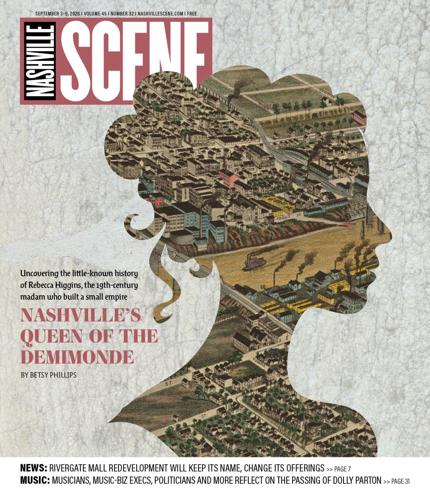
Rebecca Higgins may have at one point been Nashville’s most infamous woman, though you’ve likely never heard of her. She left quite a trail, though no one’s bothered to follow it. She was nearly blown up by a locomotive and nearly killed by Nathan Shivers. She was an integral part of the Union’s Civil War victory. And after the war, she was one of a small group of people who kept the city funded and functioning while the local economy was in the crater.
I’ll give you three guesses as to why you don’t know about a woman who, when she gets shot at, “sundry other women” get shot — and your first two don’t count. For nearly four decades, Rebecca Higgins ran a “house of ill fame.” She was the madam of a brothel here in Nashville.
For a few years during the Civil War, prostitution was legal in Nashville. In a July 2013 article for Smithsonian magazine titled “The Curious Case of Nashville’s Frail Sisterhood,” writer Angela Serratore lays out what historians believe was the situation here, before the Union started licensing sex workers: “According to the 1860 U.S. Census, Nashville was home to 198 white prostitutes and nine referred to as ‘mulatto.’ The city’s red-light district was a two-block area known as ‘Smoky Row,’ where women engaged in the sex trade entertained farmers and merchants in town on business. By 1862, though, the number of ‘public women’ in Nashville had increased to nearly 1,500, and they were always busy.”
Smoky Row was Church Street from the Cumberland River to roughly Fourth Avenue. But there were sex workers all over town. You’ll see those aforementioned numbers — 198 and nine — thrown around a lot for the total of said sex workers. But that just can’t be true. Rebecca Higgins lived in the Second Ward, far from Smoky Row, and in the Second Ward there were 62 self-identified prostitutes and seven washers or chambermaids who were living together. Back in the day, there were certain professions — like chambermaid or washer or laundress or seamstress or dressmaker — in which some women actually held those jobs and only those jobs. But often they were polite euphemisms for sex workers. (Sex workers who also might have had those jobs, to be clear.)
In those days, if you were to see, say, four 20-something women living together, you’re likely looking at sex workers. Not in all cases, I’m sure, but often enough that, if you’re going to try to come up with a number for how many sex workers were working in Nashville in 1860, you’d need to come up with some estimate for the euphemistic professions. And I didn’t even bother to count the number of households where a middle-aged woman and a handful or two of young unrelated women all declined to provide the census with any profession. But come on. Nashville wasn’t filled to the brim with boarding schools for girls. Sex work is how a lot of women in town supported themselves.
I’ve never heard anyone talk about the tremendous economic impact sex work had on Nashville, but if a woman had a job and no male relatives in her household, there’s a good chance she was a sex worker. This is before, during and after the Civil War. And after the war — talk about something we never acknowledge as a city — these women’s economic power kept the city functioning.

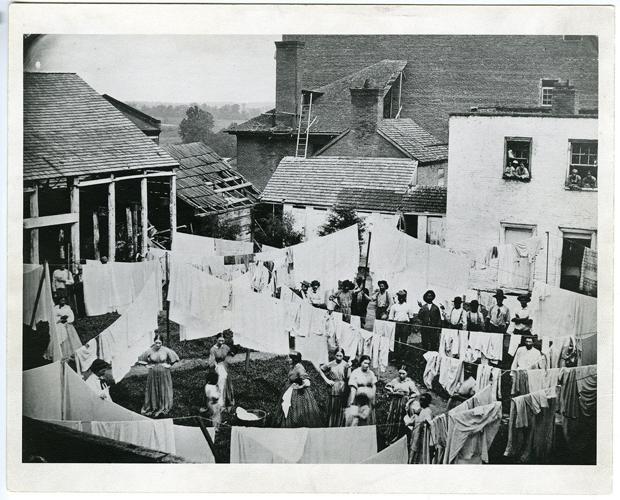
People, possibly sex workers, do laundry at a Civil War-era hospital
On Jan. 9, 1868, the Republican Banner reported on a roundup of the city’s most prominent madams and explained that “the queens of the demi-monde had been thus ignominiously compelled to open their purses for the relief of an insolvent corporation.” In other words, the city was broke and kept itself functioning by fining the city’s wealthiest madams for committing an act that had been legal a short while before. This makes a kind of sense. Who has money in the wake of a war? And in the wake of this particular war, who had U.S. dollars and not Confederate? If the city needs money to pay its bills, it has to get it from the people in town who have money in legal tender — i.e., the sex workers who serviced all the Union troops. And to think, we have all these monuments dedicated to the great heroes who saved the city during the war, and not a single solitary statue for the women who saved the city after the war.
The women named in the 1868 Republican Banner article were Sue Bell, Mattie Frazier, Mattie Barber, Kate Chambers, Mary Hooten, Bell Evans, Mary Coombs, Rose Howard, Rebecca Higgins, Emma Hynes, Mag Seate, Jennie Rodgers, Dora Puckett and Eliza Smith. These were all women who had been around a while. Mag Seate and Mary Coombs had been working for Rebecca Higgins back in 1850.

Isaac Franklin's money had a major influence on modern-day Nashville — despite the blood on it
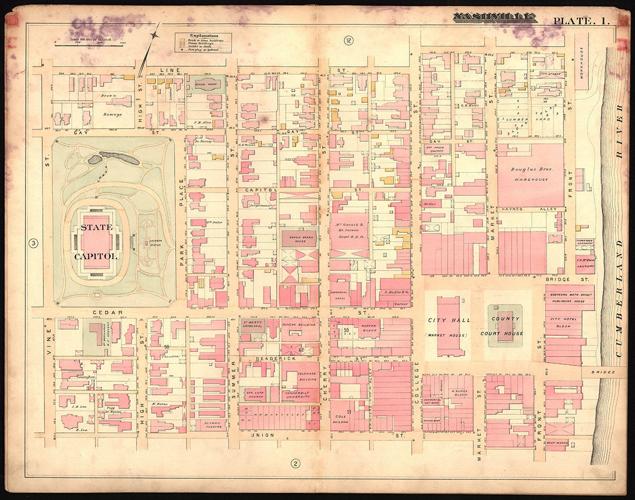
In the 1860 census, Rebecca Higgins is the 41-year-old proprietor of a house of ill fame and has real estate worth $24,000 and personal wealth of $1,500. Living with her are her sister, 36-year-old prostitute Eliza Higgins, and her brother, 28-year-old carpenter Barnard Higgins. She has 15 women living in the house, working for her, and there are eight children. In Nashville in 1860, $25,500 is so much money for a woman to have. Granted, it’s not the level of money that that famed 19th-century Nashvillian Adelicia Acklen, Mistress of Belmont, had. But it is “I do as I please” money. Rebecca had the same wealth as her neighbors who were doctors and merchants and lawyers. And for at least 30 years, she ran a notorious brothel at the corner of Market and Locust, now Jo Johnston and Second — kitty-corner from where the Strobel House is now.
When Rebecca’s brother Barnard Higgins died in 1878, the newspaper now known as The Tennessean reported that “he had no family” and “took an active part in local politics thirty years ago. By trade he was both a painter and a carpenter, was much liked by all who knew him and had few or no enemies.” You’d think that living in a brothel, even one that his sister owned, would be scandalous. Apparently not.
That isn’t to say there was no social shame in consorting with sex workers. On Oct. 1, 1859, The Tennessean reported that Alderman Richard Boone Cheatham said Rebecca wanted the city to prevent the Louisville and Nashville Railroad company and the Edgefield and Kentucky Railroad company from putting up a depot by her house. She believed such a depot would “endanger the safety of her property.” We can tell Cheatham was teased about this, because two weeks later he was back before the Board of Aldermen explaining that he had brought her concerns to them because “she lived in the Ward he represented and had asked him to present it. He should perform a like service for any constituent of his.”
Fair. And even if people teased him, no one held it against him. In 1860, Cheatham was elected mayor of Nashville.

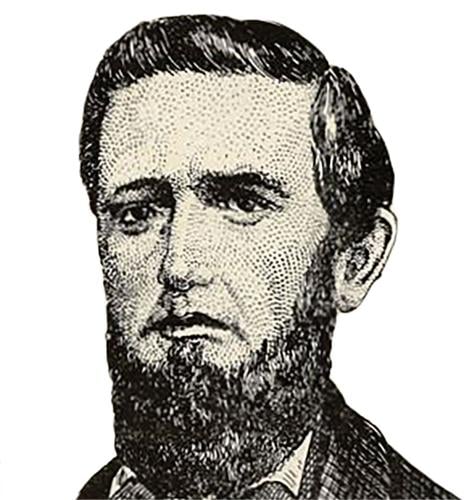
Alderman Richard Cheatham
That same year, a locomotive at the depot blew up and Rebecca’s house was damaged. The Banner reported that, though no one was hurt, “a portion of the roof of the house was torn off and several windows sashes shattered. The side of the boiler to the North was blown out, otherwise if the engine had been reversed, the loss of life and property at Mrs. Higgins’ might have been considerable.” In other words, Rebecca was right about the dangers of the depot.
Rebecca drops from the public record during the war. But the available logs of the “public women” who reported for medical inspection so they could be cleared to work while prostitution was legal in Nashville include women who worked for the Higginses as recorded in the 1860 census: Olive Barber (and possibly, if the woman she came in with is actually Molly Barber rather than Barker, her too), Mary Coombs, possibly Molly Reeves (if she’s the same woman as Mary Rieves) and Eliza Brown. If these women were still working for Rebecca, then the other women listed as living on that same stretch of College Street presumably did too.
The immediate aftermath of the war was brutal for everyone. Rebecca Higgins was robbed in 1867, and a man passed her a counterfeit bill in 1868. She continued to get shaken down by the city every time it needed money. And then, in the spring of 1881, she died.

Map of Nashville (1889)
On March 23, 1881, a notice ran in The Tennessean: “James Higgins, John K. Sloan and wife, Alice Sloan; John F. Lacken and wife, Eliza A. Lacken; William B. Thompson and John Thompson to Eliza Higgins, deed of gift to their interest in the estate of Rebecca Higgins.”
James Higgins was the second-oldest Higgins sibling after Rebecca, and after spending some time in Texas, he had settled out in Cheatham County. Alice Sloan and Eliza Lacken were sisters, Bledsoes from a lesser-known — and less-prone-to-being-killed-by-Native Americans — branch of the Sumner County Bledsoe family. And their mom was Harriett Armstrong. She was Harriett Armstrong in North America, Family Histories, 1500-2000. She was Harriett Armstrong on the death certificate of the aforementioned Eliza Locken, and she was Harriett Armstrong on the death certificate of William Thompson, who — it turns out — was the brother of John and a half-sibling to the sisters.

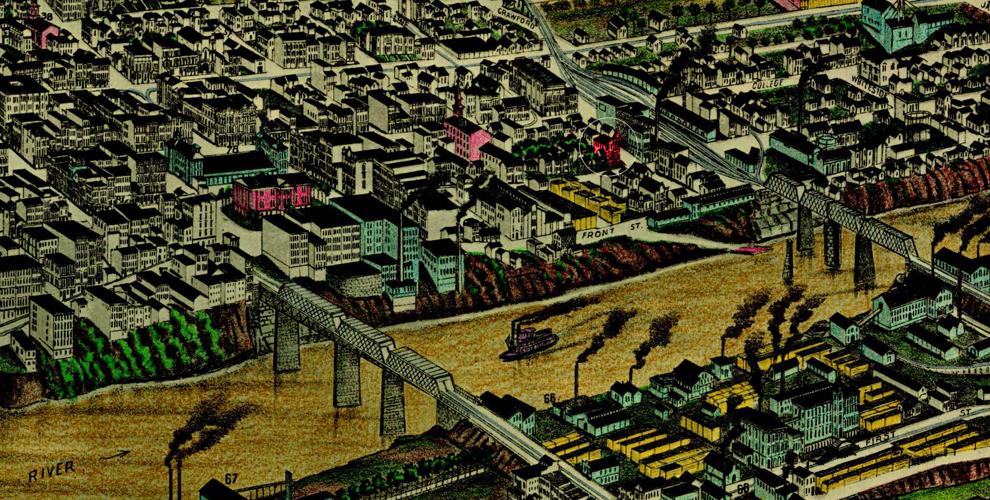
Rebecca Higgins' House (in red)
But let’s not get ahead of ourselves. One mystery at a time. Harriett Armstrong married James Bledsoe in 1836, when she was 14. Her first son, Thomas, was born the next year, followed by William (yes, she had two Williams), James, Lydia, Eliza in 1848, Alice in 1854, and Robert in 1857. After Bledsoe died, she married John Thompson and had the second William and John. Every single record that exists calls her by one of those three last names: Armstrong, Bledsoe or Thompson.
Every record except one.
When Harriett Armstrong and James Bledsoe got married, the Sumner County marriage certificate recorded her name as Harriett Higgins. There is no Armstrong. She was Harriett Higgins when she married Bledsoe, and after Bledsoe died in 1849 she stayed Harriett Bledsoe until she married John Thompson, and she was Harriett Thompson when she died. Armstrong is a name her kids put on paperwork, but it doesn’t ever seem to be a name she used.
It makes a certain kind of sense. Maybe her kids didn’t want to be linked to the Higgins name, considering its notorious link to sex work of the era. But I’m not convinced that Harriett was distancing herself from her sisters. Take another look at the year Bledsoe died: 1849. Now revisit his youngest kids’ birth years. It’s not easy for a dead man to father children, and yet James Bledsoe seems to have done so twice.
When James and Harriett were married, they were traveling constantly between Tennessee and Louisiana. Most of the children born during Bledsoe’s life are listed in various places as having been born in both Louisiana and Tennessee, as if they just put down whichever of the two states struck their fancy at the time. Imagine how easy it would have been for Harriett to show up in either place with another child. There doesn’t need to be any explanation. No one could prove she was pregnant or not pregnant before the baby appeared, because maybe she was away and the baby was born elsewhere. If one of her sex worker sisters needed a way to give a child legitimacy, Harriett could pretty easily make it seem as if the child was hers.
Aside from the timing of their births, there’s one more major indication that at least one of the youngest children was actually the child of Rebecca or Eliza — in the 1860 census, 3-year-old Robert Bledsoe is listed as living in Rebecca’s brothel. If he was Harriett’s child, why wasn’t he living with her? The youngest two girls were.
Robert died when he was 10 of “brain fever.” The interment records at the Nashville City Cemetery show that he was buried on Cherry “on Becky Hegin [sic] Lot.” I found the deed for the lot — a 30-by-16-foot area she paid $24 in full for on April 25, 1855. Bryan Gilley, the current site manager of Nashville City Cemetery, has an old map of interments in the cemetery and Rebecca’s lot is right there — along with the names of everyone buried in it:
Sarah Williams
Barnard Higgins
Harriett Thompson
James Bledsoe and his son James
Lydia Bledsoe
Robert Bledsoe
Rebecca Higgins
Sarah Williams had worked for Rebecca for a long time. She was in the house in 1850 and 1860. She died in 1861 of typhoid fever. Everyone else in Rebecca’s lot is someone we know: brother Barnard, Harriett and her first husband and the two children they lost young, and Robert — who belongs in the family, but how is not clear. But there’s no sign of Eliza.
When their brother, Robert Higgins, died in 1881 down in Alabama, he left his watch and chain to his sister, Eliza McIntire of Nashville. I thought maybe this was a lead on what had become of her. In the Dec. 17, 1871, issue of the Republican Banner, I found that a John McIntire had transferred a “reversionary interest in house and lot in North Nashville, $5 and other considerations” to Eliza. The language made me think that maybe they had history together.
I found a marriage record for a John McIntire in Nashville in 1850. He married Eliza Kinnear. Kinnear is not actually a name anyone had in Nashville in 1850, and there is no trace of Eliza Kinnear before this or Eliza McIntire after this. Was this actually Eliza Higgins under an assumed name? Or did she feed her brother Robert a story about a husband so he would not be scandalized if any children showed up?
The other important thing to note: The only nieces or nephews mentioned in Robert Higgins’ will were Eliza Lacken and Alice Sloan — Harriett’s daughters. The only sister mentioned was Eliza. When you see how property moved around the family or who lived where when, I think it’s obvious that Rebecca and Eliza’s money kept the whole family afloat, and that in return, the family intended for Eliza Lacken and Alice Sloan to have some kind of financial safety net.

Rebecca Higgins' Tombstone
Rebecca died in January 1881. Her brother Robert died in early February. In March 1881, Eliza ran that notice in The Tennessean, which we now know was Rebecca’s family giving Eliza their share of Rebecca’s estate. The Higginses, as we know them, were Rebecca (dead), James, Harriet (dead, but with heirs), Eliza (alive), and Barnard (dead with no heirs). James, Harriett’s kids and Eliza should have split the estate equally in three. But everyone gave their stake back to Eliza.
In November, we see the first indication of why they might have done that. Someone named Dovie Ragsdale is in the County Court at Nashville and putting notices in the paper for all the Higgins relatives she wants to take to court.
I mention which family members Robert named in his will and how Rebecca’s estate appears to have been split before the family gave it all to Eliza, because I deeply suspect that they did not know that this woman, Dovie, who it turns out was their oldest sister, was still alive. Which, fair. Once she landed down in Decherd, Tenn., south of Tullahoma, she seems to have stayed there. And until the railroad went through, that might as well have been the other side of the world. But here she is, now, after all the hard work is done, suing for her quarter of the estate.
The problem — and this dragged on for years, mind you — was that the grand brick house by the train depot had fallen into disrepair, and the court simply couldn’t find a buyer for it. Then, late one night in February 1884, someone burned the house. As The Tennessean reported: “About 12:45 o’clock this morning a fire broke out in the large brick house on North Market street, five doors below the Louisville depot, that until within the past two weeks was occupied by Eliza Higgins as a house of ill fame. The house has for many years been known as ‘Becky Higgins.’ No one was in the house at the time of the breaking out of the fire and the police believe it was the work of an incendiary.”
Knowing how much trouble settling the estate — with this house at the center of it — was, we might suspect that Eliza set fire to the house herself. But if there was an investigation into the fire, the papers didn’t report on it. As far as we know, Eliza was already two weeks gone before the fire started.
And there is no trace of her after this. She buried her sister, settled Rebecca’s estate, and then vanished.
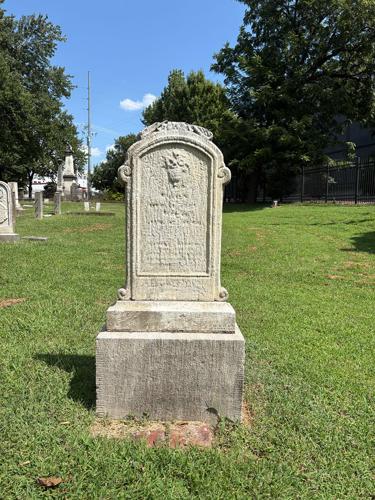
The brick vault in the Nashville City Cemetery, beneath the worn marble headstone that used to say Rebecca Higgins on it, is empty — except for a few bits of the coffin that once held her, along with some small animal bones. We know this because the vault collapsed recently and Bryan Gilley, the site manager, had to get into the grave and restack the bricks.
Rebecca is gone, returned to dirt. The woman who came from nothing, built an empire, and saved the city slipped out of history as easily as she might have slipped out of her dress.




Post a comment as anonymous
Report
Watch this discussion.
(0) comments
Welcome to the discussion.
Log In
Welcome to the discussion.
Keep it clean. Please avoid obscene, vulgar, lewd, racist or otherwise abusive language. Comments featuring hate speech or threatening or violent content will not be tolerated.
PLEASE TURN OFF YOUR CAPS LOCK.
Be truthful. Don't knowingly lie or mislead.
Be proactive. Use the “report” link on any comment that violates our comment policy.
Share with us. We'd love to hear your feedback.