
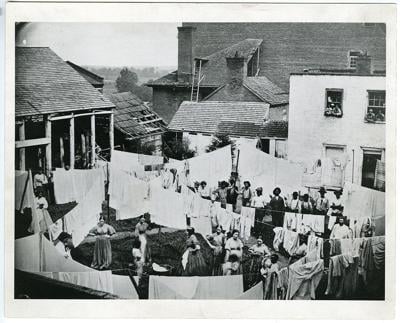

As I was working on my recent cover story about the 19th-century Nashville proprietor of a house of ill fame, Rebecca Higgins, I came across a great image (which you can see above). Many historians think it features sex workers doing laundry in back of a Civil War hospital here in Nashville.
OK, time out. I just realized that, by linking to this picture via the Tennessee State Library and Archives, I risk alerting censorious Secretary of State Tre Hargett and his fellow book black-lister, state librarian and archivist James Ritter, that this cool picture of scandalous women exists at the TSLA. I don’t trust that they’ll necessarily leave it available. And that sucks. Libraries and archives should be a place for learning and discovery, and Hargett and Ritter have made that mission more precarious. I’m hardly surprised that Hargett is pushing for express bachelors' degrees. Heaven forbid someone have time to fortuitously stumble across something they didn’t know that changes how they see things.
So I guess what I’m saying is look now — while you still can.

Uncovering the little-known history of a 19th-century madam who built a small empire
Anyhow, this is a wild picture. There are six white women standing in the foreground; two have their hands on their hips. There are a couple more women hidden in with the lines of laundry that crisscross the yard. The yard is ringed with hatted men standing around. There's one hatless man near to the front. Three Black children are blurs of motion in front of the white women.
I stared for a while, and then I texted my friend — fashion historian Sara Harvey. I’m often looking at historic photos and asking her questions like, “Why do the woman in the photo’s boobs look like that?” because I can count on Sara to know what kinds of undergarments people wore at different times and what it does to their silhouettes.
Looking at this picture, though, I was pretty sure I knew what I was seeing, but I still don’t understand it. These women aren’t wearing underwear. I showed the picture to Sara and she said, “I’m slightly flabbergasted, because they do not appear to be corseted. Their breasts are each clearly and softly defined and are hanging in a very bra-less way. Their skirt waistbands are cinched in, but they don’t look like they have any structure underneath them.”
She asked me if these women were patients at the hospital, and if so, if they might have had their corsets confiscated. She’d not heard of such a thing, but what other explanation could there be? The other explanation historians seem to have come up with is that these are sex workers. The thing is, though, that there isn’t any reason why sex workers in particular wouldn’t wear corsets while doing laundry. Also one of the things that’s so wild about these photos is that photography was still a somewhat new technology. People dressed up to get their pictures taken. And yet the women in this image aren’t put together.
It feels somewhat like a candid, but the men are staged, right? Guys aren’t standing around watching women do laundry like this, right? So the photographer cannot have caught these women by surprise. They knew a photo was being taken.
So where is their underwear?
There’s one explanation I haven’t seen floated by anyone else. We know this is too much laundry for a household, and that it’s likely for a hospital or hospitals. We know these women are broke or they wouldn’t be working. What if there’s something about their present situation, their present conditions, that puts them out of their normal corsets, and they didn’t have the extra money for specialized corsets? What if these women are pregnant?
The picture is interesting in part because we don’t get to see many pictures of poor people from this era — not a lot of pictures of women doing laundry, for sure. But it’s also kind of horrific, if you think about it for too long. Whoever these women are, chances are they would not have wanted to have their pictures taken looking like this. And yet here we are looking at it together.
A thing I admire about sex workers of this era is that, at a time when everything was stacked against them, some of them found a way to find some level of financial security and a way to take care of their families.
But women in this era ended up doing professional sex work because their lives had been completely derailed. One brothel owner I researched had her first child at 13 and her second at 15. She wasn’t married to anyone. I think it’s likely that someone was just messing with her. Considering that her sisters all went to work for her, I have some guesses as to who that might have been.
But think about being a woman who had been messed with as a child and what it might mean to her to be able to dictate who she was going to have sex with and when and what she would get out of it. Think about the appeal of not depending on a man. Imagine the grim satisfaction of being able to give your sisters those same options.
The facts we know about the Higgins family suggests something went very wrong there too. Rebecca’s brother Barnard was born in roughly 1832. This is the last time we can safely assume that the Higgins parents were around. Her sister Dovie was already married with kids, so she was out of the house. Their mom Harriett married in 1836. No sign of problems then. But in 1840, Rebecca’s living in a Nashville residence containing a white boy under 5 (maybe Barnard), a white girl between the ages of 10 and 15, two white girls between 15 and 20 (one of these is probably her sister Eliza), and four white women between 20 and 30 (one of whom is Rebecca). She also enslaves three people — two women between the ages of 36 of 54 and a boy under 5.
This tells us two things — she either had slave-buying money or had inherited the people she enslaved. (And I think it’s unlikely she inherited them, because her siblings were all financially precarious at this time and that wouldn’t be the case if there was enough family money to give one daughter three people). It also tells us this is probably already a brothel. And yet it’s likely she’s got two of her siblings living with her, which suggests no one else in the family was in better shape to take the siblings in.
Pick up a fact of life for these women, find some deep trauma.
These are women who got kicked in the teeth hard by life, and as far as society was concerned, they were supposed to curl up and die. And then they didn’t. The way they went was very hard and didn’t afford them much in terms of dignity. They went on anyway.
There’s a virtue in that kind of pragmatism. Just not one we often recognize.



Post a comment as anonymous
Report
Watch this discussion.
(0) comments
Welcome to the discussion.
Log In
Welcome to the discussion.
Keep it clean. Please avoid obscene, vulgar, lewd, racist or otherwise abusive language. Comments featuring hate speech or threatening or violent content will not be tolerated.
PLEASE TURN OFF YOUR CAPS LOCK.
Be truthful. Don't knowingly lie or mislead.
Be proactive. Use the “report” link on any comment that violates our comment policy.
Share with us. We'd love to hear your feedback.