
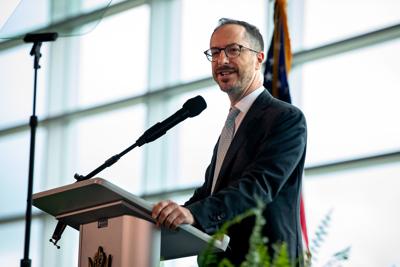

Mayor Freddie O’Connell proposed his annual capital spending plan — which allocates hundreds of millions of dollars each year to city projects — and is putting a focus on schools, public facilities and transportation infrastructure.
O’Connell filed the $544.7 million proposal with the Metro Council last week, following last year’s $532 million capital spending plan.
The largest chunk of the funds would allocate $202 million to public facilities. This includes $75 million to relocate the Metro Southeast campus — an effort that must be completed within the next two years due to construction at the Nashville International Airport, according to the mayor’s office. In June, the mayor referenced the Nashville-zoo area site being eyed for a data center as a potential site for the relocation of the Metro Southeast campus. Metro is currently considering using eminent domain to seize the property purchased by Atlanta-based tech developer DC BLOX.

Mayor O’Connell’s proposal to seize control of South Nashville property for Metro use advances, though condemnation is not final
In addition, the spending plan proposes $35 million to design and construct a new Davidson County Sheriff’s Office jail complex. The mayor is also proposing $17 million in funds to replace 45 heavy fleet vehicles for Metro services related to fire, waste, Nashville Department of Transportation and Multimodal infrastructure, the sheriff’s department and Metro Action commission. The proposal also includes $5 million directed toward repairs to Metro Head Start facilities.
The spending plan allocates $107.4 million toward Metro Nashville Public Schools, including the design and construction of a new elementary school in Antioch, as well as upgrades and renovations to existing Metro schools like a stadium for Martin Luther King Jr. Magnet High School and Hume-Fogg Academic High School.
NDOT would receive $86.3 million for maintenance, repairs and improvements to local roads, bridges, culverts and other transportation infrastructure. This will also include investment in Vision Zero projects, sidewalks and signal upgrades. In addition, WeGo Public Transit would be allocated $12.5 million to purchase Access Ride paratransit vehicle replacement and bus replacements and to match transportation grants from both the state and federal government.
The mayor is proposing that $44 million be directed toward three new fire stations and upgrades to existing stations and $2.7 million toward libraries, including continued work on a new Richland Park Branch Library. Metro Water would be directed $20 million, and the Metro Development and Housing Agency is expected to receive $8 million for infrastructure needs.
Metro Parks would receive an allocation of $14 million, which would include $4.6 million for completion of segments of the Cumberland River and Seven Mile Creek greenways.
The Metro Council will begin consideration of the capital spending plan at its Oct. 5 meeting.
“The capital spending plan isn’t just about investing in projects, it’s a commitment to how we grow as a city in a way that let’s Nashvillians know they are cared for with basic city services and prioritized through key neighborhood investments,” O’Connell says in a statement.
“As Nashville continues to grow, we’re upgrading our infrastructure across the city, so no community is left behind, and every resident has access to safe streets, good schools, and reliable services.”
This article was first published by our sister publication, the Nashville Post.



Post a comment as anonymous
Report
Watch this discussion.
(0) comments
Welcome to the discussion.
Log In
Welcome to the discussion.
Keep it clean. Please avoid obscene, vulgar, lewd, racist or otherwise abusive language. Comments featuring hate speech or threatening or violent content will not be tolerated.
PLEASE TURN OFF YOUR CAPS LOCK.
Be truthful. Don't knowingly lie or mislead.
Be proactive. Use the “report” link on any comment that violates our comment policy.
Share with us. We'd love to hear your feedback.