

Metropolitik is a recurring column featuring the Scene’s analysis of Metro dealings.
The other Nashville looks pretty good. It’s payback for I-440 ramp traffic, revenge on I-24’s 18-wheelers and a karmic antidote to every irresponsible SoBro merge on I-40 East, taunting the city’s hellish highway commutes with a smile. The grand vision — a vast, interconnected greenway path system tightly hewn to the existing interstate ring — is not hard to find. That’s because for decades it has been obvious to urban planners and residents that Nashville will suffer if it fails to evolve from a car-obsessed past.
Ghost greenways currently haunt the patchwork of paved shared-use trails that physically liberate but functionally trap the typical Nashville walker or biker. Completed portions spatter across the map in lonely wiggles, inviting optimistic urbanists while often supplying disparate pieces of frequented routes cut short by major arterial roads. Besides a few stunted segments near Elmington Park and The Fairgrounds Nashville, several miles along the Cumberland River are all that exist of the ringed 23-mile “necklace” envisioned by boosters as the greenway’s primary citywide mover. Like the bus system, greenways aren’t necessarily an efficient means of getting across town. A few contiguous networks in places like Sylvan Park and Donelson have enabled elegant connections between friends’ homes, access to green space and even errands and commutes. Ditching cars for a walkable city rife with green space and dense housing has become a vibrant political force unto itself in recent years, springing from turn-of-the-century New Urbanism. Dusty plans promise such possibilities, though their fading mayoral signatures — from Karl Dean, and Bill Purcell before him — suggest a very reasonable question that would fluster most Metro bureaucrats: Why is this taking so long?
In their shared lofty office space on Main Street, Meg Morgan and J.T. Neal both come back to the same word: “block,” an appropriately vague and discouraging catch-all for so many projects dying on the vine. Both work at the nonprofit Greenways for Nashville, a non-government booster group trying desperately to find this other Nashville.
“You would think the greenway process starts with wanting it, then planning it, getting the money, then building it, and that would certainly be the easiest,” says Neal, a newly hired communications and outreach coordinator. “Blocks to any plans, any greenway or any expansion are truly individual to that one — there is no one way to make a greenway. Part of our existence is dealing with these blocks, because they show up in so many different places for so many different things.”
Along with executive director Morgan and a few others, the small Greenways for Nashville team functions like a mediating party between the city and private stakeholders while publicly promoting citywide greenway use. Neal and Morgan cite the same plans that show how far Nashville has fallen short of its potential.
“Plan to Play is Metro Parks’ master plan,” explains Morgan. “The city did a lot of community outreach last year and is working on an update that should be released in the next few months — we’re excited that it will have updates to priorities and vision for what’s moving forward.”

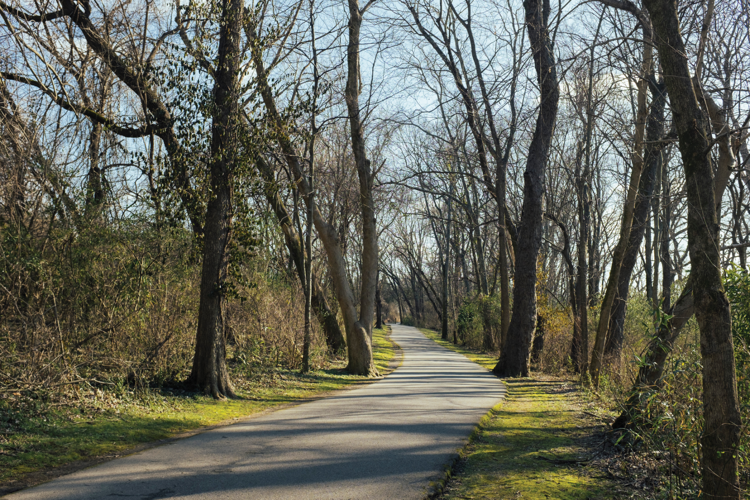
Shelby Bottoms Greenway in 2019
Planning documents see the “Charlotte Corridor Rail-With-Greenway” as central to the planned downtown greenway loop. Railways’ convenient vectors through urban centers are well-positioned for pedestrian reclamation, with no better proof than New York’s High Line — an elevated park and “rail trail” that runs above Manhattan from Midtown to the West Village. Charlotte corridor rail-trail chatter started about a decade ago, envisioning a crucial 4-mile link between Centennial Park and the Nashville Farmers Market via the Cheatham County Rail Line. The narrow vector from 28th Avenue would move people, rather than scrap coal and perlite, through North Nashville. Presentations throughout 2022 and 2023 convincingly made the point. Negotiations with the Cheatham County Rail Authority came with a hefty price tag and suffered with the departure of Metro Parks’ greenways director Cindy Harrison, according to one city source. The discussions remain on ice, and the city has not yet replaced Harrison.
“We are still actively working with the [Cheatham County] Rail Authority to finalize the terms of that agreement,” explained Metro’s Amrita Chatterjee in front of the city’s Greenways and Open Space Commission on April 9.
In a statement to the Scene, Metro Parks’ Jackie Jones further specifies that private property easements, including a contract with the rail authority, have held up progress. Government entities frequently pursue such easements — long-term land use deals with a specific purpose — for public use of private property, sometimes resorting to controversial eminent domain claims. (Metro has not used eminent domain for greenway acquisition.)
Three more greenways reside in similar purgatory between design and procurement, with various holdups — “blocks” — often involving third parties like city consultants or private land owners.
After intensive community engagement, a connection between Sevier Park and Gale Lane Park that primarily relies on city-owned Nashville Electric Service land has gone quiet for several years in what had appeared to be a straightforward design-and-build. Jones says lighting design is underway, and the project will open bidding for contractors later this year. The elusive Richland Park Spur could bring The Nations into the fashionable and functional 4-mile greenway web between McCabe recreation, Sylvan Park restaurants and White Bridge retail. Eight years ago, it was vaunted in multimodal visions; today it’s an overgrown floodplain along Richland Creek between two greenway dead ends — and there’s “no information” to share per Metro. Oracle Corp.’s $175 million incentive deal from the city has yet to produce anything more than glossy renderings of a walk-bike bridge between Germantown and River North. Oracle’s mass layoffs amid an uncertain tech economy could threaten the entire campus inked by then-Mayor John Cooper almost five years ago.
The hundred miles of shared-use trails still might be Nashville’s best urban asset. Though the pieces don’t always fit together, greenways are growing slowly, mostly in places where the city can influence new development — like the Ascend Amphitheater. In 2024, transit-obsessed Mayor Freddie O’Connell won a mandate to pursue a better connected Nashville — a functional greenway system could become Nashville’s truly modern highway.



Post a comment as anonymous
Report
Watch this discussion.
(0) comments
Welcome to the discussion.
Log In
Welcome to the discussion.
Keep it clean. Please avoid obscene, vulgar, lewd, racist or otherwise abusive language. Comments featuring hate speech or threatening or violent content will not be tolerated.
PLEASE TURN OFF YOUR CAPS LOCK.
Be truthful. Don't knowingly lie or mislead.
Be proactive. Use the “report” link on any comment that violates our comment policy.
Share with us. We'd love to hear your feedback.