
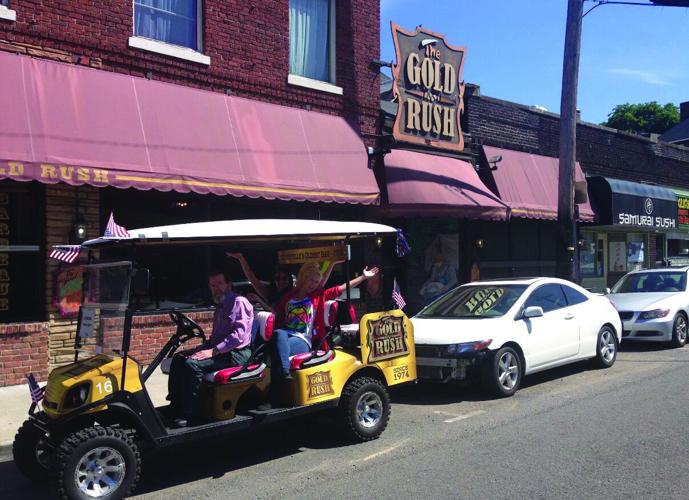


The Gold Rush Cart
Perhaps Scott Moskovitz’s biggest contribution to Nashville was ensuring that the city received the Sunday edition of The New York Times the day it dropped. Before his personal campaign to make that happen in the 1970s, Nashville received the paper on Monday.
Moskovitz, the founder of since-closed newsstand-and-more Mosko’s, says he called the Times’ circulation manager every day for two years. He left hundreds of messages and spent hundreds of dollars in his pursuit. Eventually, a well-connected friend of Moskovitz said he’d ask his “Uncle Punch” about it.
The next week, Moskovitz’s phone rang, and the circulation manager was on the other end. As it turns out, Uncle Punch was The New York Times’ then-publisher, Arthur “Punch” Ochs Sulzberger.
Moskovitz recalls the conversation: “‘Mr. Moskovitz, I am so sorry I haven’t called you back.’ And I went, ‘You haven’t called me back for two years, you son of a bitch! What the fuck is wrong with you?’ Pardon my language. It’s exactly what I said to him. I said, ‘If you were here, I would absolutely strangle you. Why haven’t you called me back?’ Dead, dead silence.”
Mosko’s had the Sunday Times, on Sunday, the following week.
Nashville was an underestimated market, to say the least, when Moskovitz opened his newsstand on Elliston Place in 1977.
“I mean, people didn’t think we wore shoes,” he says.
The Rock Block — which extends roughly from Louise Avenue to just beyond 22nd Avenue North on Elliston Place in Midtown — is a small piece of land that has launched an outsized collection of anecdotes like this.
Mosko’s wares included then-novelties like dirty greeting cards, a cigar humidor, some craft beers and a comprehensive newsstand that included everything from The Advocate to the Harvard Business Review. The Rock Block introduced many new flavors to Nashville, including sushi at Samurai Sushi, the famous “bean roll” (i.e., a massive burrito) at The Gold Rush and Chicago-style pizza at Obie’s, not to mention excellent but more familiar fare like a lineup of sandwiches at Mosko’s (and the burgers at Rotier’s just a few blocks away). In its heyday, beginning in the 1970s, the Rock Block was a place where people found their personal style at vintage stores, got their first drink, did their first drugs and saw that first band that made them a music fan at Exit/In or The End. Those bands bolstered the block too, frequenting the surrounding businesses. As was the Nashville way, they were welcomed, but left alone.
Today the block is a far cry from its glory days. Developer Tony Giarratana has slowly collected many of the properties in the area over the past several years — and at long last, his plans are set to get underway.

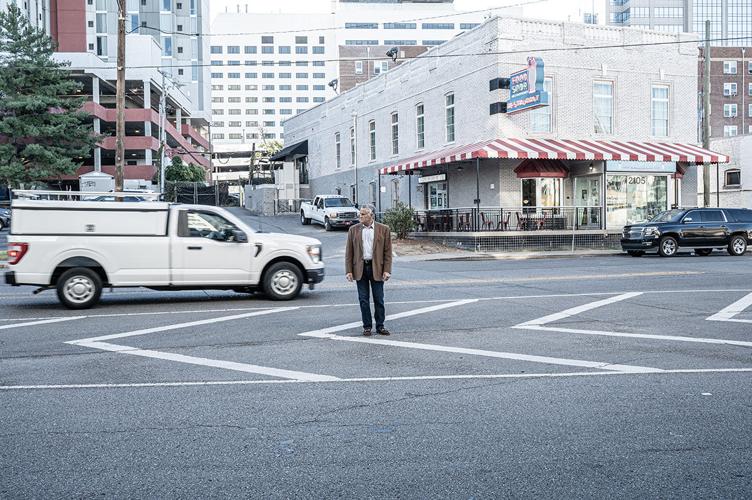
Tony Giarratana standing by Elliston Place Soda Shop
Some say re-creating the Elliston Place Soda Shop is the best thing Giarratana ever did. He bought the soda shop in 2019 on the night it closed, and tells the Scene he spent $6 million remodeling the building next door to house the 1939-founded business. It’s “better than it ever was,” says Giarratana.
Giarrantana, who owns many of the properties on the Rock Block — save for Exit/In, The End and a few others — says the key ingredient the neighborhood needs is people. The businesses will follow. In the past, the block was bolstered by the Louise Douglas Apartments, which have since been replaced by a Holiday Inn.
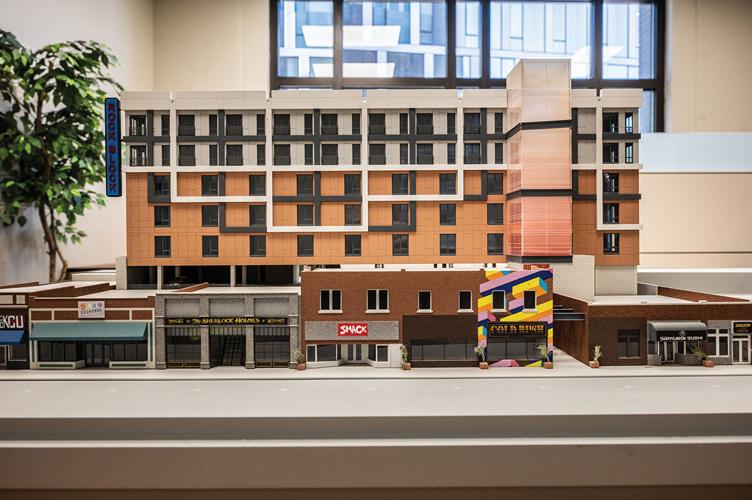
In the first quarter of 2027, his crew will begin work on Rock Block Flats, a project that has been in the works for six years and will yield five stories and 90 total apartments an estimated 18 months later. Rock Block Flats will be located on the south side of the street, behind the facades that previously housed The Gold Rush, Elder’s Bookstore, Buffalo Exchange and others. In 2028, Giarrantana is set to start work on the 17-story mixed-use building 22 Elliston with 356 apartments and retail space. The former Corner Bar and New York Pizza buildings will be demolished.

Developer plans return of old businesses, plus the addition of apartments and a park
In addition, the project includes a park in front of Ducklo Eyecare that will seal off the sidestreet running in front of it, plus a parking garage down 22nd Avenue North. Volley Automation will park cars robotically for Rock Block Flats residents in front of the building.
“You need people living there,” Giarrantana says. “Because they live there, they walk to the restaurants, they walk to the bars, they walk to the entertainment venues. You need people, and the more people you get, the more vibrant the neighborhood is. If there’s no people, it’s pretty bleak.”
It’s pretty bleak now, he admits.
“All of a sudden, it’s not a deserted, scary place,” says Giarratana. “It’s a vibrant neighborhood, like 12South.”

Tony Giarratana's Rock Block Flats model
Chuck Koehler, the owner of former Rock Block staple Anthony’s Jewelers, would often watch the comings and goings at Mosko’s deli counter across the street.
“One day, I look over there and I see Sen. Fred Thompson, who’s sitting next to some young guy that’s got this purple spiked mohawk,” Koehler tells the Scene. “They’re just having this lively conversation. Elliston Place was pretty wild like that.”
Koehler inherited the title “Unofficial Mayor of Elliston Place” from Buford Anthony, who had run the jewelry shop since 1947. Koehler bought the shop in 1993, eventually relocating off the block in 2007.
Two of Koehler’s best stories start with Cadillacs.
Billy Gibbons and Dusty Hill of ZZ Top rolled up in a Cadillac one day, as the brand had sponsored the band’s tour that year. Gibbons came into his store and played Koehler’s guitar.
On another occasion, a couple rolled up to the store in a Cadillac, with the husband climbing out of the car to try to direct the boat of a vehicle into a parallel parking spot. As it turns out, it was Johnny Cash and June Carter Cash on their way to Samurai Sushi.
It was a bit of a fan-boy moment for Koehler. In his previous career in entertainment, he had compiled a video featuring comedic moments from Carter Cash’s career.
“I was like, ‘You used to be really funny,’ and June Carter Cash looks at me and she goes, ‘What do you mean used to be funny?’” Koehler recalls. Each time he saw the Cadillac show up, he’d rush out to fill the meter in exchange for a joke from Carter Cash.
Yunho Choo is the owner of Samurai Sushi, which is still open today, and remembers Johnny Cash requesting Samurai’s food as one of his last meals. He knows famous people come in, but he doesn’t know all their names — save Nicole Kidman and Keith Urban.
Samurai Sushi originally opened in 1989, and Choo says when he took over in 2003, he could count Nashville’s sushi offerings on one hand. His restaurant became popular thanks to a fusion approach that is ubiquitous among sushi offerings today. The Choo Choo Roll, complete with strawberries and pine nuts, and the Hawaiian Roll with fresh mango remain his most popular dishes.
Mosko’s alleged first three customers sum up the prestige of the Rock Block at the time. First was Randy Rayburn, who would later found Sunset Grill, and lived in the Louise Douglas Apartments at the time. Then came Brooks & Dunn’s Kix Brooks, then a struggling artist who also lived in the Louise apartments. Third was Don Schlitz, who would read the magazines for free all day, looking for song ideas. Schlitz, who died in April of this year, later became known for writing “The Gambler,” among other hits.
Moskovitz has a file of dozens of signed photos of celebrities who would stop in. But he never hung any up.
“My philosophy was anybody can come in here, and I don’t want you to be bothered,” he says. “This is a private space. You can come in here.”

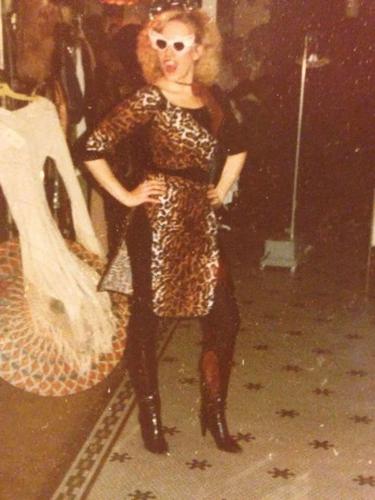
Debbie Michael, owner of Betty Boop’s
At Elliston Place vintage store Betty Boop’s, the costume department for Robert Altman’s legendary 1975 ensemble film Nashville stopped by to purchase pieces for the cast and extras. One of the film’s most memorable scenes, during which Keith Carradine’s character sings the Oscar-winning song “I’m Easy,” was filmed at Exit/In just across the street.
Debbie Michael’s store became a hit with both artists and students. Betty Boop’s opened at a time when vintage stores were a new concept, and when “we were all trying to break the glass ceiling,” she says.
“I did not graduate [from Vanderbilt] because I felt like I could earn more money messing around with antiques,” Michael says. “Back then, you have to understand, there’s two reasons why women went to college. Mainly to find a rich husband or someone that would be rich, and secondly to be a schoolteacher or a nurse.”
As she saw it, Michael and her crew of “Boopettes” were doing something subversive — just like everyone else on the Rock Block.
“To be a Boopette meant that you were part of our group,” she tells the Scene. “Either you worked there or you would wear the vintage clothes. And we’d all kind of hang out together, and we’d all look beautiful and crazy-looking, and we were all beautiful women who were kind of wild.”
Perhaps Michael’s most lasting legacy is the Elliston Place Street Festival, which she started with audio engineer Johnny Rosen in the late ’70s. Boop’s closed in 1980, and Michael moved to Arkansas. But the street festival lived on.
“Elliston Place was really, really coming about,” Michael says. “The Exit/In was booking up-and-coming people that later became incredibly famous. You just never knew who you were going to see down there.”
Marshall Chapman inadvertently broke the glass ceiling at TGI Friday’s — which opened one of its early locations in Nashville in 1971 — as the outpost’s first female bartender.
“I think they did that as kind of a gimmick to attract attention,” she tells the Scene. “But I was a terrible bartender.”
She never mastered the soda gun, so she’d often mix the wrong drink. She didn’t last long in the role.
“I was usually very generous with the alcohol, so they loved me,” she says. “But I put the drink down and I say, ‘I hope this isn’t too strong for you, sir.’ He couldn’t complain after that.”
Chapman and her friends knew the Rock Block as the “Devil’s Triangle,” with TGI Friday’s, Exit/In and The Gold Rush as its three points. The list of legendary artists she saw at Exit/In in the ’70s and ’80s is long: Tom Waits, Linda Ronstadt, Wayne Cochran, Roger Miller, the Nitty Gritty Dirt Band, Bobby “Blue” Bland, B.B. King.
“I can tell you 100 things like that that I saw at the Exit/In,” she says. “I saw some of the most incredible acts when they were still young and hungry.”
Chapman played her own first show at Exit/In, opening for Cowboy Jack Clement, who became an iconoclast of country music. At her show, she looked out into the audience and saw Johnny and June Carter Cash, Ray Stevens, Jerry Smith, Harlan Howard, Jessi Colter and Waylon Jennings.
“The entire audience was of that caliber, and I went there — little Miss Vanderbilt just graduated, just started writing songs — and I just thought I’d died and gone to heaven,” she tells the Scene.
By the time Erin Plew Lyles got a job at The Gold Rush in 2007, female bartenders were the norm. She started working there under the belief that if you work at a bar you like, it won’t feel like work. It’s still her favorite job.
“It was always a place that I knew I could go, where there were people who were into film and music,” Lyles says. “A bar [where] you can just go by yourself and all your friends are there.”
She was able to play her favorite indie-rock acts over the bar’s speakers, like Magnetic Fields and Spoon. An area of The Gold Rush referred to as The Blue Bar was reserved for classic rock like Pink Floyd and the Grateful Dead. The Gold Rush was another establishment where famous musicians could come to be left alone.
It also prepared her for her work today as a therapist.
“Being a bartender, there is a lot of listening to people and what they’re going through,” she says. “I think I really did discover, ‘Oh I’m pretty good at this. I’m pretty good at listening and talking to people that are going through really tough stuff.’”

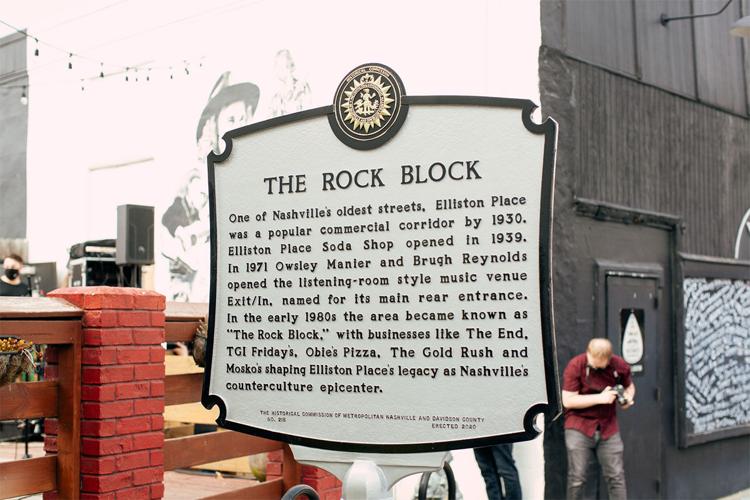
Historic Marker outside Exit/In
Part of what earned Chuck Koehler of Anthony’s Jewelers his Unofficial Mayor of Elliston Place title: He started the Elliston Place Merchants Association. Each member of the association sponsored a street light, paying Nashville Electric Service monthly to become the best-lit entertainment district in town. The bars also allowed people to order outside food from fellow Elliston Place restaurants. You could eat a Gold Rush bean roll at The Corner Bar, for example, or Obie’s Pizza at The Gold Rush.
“I would always try to preach, so to speak, that we’re not competing with each other,” Koehler says. “We’re competing with Hillsboro Village. We’re competing with 12South. Our goal was to always cross-promote everything, because once you get somebody to park their car and come into an establishment on Elliston Place, you want them to stay.”
Over the past half-century, there’s been so much transience on Elliston Place that it’s difficult to name all the businesses that have come and gone. There was Elder’s Book Store, Rock Block Guitars, music store Safe Psyches, Sherlock Holmes Pub, hair salon Scissor Cuts, Audio Systems, Sundance Leather, and vintage stores Smack and Dangerous Threads.

The listening room’s happening scene laid the groundwork for a culture that still exists today
It was hard for Chris Cobb to narrow the Rock Block’s legacy down to the 480 characters that were placed on a historical marker in 2020. The marker was unveiled in preparation for the 50th anniversary of Exit/In, which Cobb co-owned at the time. The club was purchased by developers AJ Capital in 2022, though it has maintained operation as a music venue since.
“I think the driving factor of the marker was that there’s a really important musical history that would not exist had it not been for the Rock Block specifically,” says Cobb.
The marker focuses on the 1970s and ’80s, describing the neighborhood as the “counterculture epicenter.”
“During that time, at that moment, Nashville had a very real, very authentic music-driven culture that was part of the foundation of what has now become a global brand in Music City.”
Annie Choo — translating for her father, Yunho Choo of Samurai Sushi — tells the Scene, “The charm of Elliston Place is like what he hopes one day might come back. But he loves Elliston Place and he wants to continue doing sushi over there.”
The business moved over one building to the former Obie’s Pizza space when The Gold Rush closed in 2019. Yunho was told years ago that he could potentially occupy his old site after Rock Block Flats was built.
“Basically everything around him just starts to close, and obviously when everything closes, the whole dynamic of the street changes,” Annie says. “The personality of the street kind of all went away. It negatively affected his business.”
Yunho will believe pending changes when he sees them.
“I know people are frustrated, and some people are downright angry that we haven’t developed the property,” Giarratana says. “It isn’t because we’re ignoring it. It’s because of the market. The Rock Block Flats is $31.5 million. It’s not like, ‘Let me pull some cash out of my pocket and do this project.’”
Yunho’s lease will last for at least four more years, and he’s proud of what he created there.
“What makes him fulfilled and happy is when all these Vanderbilt students used to be regulars at Samurai, and now they’re like in their 40s, or when they get married and they have kids,” Annie says on her father’s behalf. “They come back to the restaurant, even though it’s been over 20 years.”
Annie, who owns vegan restaurant AVO, married the man whose father sold the restaurant to Yunho in 2003. They named their son Elliston.
Five-year-old Elliston is part of why the family is holding onto the location. Both Annie and her husband have memories of hanging out on that street; her husband would play pool at The Gold Rush as a child.
“When Elliston was born, I walked the street and I took a picture of every sign that said Elliston on it,” Annie says. “And I hope to show him that one day. Some of the signs are gone now. I’m glad I took photos, because it’s changed so much.”




Post a comment as anonymous
Report
Watch this discussion.
(0) comments
Welcome to the discussion.
Log In
Welcome to the discussion.
Keep it clean. Please avoid obscene, vulgar, lewd, racist or otherwise abusive language. Comments featuring hate speech or threatening or violent content will not be tolerated.
PLEASE TURN OFF YOUR CAPS LOCK.
Be truthful. Don't knowingly lie or mislead.
Be proactive. Use the “report” link on any comment that violates our comment policy.
Share with us. We'd love to hear your feedback.