

As each name is read, discussion pauses briefly at the Howard Office Building downtown, the centerpiece of Davidson County’s administrative nerve center nestled on Rutledge Hill.
There are more Vision Zero Advisory Committee members sitting at the dais than there are people in the audience — excluding a Metro cameraman, who is filming but does not actually plan to post tonight’s entire proceedings online. For three months, Chair Charlie Weingartner has recorded the meetings with his own tripod setup, bringing each deliberation to a dedicated Vision Zero Nashville YouTube channel and its handful of subscribers.
Six people — Martin Villagomez Jr., Jason Bungarz-Kinney, Madeline Mitchell, an unnamed driver on East Trinity Lane and two pedestrians — died between the group’s last meeting on July 14 and the day of this meeting, Aug. 11. Among those was the death of an Australian tourist in a high-profile incident on Lower Broadway that also injured three other pedestrians and has renewed calls to close the bustling party street to vehicles. The 87-year-old driver, who ran a red light around lunchtime on Saturday, Aug. 1, was among those taken to the hospital with critical injuries.

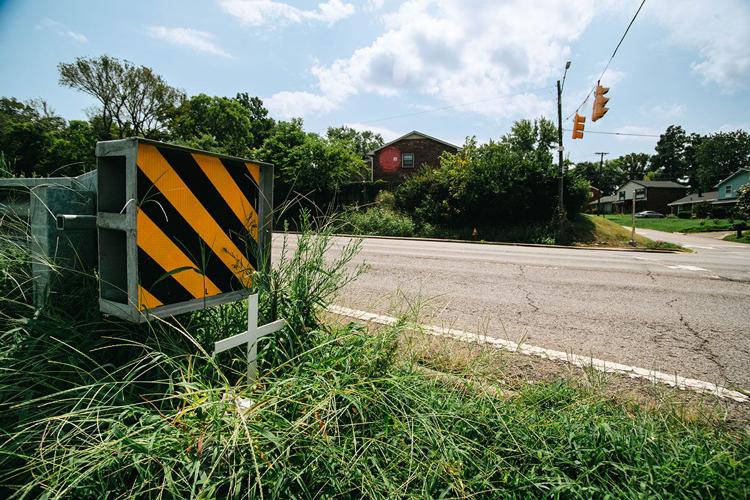
A memorial at the intersection of Harding Place and Tampa Drive
Part vigil, part analysis, part advocacy, the 14-person committee was tasked more than three years ago to “coordinate with Metro staff” on the shared goal of eliminating roadway deaths by 2050. Monthly meetings and work sessions are a chance for passionate citizens to get involved in civic life, but as many in the transit community admit privately, the body has little real power and sits low in the Metro pecking order. Other groups like the Advisory Committee on Transportation (ACT), which helps influence projects under the city’s Choose How You Move transit umbrella, and the catchall Bike and Pedestrian Access Committee (BPAC), relaunched in part by then-Councilmember Freddie O’Connell months before his mayoral win, get more attention. Advocates speak with awe about the nine-member Traffic and Parking Commission, which can actually change speed limits.
Since then-Mayor John Cooper signed on to the five-year Vision Zero plan in February 2022 — also at the urging of then-Councilmember O’Connell, who on the mayoral campaign trail often cited his formative years navigating Nashville without a car — the city has trended in the wrong direction. According to data gathered by Weingartner, in 2017, Nashville suffered 73 roadway deaths; then 80 in 2018, 105 in 2019, and eventually, 136 in 2023, the deadliest year of the past decade. So far this year, three times as many people have died by cars in Davidson County as by gunshot wounds.
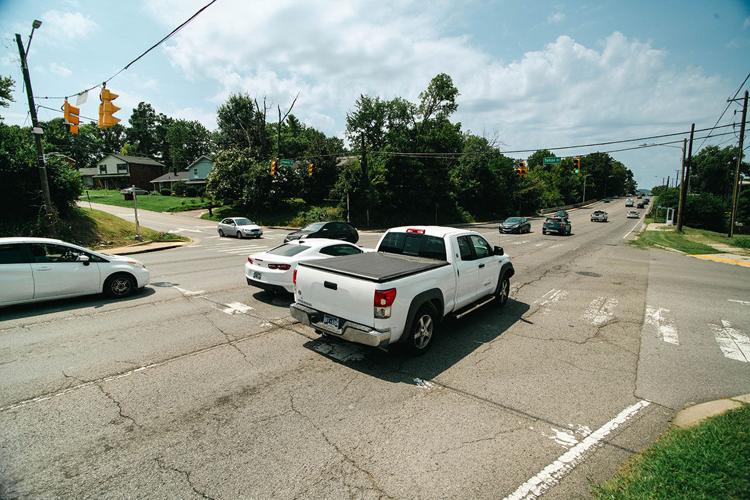
Increasingly deadly roadways have plagued many American cities in recent years. Cars have gotten bigger. More people are walking and biking. Residents living outside, and frequently navigating the city outside, have also grown in number and are overrepresented in pedestrian and cyclist fatalities. Any local driver needs only to look around at a red light to grasp how frequently people operate vehicles and their phones at the same time. Other factors weigh more particularly on Nashville, such as its car-friendly street grid, designed around major multilane pikes like Nolensville, Murfreesboro, Charlotte and Gallatin, most of which move drivers between their namesake suburbs and downtown. These “stroads,” along with the ringed connectors that link them — Old Hickory Boulevard, Trinity Lane, Haywood Lane, Harding Place — make up much of what’s known as Nashville’s high-injury network, where historic data clearly lays out the city’s predicted and predictable high-speed tragedies.
“ Every morning I wake up and check the news to see if someone has died,” Weingartner tells the Scene days after the Vision Zero meeting. “ There’s levels to this: There’s people that are killed, there’s people that are hit and injured, and there’s lots of other collisions that happen daily that nobody will ever know about.”

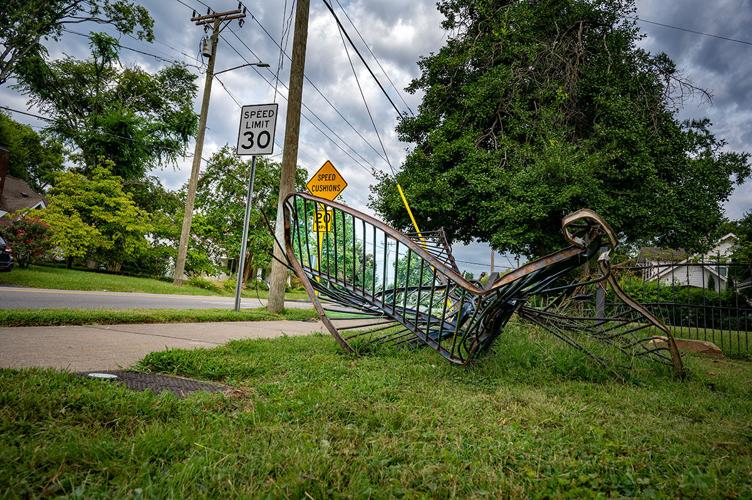
Gnarled fence on Greenfield Avenue
Weingartner — who privately runs his own interactive dashboard, “Nashville Fatal Crash Map” — considers his volunteer work sitting through Vision Zero meetings among a larger effort to reengineer streets to slow cars and accommodate more walkers, bikers and buses. Many physical streets have changed dramatically since Mayor Freddie O’Connell — “an ally, but maybe not as much as everyone had hoped when he took office,” according to Weingartner — took office in 2023. He has clearly reoriented the mayor’s office around transit, starting with the overwhelming 2024 Choose How You Move referendum victory that secured dedicated transit funding off a 0.5 percent sales tax bump. New bus stops, bike lane bollards and sidewalks adorn most crosstown routes while CHYM and the Nashville Department of Transportation and Multimodal Infrastructure line up a yearslong project queue.
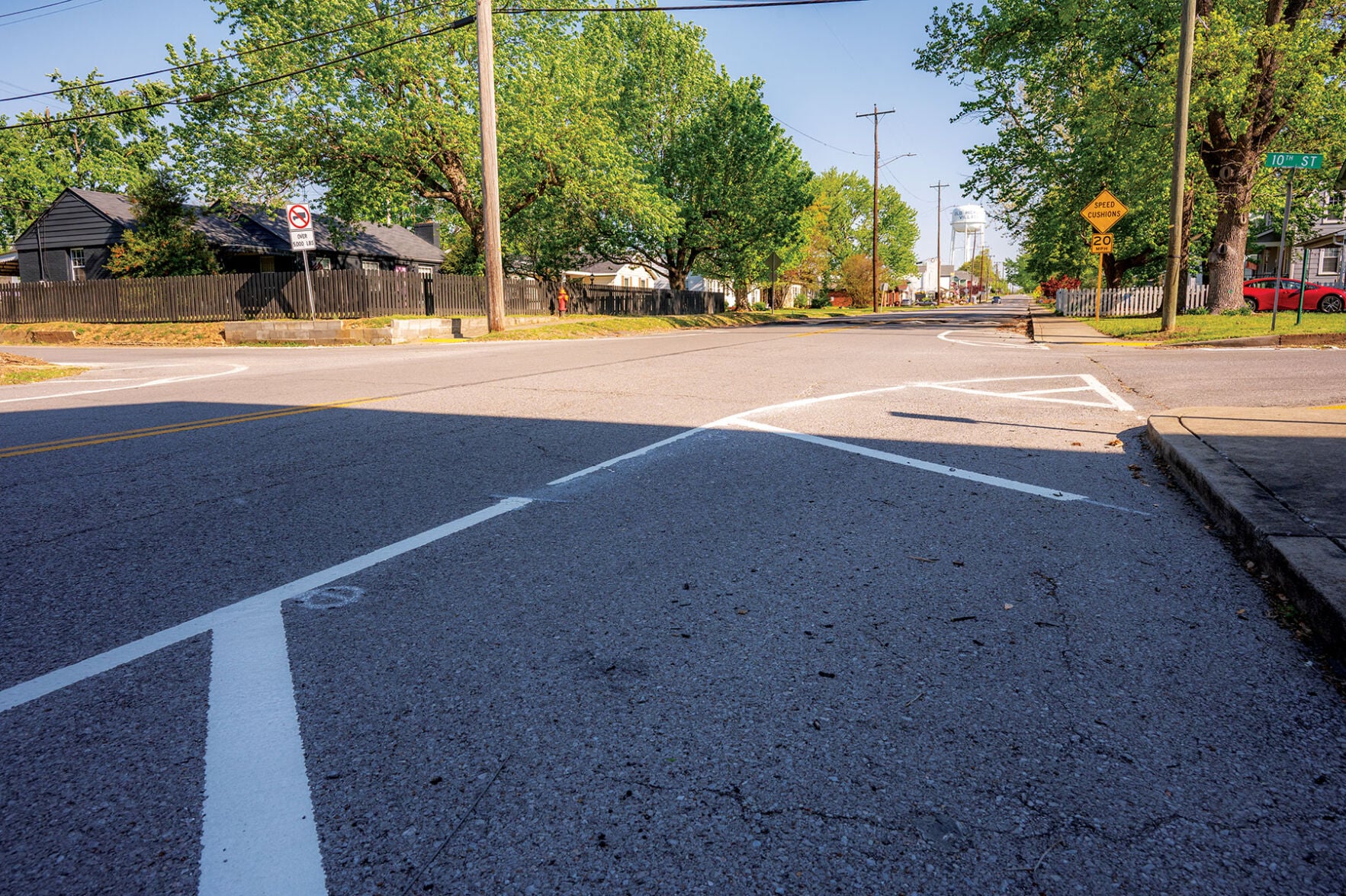
Old Hickory homeowners wanted traffic calming measures. It worked. Then they petitioned to have them removed.
“ I think that we are undergoing a transformation, and yes, that transformation is happening while some of the city throws a tantrum, but we have to do this work,” Weingartner continues. “This transformation is our only option for sustained success as a city. Not just as a tourist destination but for the longevity and vitality of Nashville. It has to happen.”
On Aug. 11, as the Vision Zero Advisory Committee combs through slide decks and data with NDOT planner Valeria Martinez and Metro Nashville Police Department Traffic Division Capt. James Williams, committee member Kim Unertl makes a point to break up talk about intersection size and vehicle speeds with the full names of each data point that represents another fatality. Outside, the parking lot is mostly empty, besides two charging electric vehicles. The bike racks are full. The meeting lets out in time for Unertl and her colleagues to beat the sunset.
“ Somebody in the bike community said there were all these boards in Nashville that dealt with bikes and pedestrians, so I threw my name in and sort of forgot about the whole thing,” Unertl, a biomedical engineer at Vanderbilt University Medical Center, remembers. “And then Dot Dobbins got killed over on Third Avenue. I was so angry.”
Unertl gestures toward Morgan Park, blocks from the Germantown home she bought more than 20 years ago — she liked the sleepy neighborhood’s wide brick sidewalks and convenient location.
“ I’d gone through that intersection hundreds of times, and I had stopped using it because it felt so dangerous to me,” says Unertl, whose household recently gave up its only car. “Anybody who had ever gone through that crossing knew it was a dangerous crossing. You had traffic coming, they weren’t looking, they weren’t slowing down, and it just felt like a situation where something was gonna happen. That motivated me to get a little bit more involved.”
Unertl often commutes by bike with her teenager, letting him continue to school while she heads to campus. Constrained and homebound as COVID-19 threatened public gatherings, Unertl looked to cycling to get outside and meet people. She liked the new perspective on Nashville but navigated daily physical danger and outright hostility from drivers. Both pushed her to advocacy and, eventually, Vision Zero.

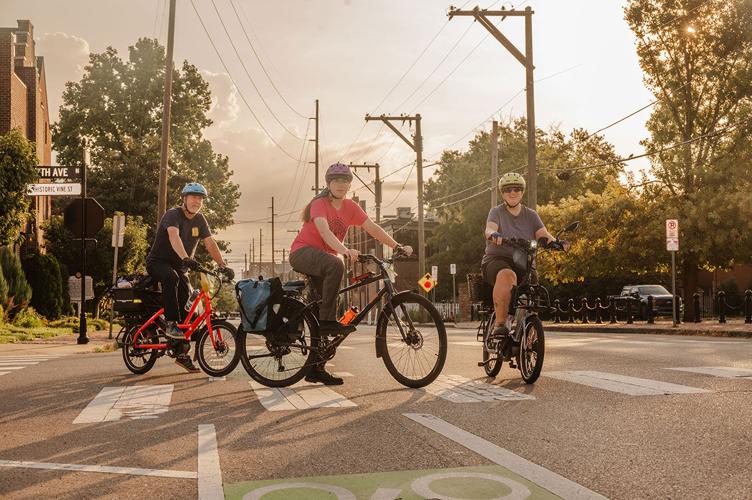
Kim Unertl (right) and family biking in Germantown
Country singer Conner Smith fatally struck Dorothy “Dot” Dobbins, a family attorney, on June 8, 2025, with his Chevy Silverado in a marked crosswalk across Third Avenue North. The crossing linked Morgan Park to the Germantown greenway. Like the names of many other people — including 31-year-old cyclist Blaise Schaeffer, killed by a speeding driver in a hit-and-run, or 62-year-old Carlos Lyons, killed by a speeding Ford Raptor that careened onto the sidewalk — Dot’s name has accumulated meaning among transit safety specialists. Each death communicates its own lethal combination of factors that were not addressed in time.
These cases’ key details — broad daylight, specified pedestrian zone, walkable urban area, high-hooded pickup truck that weighs more than 2 tons — drew attention to drivers’ deadly power and responsibility. When the Davidson County District Attorney’s office charged Smith with a misdemeanor, brief public outcry reflected an appetite for a harsher penalty. (In February, all charges were dropped at the request of Dobbins’ family.)
State law directly prescribes punishments for vehicular crimes in more detail than in almost any other area of public conduct. Assistant District Attorney Matthew Gilbert tells the Scene his options exist entirely within Title 55 of the Tennessee Code Annotated.
“In Title 55, there’s a crime called ‘failure-to-yield,’ and it’s got all these different subsections, and what it basically means is you didn’t drive as safe as you could,” Gilbert explains to the Scene from his office. “ The law books go on and define that in countless different ways, but it’s just unsafe driving. If you have unsafe driving that resulted in a serious bodily injury or a fatality, then that should be prosecuted, but it needs to be limited to a misdemeanor according to the state legislature.”
Gilbert explains a “three-part continuum” that starts at simple unsafe driving, like running a red light. It jumps up to a class-A misdemeanor if that action injures or kills someone. The third level increases penalties from a simple failure-to-yield into a felony, the highest category, which includes reckless driving and vehicular homicide by intoxication. (The latter carries a required penitentiary sentence.)

Fifty-eight-year-old Billy Ray Swaner was walking along the sidewalk near the intersection of East Trinity Lane and Gallatin Pike on May 4 whe…
Punishments focus on drivers. Drunk, high or otherwise intoxicated? Speeding or distracted? Driving recklessly, with “willful or wanton disregard” for their surroundings? These questions determine legal recourse, as does the driver’s impact on the victim. Legally, there is no difference between a victim suffering that harm in a crosswalk, on a bicycle or behind the wheel of a Cybertruck.
“The DA’s office is oftentimes a challenging place to get data about the macro level of road safety, because we just get the ones that are actually prosecutable — but I will say two things,” says Gilbert, who sees many versions of the same situations. “One: People continue to choose to drive when they’re not sober. Two: reckless driving — people not appreciating the severity of their actions. And I bet you that every person I’m prosecuting for one of these didn’t believe that something bad would happen to them.”
Dobbins’ case was rare in that the driver faced any charge at all. Many simply hit, run and avoid any consequences, based on the Scene’s review of every completed investigation into a pedestrian death from June 2025 to mid-July of this year, which excludes about 15 cases still open. Prosecutions rely first on police investigations carried out by the Traffic Division under Williams, the same officer who delivered the MNPD update to the Vision Zero Advisory Committee earlier this month.

Intersection of Harding Place and Tampa Drive
“ We are seeing an increase in drug impairment with everybody involved in fatal crashes,” Williams told that group. “ It’s a big change just over the time in my career. It used to be a drunk driver — alcohol, that’s it. We are really seeing what we consider poly-drug impairment — alcohol and something else.”
Cocaine, meth, fentanyl, alcohol, marijuana — Williams drove home the point that roadway deaths often include intoxicated drivers. This year, of drivers at fault in fatal crashes, nine tested positive for drugs alone, two tested positive for just alcohol, and seven tested positive for both. Hit-and-run prevalence makes data collection difficult for roadway deaths, which is another complicating factor for Gilbert’s prosecution cases, but many drivers involved in such serious incidents arrive with a long list of documented irresponsible driving.
Over several weeks — sometimes months — pedestrian deaths become reports roughly 15 to 20 pages long compiled by investigators within the MNPD Traffic Division. Both Williams and Gilbert praise the extensive expertise within the department, which includes two investigators trained by the Wisconsin-based Accreditation Commission for Traffic Accident Reconstruction (ACTAR). They convey initial analysis to Gilbert, often including no charge if police find that the pedestrian entered the roadway. For other cases, the charge to drivers in fatal crashes is simply one line: failure to yield the right-of-way.
Official documentation re-creates accidents with two-dimensional diagrams and red shapes labeled “blood.” Sometimes these remains are sampled off the ground and tested for alcohol — another page in the report. Of the MNPD paperwork reviewed by the Scene, many reports show people hit near or in crosswalks, like Dobbins, as well as near bus stops. Crashes happen any time, but frequently at night. People are dragged and run over. Many drivers keep driving.
Most (but not all) of the cars involved are big. Another Chevy Silverado killed Dean Levinsohn in a crosswalk on Bell Road in October, and a Lexus LX 570 killed James Galloway in July 2025. According to the investigation report, the vehicle’s collision with Galloway did not even register on internal metrics.
“This is common with crashes involving pedestrians due to the lack of delta V (change in velocity),” the report reads.
Vision Zero members had lodged complaints about the short police press release on the April 18 hit-and-run death of 66-year-old cyclist Hershel Trotter, who was hit from behind at 1:30 a.m.
“The bicyclist was not wearing any protective gear,” the release reads. It’s a statement of fact, but it suggests that Trotter’s gear choices might have protected him from the lethal force of a Nissan Altima. After a long presentation spanning investigators’ methods, state laws, DUIs and data sharing at the Aug. 11 meeting, Williams turned back to the disputed press release.
“ When it comes to pedestrians and bicyclists, as investigators, we don’t treat them as less than, because they’re not,” Williams told the committee. “ They’re all people, all victims, and it’s the families that we’re talking to every day after this. There’s none of that intention for us to say that they were doing something wrong.”
Something still did not sit quite right.
“ The implication that we’re somehow not treating these people the same way as everybody — as drivers — it hurts,” Williams continued. “We go out there and do our job to the best of our ability.”
Trotter’s case is still open, according to Metro police. A new bus stop at the intersection where he was killed gives transit users a small refuge from Harding Place, a five-lane road on Nashville’s high-injury network.
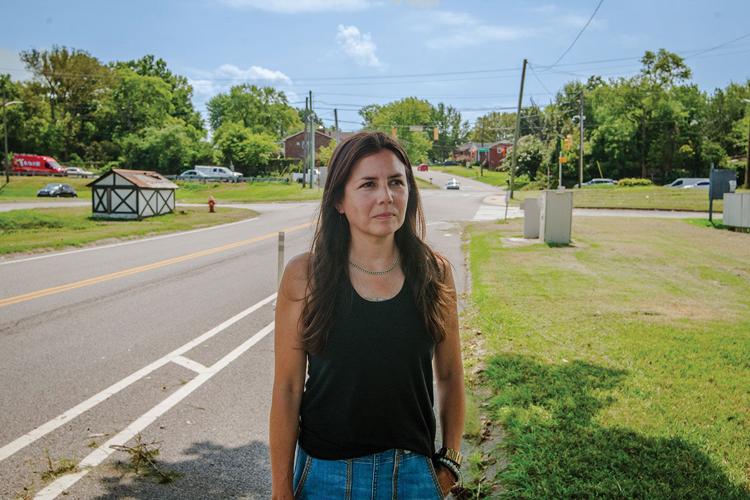
“ The speeds, sounds and volume of car traffic just feel like a hostile environment,” says Meredith Montgomery, a few feet from Harding Place. “It feels like a highway. Yes, there are some crosswalks here, but they’re faded — no medians or refuges for people that are trying to cross the street. The way that the road is designed, it’s telling you as a driver to go fast.”

Meredith Montgomery, executive director at Walk Bike Nashville
Montgomery is the executive director at Walk Bike Nashville, an advocacy organization aiming for a “more walkable, bikeable and livable Nashville.” The nonprofit released its annual “State of Our Streets” report this month. The group’s analysis emphasizes safety and connectivity and makes recommendations both broad and specific. Its conclusions praise ongoing progress to remake Nashville roads while lightly agitating for faster, more comprehensive change.
Retreating to Tampa Drive, Montgomery shelters herself under a tree in a new pedestrian path. Working with the school district and community members, Walk Bike Nashville helped advance this infrastructure project in recent years to connect nearby apartment complexes with Paragon Mills Elementary School. Along with the data, maps and analytics, Montgomery says the city is undergoing a culture shift away from cars as more people choose to walk, bike and take the bus.
“ I think one of our goals is to cultivate a culture of care for victims of traffic violence — it’s really sad to say that I think a lot of people are desensitized to these statistics that we keep seeing,” Montgomery continues. “ We essentially inherited this giant problem that’s been built for 100 years. It’s really important that we acknowledge the vastness of what we have all inherited from previous generations and that, basically, we’re redoing a city.”
Above the committees and nonprofits, planners and engineers are tackling the problem with the same analysis. The stand-alone Nashville Department of Transportation and Multimodal Infrastructure spun out of the city’s Public Works Department under former Mayor John Cooper. While Vision Zero and hundreds of pages of guiding city documents call for a pedestrian- and bike-friendly Nashville, actually doing the work requires legal, political and engineering labor to align for hundreds of projects across Davidson County. Incoming NDOT chief Ryan Lynch will take over the department in September.
Derek Hagerty has led the city’s hardscape work in the meantime. He briefly traces the city’s growth by transportation. After the city abandoned its streetcar service, the rise of the personal automobile and suburbs created a county divided, in Hagerty’s historical view, by the I-440 loop.
“How do you retrofit a city designed for cars — that is the challenge that we’re facing today, and there’s a couple pieces of that,” Hagerty tells the Scene in August. “Nashville’s 500-plus square miles — so we have a lot of ground to cover to get back to where we wanna be right now. That’s just gonna take time, and it’s gonna take money.
“But passing the transit referendum by a 2-to-1 margin,” he continues, referencing Choose How You Move’s successful 2024 passage, “shows that there’s the appetite.”
Each project progresses through multiple phases that start with a two-page charter document with planning goals, stakeholders and related projects. Then it gets planned in two dimensions, then released for community engagement, then designed in three-dimensional space. Utility and right-of-way acquisitions can reveal legal hurdles or expensive easements. Final plans go out to bid to contractors, they are awarded, then they are constructed. Simple changes like a stoplight can take nine months, Hagerty says, sometimes due to huge waits for materials.
State of good repair — keeping and maintaining roadways — still takes up a big chunk of NDOT’s resources. Traffic calming for neighborhoods is application-based. The city’s WalknBike plan from 2022 guides bike lanes and sidewalks — which are better described as stormwater projects, because they more demand redesigning runoff and drainage paths than pouring concrete.
Regular meetings with the Tennessee Department of Transportation (TDOT) allow Nashville to work on the big pikes and arterial roads, many of which are state routes. These multilane connectors are among the city’s most dangerous crash sites. Every roadway death gets directly reported to NDOT’s top executive.
“Any fatality that takes place is a failure,” Hagerty says. “With that being said, we recognize a lot of that is the history that’s taken place. We’re focused on what we can do to fix things.”
For now, the answer is: a lot. Nashvillians should get used to seeing their roads change, especially as CHYM money continues to flow from sales taxes.
Longtime drivers may feel squeezed sharing the road with the occasional cyclist, or inconvenienced by adopted technology to service pedestrians at sidewalks. Still, some feel the city is not going far enough fast enough. Last year, frustrated Nashvillians began placing handmade benches across the city as a practical and political statement about Nashville’s lacking street-level accommodations. (The yearlong bench-building campaign was recently featured in The New York Times.) The East Bank has emerged as the city’s next best opportunity to get things right the first time, and has not yet settled on designs for its central boulevard — an infrastructure battleground eyed by advocates as an essential avenue for pedestrians and cyclists. The Nolensville all-access corridor and an overhaul of Gallatin Pike and Main Street will be comprehensive, centrally located evidence of Nashville’s transformation over the next year amid intensifying public debate surrounding roadway safety. Nashvillians can also expect more tragic headlines — statistically, the year will likely see many more roadway fatalities.
As the city changes, the roads change, and friction between walkers, bikers and drivers will continue to represent a Nashville desperately trying to build itself into the future.




Post a comment as anonymous
Report
Watch this discussion.
(0) comments
Welcome to the discussion.
Log In
Welcome to the discussion.
Keep it clean. Please avoid obscene, vulgar, lewd, racist or otherwise abusive language. Comments featuring hate speech or threatening or violent content will not be tolerated.
PLEASE TURN OFF YOUR CAPS LOCK.
Be truthful. Don't knowingly lie or mislead.
Be proactive. Use the “report” link on any comment that violates our comment policy.
Share with us. We'd love to hear your feedback.