

Street View is a monthly column taking a close look at development-related issues affecting different neighborhoods throughout the city.
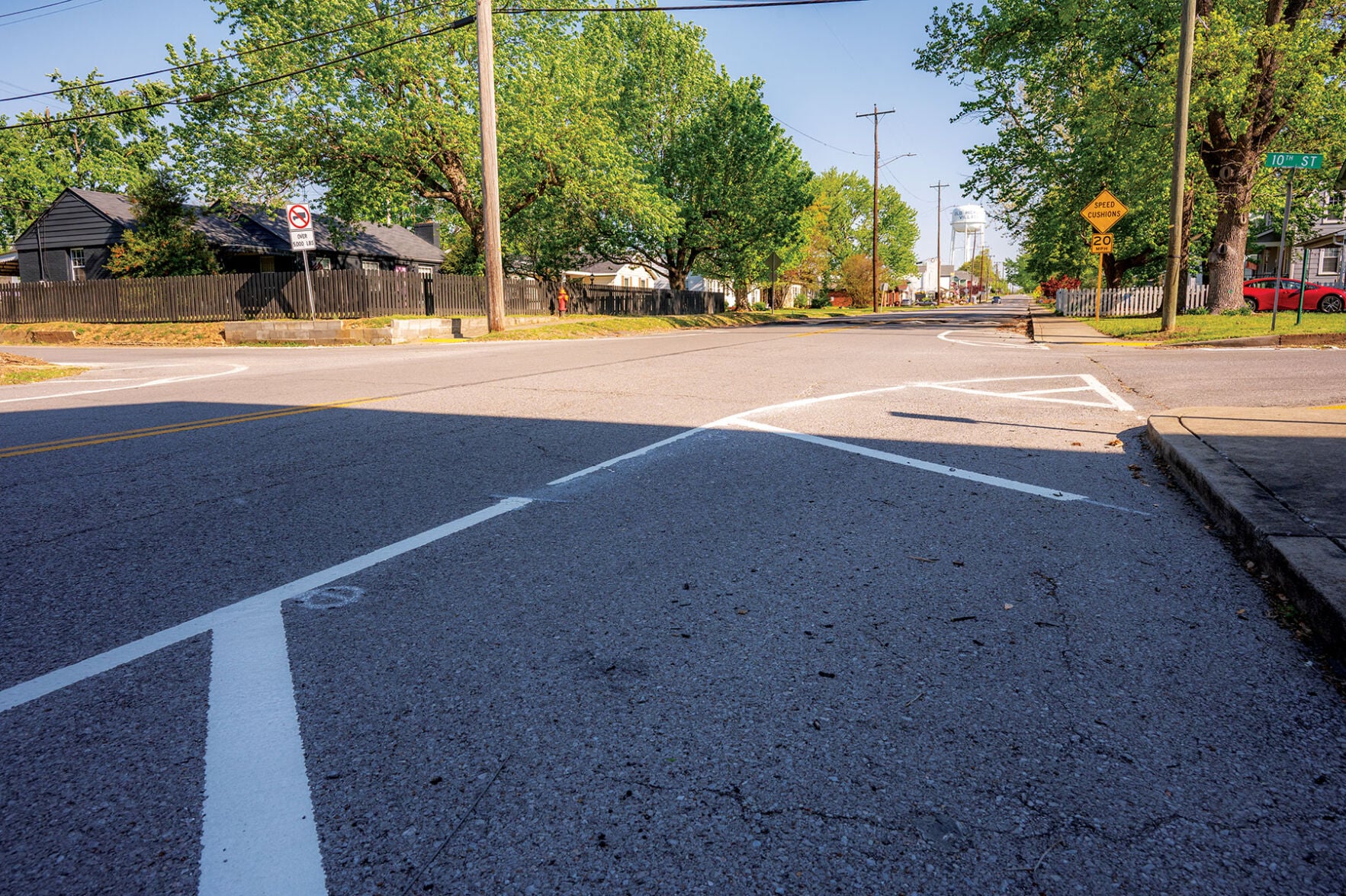
In mid-February, new white lines and plastic posts appeared on a section of Hadley Avenue in Old Hickory. These changes created “bulb-outs,” extended sections next to the sidewalk designed to slow down traffic and protect walking areas.
But a month after the bulb-outs were installed, the white posts — called “delineators” — were already removed. On March 9, District 11 Councilmember Jeff Eslick posted on his Facebook page about their upcoming removal. “Bye Bye bulb-outs!” the post reads. “The community wasn’t thrilled about the bulb-outs as part of the traffic calming measures on Hadley. The speed tables have support from the neighborhood, but the lane intrusion at 10th & 13th seems to have gone too far.” On March 12, Eslick posted that the delineators had been removed.
According to Nashville’s laws, this all happened by the book. Old Hickory homeowners asked for street calming, and the Nashville Department of Transportation and Multimodal Infrastructure delivered it. Then, when residents didn’t like the way street calming played out, their local councilmember worked with NDOT to remove some of the features.
But this small interaction raises a few big questions: Who is qualified to make decisions about roadway design? Why do solely homeowners vote on design that impacts renters and people passing through? And perhaps most importantly, should a community be able to vote to theoretically make its roads less safe?
Bulb-outs are also called curb extensions. They go beyond other speed-reducing tools like speed cushions, increasing visibility of pedestrians, reducing the distance it takes to cross the road and particularly reducing speeds of drivers who are turning. Like many road safety features, they work by making driving slightly more uncomfortable: When a road feels narrower, drivers naturally slow down.
In Old Hickory, the bulb-out technically remains, though now it’s just marked out by white lines on the street. “The placement of the delineators didn’t match what the residents expected,” Eslick tells the Scene. “They made turning more difficult than necessary, and many of the residents didn’t see the benefit with the added issues.”

Seven pedestrians killed in four weeks as projects remain delayed or deferred in city bureaucracy
“The look of the bulb-outs was an issue too,” he says. “A lot of people commented about the loss of charm caused by the delineators.”
The Old Hickory bulb-outs are part of NDOT’s Neighborhood Street Traffic Calming Program, which is led by residents. When residents apply to have a safer street, NDOT scores them on a set of criteria (including vehicle speed, traffic volume and proximity to places like schools and libraries), meets with the local councilmember, and hosts community meetings. They distribute online ballots via mailers, and any traffic calming projects need at least 66 percent approval before construction begins. The traffic calming project on Hadley Avenue received 79 percent approval.
“The Neighborhood Traffic Calming Program is one of our most popular programs at NDOT and relies heavily on communication from Nashville residents,” says NDOT representative Brendan Scully.
“This project was an extremely atypical process,” he says. “I want to state that even though one specific element was removed, the overall project has been maintained. It would take extraordinary circumstances to remove a traffic calming project, especially since the whole program is a community-led process that requires approval from residents.”
Eslick tells the Scene he wanted to see NDOT’s full design earlier, with more community meetings. Scully says the bulb-outs were proposed alongside the ballots, which is standard practice for NDOT.
Still, while this whole controversy may be an anomaly, for some it shows a frustrating side of Nashville’s road design process: communities willingly removing pedestrian safety features from their streets in favor of aesthetics or convenience, while pedestrians continue to be killed or injured by cars at an alarming rate across the city.
Winston Wright is one of the Nashvillians concerned with pedestrian safety. He lives “three or four streets down” from the bulb-outs and passes the intersection regularly. “When I’m doing my morning walk or evening jog around [Old Hickory Village], I’d directly walk onto Hadley and I’d pass [the delineators],” he says.
Wright posted a video on Instagram after he heard about the delineators being removed, explaining why — as a neighbor and inclusive urban design advocate — he wanted them to stay.
Living in Old Hickory Village, Wright says he sees people from “all walks of life” in his neighborhood, walking to the local Dose Coffee, the Piggly Wiggly and the gas station. “It’s a very diverse neighborhood,” he says. “You have young families, you have folks who need assistance with mobility, you have folks [walking] because they want to for their health, and you have folks who walk because they have to, because they don’t have a car. I think if we’re just having an inclusive conversation about all of these different identities from a transportation standpoint in our neighborhood, we can really come together to understand, ‘OK, this is a good thing for all of us.’”
The delineator removal caught the attention of transit advocates outside Old Hickory too. Ben Vaught, a former NDOT engineer, says it shows how Nashville’s road safety process isn’t working the way it should.
“I don’t really like the concept of putting safety measures up for a vote,” Vaught says. “Safety measures are treated as a neighborhood amenity, but they’re not. They’re a safety measure. We don’t put water lines up for a vote; we just do it.”
Vaught says the city doesn’t always connect the dots: The faster Nashville redesigns its roadways, the fewer people will die in traffic-related incidents.
“We are a Vision Zero city, and we either mean that or we don’t,” he says, referencing the city’s primary road safety initiative. “I think we want to prevent traffic deaths on our streets, but we have to change how we design streets to achieve that. I don’t think our process around [changing street design] reflects either the urgency or the weight of the issues.”
Outside Old Hickory, Vaught has seen the process have real-world consequences. In 2023, a truck driver killed a legally blind woman in Germantown while she was walking her dog. At the time, her neighborhood was voting on whether to install a traffic calming project. “She didn’t get a vote because she was a renter, and she died while her neighbors who owned land were deciding whether to install a walking path,” says Vaught. “I just think that is the biggest possible indictment of that process — people are dying while we dither and go hat-in-hand to homeowners, asking permission to do what we said we already wanted to do.”
Wright tells the Scene he hopes his neighborhood keeps having a conversation about pedestrian safety, and either reinstalls the delineators or finds a suitable alternative.
Eslick tells the Scene that in place of changes like delineators, he’d like to see more traffic stops by police to help enforce safer driving.
As of this writing, 33 people have died in fatal crashes in Nashville in 2026 — 12 of them were pedestrians.



Post a comment as anonymous
Report
Watch this discussion.
(0) comments
Welcome to the discussion.
Log In
Welcome to the discussion.
Keep it clean. Please avoid obscene, vulgar, lewd, racist or otherwise abusive language. Comments featuring hate speech or threatening or violent content will not be tolerated.
PLEASE TURN OFF YOUR CAPS LOCK.
Be truthful. Don't knowingly lie or mislead.
Be proactive. Use the “report” link on any comment that violates our comment policy.
Share with us. We'd love to hear your feedback.