

Cars on Ewing Drive slowed to a crawl this week as two men in neon vests and hard hats directed traffic with handheld signs. It was a stark change of pace for the narrow east-west connector that often sees drivers pushing 40 miles per hour.
City workers recently installed electric speed radar signs — a noninvasive strategy to slow cars. Last week, Beverly Jackson struck and killed Clifford Coleman with her car on the same stretch of road, well-known by the neighborhood as a deadly corridor that has seen three deaths in 20 months. Jackson struck Coleman, a pedestrian, with her Dodge Dakota pickup truck, marking the city’s seventh pedestrian death over a particularly deadly four-week stretch from late February to early March.
Mayor O’Connell appoints Phillip Jones acting director following Cooper appointee’s exit
As Vision Zero — the city’s primary road safety initiative — enters the final phase of its five-year action, key intersections and deadly stretches identified for years as top priorities remain untouched. Leadership transition atop the Nashville Department of Transportation and Multimodal Infrastructure and Nashville’s fractured relationship with the state, whose transportation department oversees many local arteries, have hindered the city’s response to dangerous roadways. Acting NDOT director Phillip Jones says this week’s Ewing Drive work was protocol after any fatal incident.
“ I know anytime there is a fatality, we do go out within two days and look at the area and see if there's anything we can do immediately,” Jones tells the Scene. “I’m still playing catchup about that specific incident.”
Jones replaced Diana Alarcon, appointed under former Mayor John Cooper, as NDOT’s chief. When faced with road safety problems on major state routes — like Charlotte Avenue or Nolensville Pike — Alarcon was known to point toward the Tennessee Department of Transportation for abandoning or delaying projects. The 15 most dangerous stretches identified by Vision Zero’s “High Injury Network” are on state roadways, which are under TDOT's control.
If pedestrian deaths continue at this rate, 2026 will match Nashville’s 10-year high. Many criticize the city’s reactive posture toward transit safety, considering the years of maps, data, studies and plans that demonstrate traffic, cyclist and pedestrian danger.
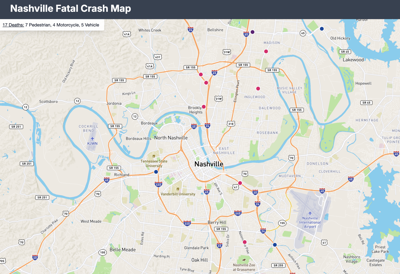
“ It's not as simple as flipping a switch, but at the same time, we've not seen [the city] do the safety implementations that, as a committee, we would want or expect them to do,” says Charlie Weingartner, chair of Mayor Freddie O’Connell’s Vision Zero Advisory Committee. Weingartner's hobby projects include a fatal crash tracker meant to check "discrepancies" he noticed in official city statistics. “ I don't think the mayor's office, NDOT and councilmembers are really aligned on how to achieve this. They're our leaders, they have an opportunity to make Nashville the great city that everyone wants it to be, and I just hope that they rise to that challenge.”
O’Connell came into office as a true believer in multimodal transit. But momentum on street safety projects has disappointed advocates like Weingartner, who expected faster and more comprehensive street safety. O’Connell’s successful 2024 Choose How You Move referendum opened up dedicated funding for walking and biking infrastructure, but projects that followed — while funded — have become mired in the engineering and planning phases.
“ We are getting embarrassed by cities that we do not think of as fancier or better than us — and I'm not comparing us to Paris, Copenhagen or New York,” says Peter Robison, another Vision Zero Advisory Committee member and Weingartner’s predecessor as chair. “We are getting embarrassed by Cleveland and Atlanta, even by Knoxville, because we are setting aside a lot of tools at our disposal and just not using them.”
Robison points to Haywood Lane as a clear priority that is both city-controlled and highly dangerous. Like Ewing Drive, it’s a narrow east-west route frequently used by high-speed drivers. The short connector between Nolensville Road and Antioch Pike has seen nine fatalities in the past five years.
O’Connell says traffic-calming projects remain highly sought-after and popular. Smoothing out the actual internal Metro bureaucracy — capital allocation, scheduling, tracking — will make it easier to get projects online.
“ It's harder than anyone wants to get things done, and we're trying to make it easier day by day,” says O’Connell after a Thursday event in East Nashville.
After a brief interview, O’Connell calls the Scene back over to say one more thing.
“ Every one of these deaths, that's heavy weight I carry every day,” the mayor adds. “We are trying urgently to make our streets safer.”



Post a comment as anonymous
Report
Watch this discussion.
(0) comments
Welcome to the discussion.
Log In
Welcome to the discussion.
Keep it clean. Please avoid obscene, vulgar, lewd, racist or otherwise abusive language. Comments featuring hate speech or threatening or violent content will not be tolerated.
PLEASE TURN OFF YOUR CAPS LOCK.
Be truthful. Don't knowingly lie or mislead.
Be proactive. Use the “report” link on any comment that violates our comment policy.
Share with us. We'd love to hear your feedback.