

Street View is a monthly column taking a close look at development-related issues affecting different neighborhoods throughout the city.
Last year, Grace Lewis had an idea. She’d been to downtown Nashville with her family, and they’d thought about riding a pedal tavern together. But Lewis’ mom, who has limited mobility, couldn’t climb into the vehicle without a ramp. And even if they got onto the vehicle, the seats wouldn’t offer much support.
That’s when Lewis, owner of local pedicab company Local Bike Taxi, had an idea. What if she invented a pedal tavern that accommodated disabled people?
After months of design and discussion, that idea will soon be a reality. Nashville’s first Americans with Disabilities Act-compliant pedal taverns will be on the streets in the next six months.
Lewis’ idea started simple, with plans to retrofit a pedal tavern with seats that could offer some lumbar support, a ramp and space for a wheelchair. But as she spoke to more local disabled people, her design gained more features. At the recommendation of the Mayor’s Office of Nightlife, Lewis joined forces with Dr. Cynthia George, a punk rock musician and disability rights advocate. George, who often goes by “Dr. Cyn,” leads Disabled to the Front, a group that’s working with the night mayor, local venues and the Office of Nightlife to help disabled people get better access to what many Nashvillians take for granted — the right to party.
With Disabled to the Front, George has helped venues better understand accessibility needs. As a musician and a disabled person, they’ve seen these issues play out first-hand. But they had an advantage, because so much of the community already knew them. “I sing in a band and I grew up in Nashville, so I have always felt welcomed in venues,” says George. “I could just call up.”

Roadway deaths are regular tragedies in Nashville — and the city is trying to build itself into the future
“But the more I had those needs, the more I needed accommodations from venues I didn’t really know,” they say. “I saw how difficult it was to get venue owners to answer their email sometimes, and I became so grateful for my inside connections to be able to get things done.
“That’s why I started the group,” George continues. “To share my privilege with other people with disabilities.”
With her pedicab company, Lewis has also seen how difficult it can be for disabled people to access music and nightlife venues. “She’s down there and she has seen people with disabilities stranded,” says George. Oftentimes, disabled people have to wait until everyone else at shows has gone home before they can catch a ride with the WeGo Access bus.
To meet this need, pedicabs can provide a crucial service for some disabled people downtown, bridging the gap between inaccessible dropoff points and the doors of a venue, or anywhere else someone might want to go. But their size means they can’t accommodate all types of mobility aids.
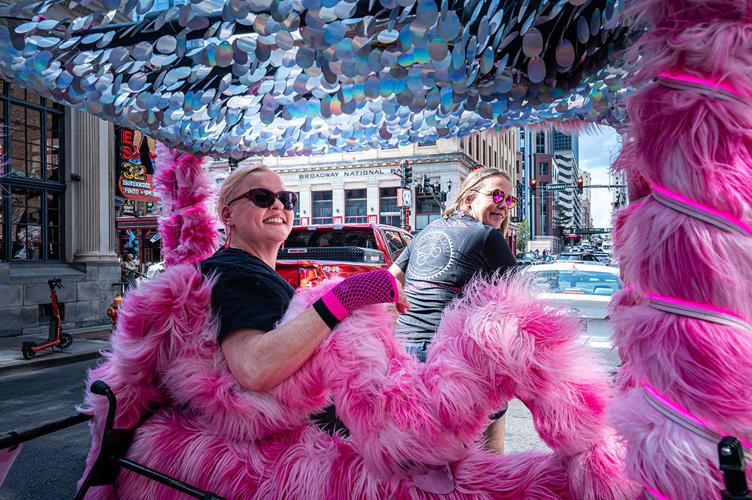
Lewis’ experience working downtown — and her friendship with many members of Disabled to the Front — has shaped her pedal tavern. Her design accommodates a diversity of needs, with space for either two mobility devices side by side (like a wheelchair or rollator) or a mobility device beside a bench, allowing a disabled person and their caregiver to sit side by side. It will also have spaces large enough for “oversized” mobility devices that aren’t always accommodated by other accessible transport. And then there are Lewis’ favorite features: a rollout ramp to allow people to be dropped off directly on the sidewalk, and comfortable bright-pink seating for people who might want — or need — more support.
Lewis has a pedicab operator’s love for tinkering as well as an associate’s degree in mechanical engineering. As her design has evolved to accommodate different bodies, she’s gotten creative. On a call with the Scene, she explains her design choices while scrolling through eBay, looking for retired airline seats for the pedal tavern’s new pink bench. “There’s a lot of different devices out there that have been created, and it’s just thinking about how you can repurpose them to the needs you have,” she says. Lewis says she will probably use seats from Southwest planes, since the leather will hold up against drink spills or bad weather. They’ll be bright pink like her pedicabs, and one member of Disabled to the Front, Emily Grooms, has already asked Lewis for them to include a plaque with Grooms’ name somewhere on them.
On Aug. 18, Metro’s Transportation Licensing Commission heard two cases for construction of accessible pedal taverns. One was from Lewis, and the other was from Jake Badaszewski of Every Body Rides, who has built an ADA-accessible design with a ramp, wheelchair space and a removable seat that can be swapped out to accommodate someone in a wheelchair. Both parties were awarded permits to construct the new vehicles.
The two designs will accommodate different markets. Badaszewski’s design provides convenience, since it can be converted to and from an existing conventional pedal tavern to accommodate groups with one person in a wheelchair. While less conventional, Lewis’ pedal tavern will accommodate a wider range of disabilities (though she has said that non-disabled people can book the service too).

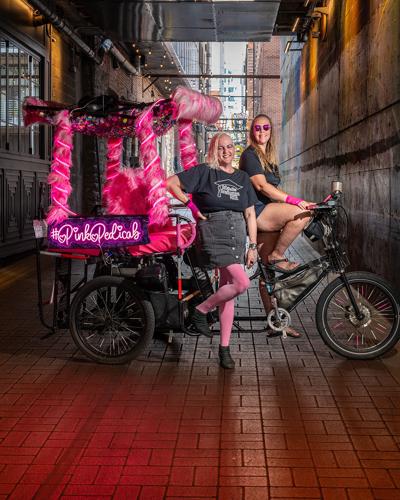
Dr. Cynthia George (left) and Grace Lewis
While discussions of accessibility in Nashville often focus on the city’s incomplete, inconsistent sidewalks or other transportation issues, those are just pieces of a larger puzzle. Like any group of people, Nashville’s disabled community has a variety of wants and needs. As George has seen, some disabled people really want to party. Downtown transpotainment can be part of that. “Where normally people with wheelchairs have to go through agony to get to the second location, the pedal tavern makes it fun,” says George. “It’s designed to keep the party going from stop to stop.”
Both ADA-accessible pedal taverns will be a world first, and both George and Lewis have already heard from people in other cities who want accessible party vehicles of their own. Looking at the bigger picture, George says Nashville has a real chance to make lasting change as a disability-friendly city, particularly ahead of Nashville hosting the 2034 Special Olympics.
For George, this fight is over so much more than just a pedal tavern. Backed by their academic research in social change and prevention science, they know community is a crucial part of a good life.
“Without access to social networks and meaningful social connection, what is the point?” says George. “While I’m saying I’m fighting for disabled people’s right to party, I’m really fighting for disabled people’s right to live.”



Post a comment as anonymous
Report
Watch this discussion.
(0) comments
Welcome to the discussion.
Log In
Welcome to the discussion.
Keep it clean. Please avoid obscene, vulgar, lewd, racist or otherwise abusive language. Comments featuring hate speech or threatening or violent content will not be tolerated.
PLEASE TURN OFF YOUR CAPS LOCK.
Be truthful. Don't knowingly lie or mislead.
Be proactive. Use the “report” link on any comment that violates our comment policy.
Share with us. We'd love to hear your feedback.