

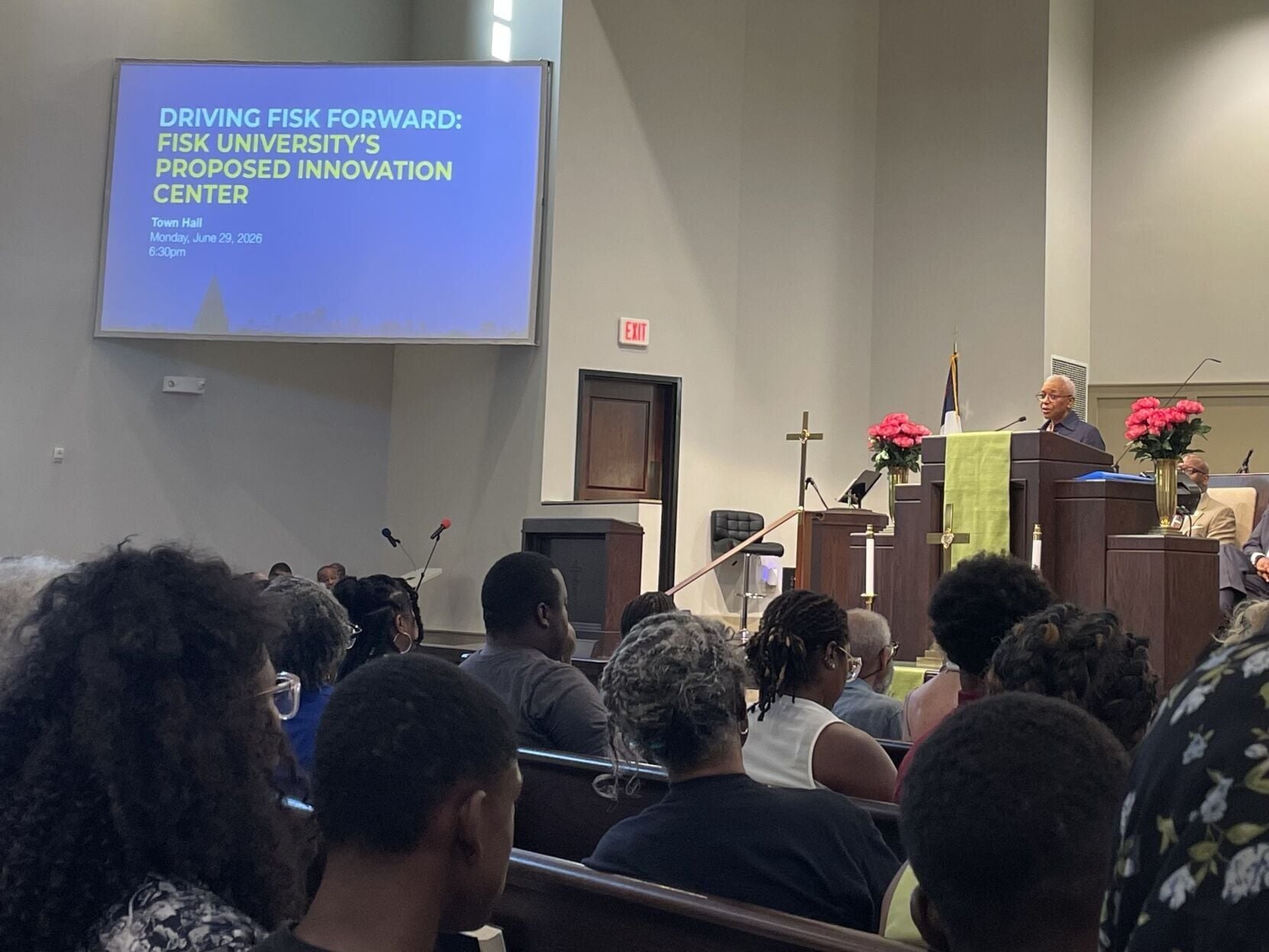
Fisk President Agenia Clark speaks at a town hall related to a proposed on-campus data center, June 29, 2026
Curious and frustrated Davidson County residents packed the pews of Lee Chapel AME Church in North Nashville Monday night for a town hall addressing a proposed data center on the campus of Fisk University.
The data center, which was first proposed in May as one part of Fisk’s $1 billion Quantum Leap campus master plan, has been met with intense opposition from Fisk students and alumni as well as residents of the surrounding North Nashville neighborhood. Potential excessive noise and environmental impact like water and air pollution are among the top concerns of those opposing the proposed 70,000-square-foot data center, which is planned for the southern end of the university’s campus.

Neighbors and alumni are questioning how the university’s proposed data center will impact the community
Fisk’s data center plan arrives at the same time as a controversial proposal to construct one of the tech centers near the Nashville Zoo.
Fisk President Agenia Clark, NAACP Nashville Branch President Timothy Hughes, state Sen. Charlane Oliver (D-Nashville) and state Rep. Harold Love Jr. (D-Nashville) gathered at the town hall Monday evening in an effort to address some of these concerns.
At the start of the meeting, Oliver said she does not currently support the data center proposal. She noted, however, that there are many unknowns about the proposal. She said she is engaging with Fisk officials and the community to learn more about the project and make an informed decision.
“If you ask me today whether I support this proposal, the answer is no,” Oliver said Monday night. “I cannot support the data centers and all that comes with them that could potentially perpetuate harm and jeopardize the health and well-being and quality of life of North Nashville residents.”
“This is a community that has been hurting for decades, being dumped on by landfills, money being taken out of their community, a whole interstate went right through right here,” Oliver added, saying she is looking at what state-level legislation she can propose related to data centers.
Clark followed Oliver’s comments with a presentation on the proposed data center (which Fisk officials have referred to as an “innovation center”) and campus expansion. Clark maintained that the plans are a part of Fisk’s strategy to grow and remain sustainable as it faces the challenges of fundraising and revenue generation.
“Do you all know how much money this university has in its endowment?" asked Clark. "Right around $25 million. We’ve got a long way to go, and that's just one of the things you need to know about us. We have a lot of growth to do at this university.”
She also noted the rising political battles in the higher-education sector since the start of the second Trump administration in 2024.
“I arrived at Fisk in October of 2023,” Clark said. “In January the following year, a new administration comes into the White House, and there's been an unusual attack that's going on in the higher-education space unlike any institution of higher education has ever seen and or experienced before. That is also impacting the necessity that this school must have a strategy in order to stay here, be here, not just survive here, but to thrive here. We've got to do it. We've got to do something.”
Clark emphasized that the data center is still in its very early stages and that no final plans or corporate partners have been selected for the future space. Clark recently told WPLN that the building is not expected to host an AI data center and that its specific use is still to be determined. She cited examples of other universities across the U.S. that are home to varying kinds of data centers for both academic and research purposes and colocation. (The latter meaning businesses can rent space within the centers to store servers and other high-powered IT equipment.) Clark also pointed toward businesses like 365 Data Centers, located in downtown Nashville.
“What I realized is in many of the conversations I'm having, everybody thinks all data centers are alike,” Clark said. “No two [historically Black colleges and universities] are alike. No two data centers are alike.”
Clark said the so-called innovation center would provide academic opportunities for Fisk students, faculty and staff, as well as potential workforce training opportunities for North Nashville residents. She also said Fisk has no intention of selling the land proposed to host the data center.
In terms of water and air pollution concerns, Clark also maintained that Fisk is committed to a “do no harm” approach.
“We will have no interest in bringing in methane gas fuel turbine engines — period,” said Clark. “Those are the models that are creating the greatest level of environmental harm and danger.”

Following community backlash, Metro could take control of South Nashville property for public use
During Monday’s town hall, attendees were able to write their questions on notecards, which were then returned and read aloud in large batches by NAACP Nashville Branch President Timothy Hughes. Either Clark or the attending local legislators would then respond to the groups of questions. This led to frustration from some attendees, who yelled from the crowd and talked over speakers, saying they didn’t feel that their questions had been answered.
Amid the recent community backlash over data centers, the Metro Council is considering several pieces of legislation that could impact the construction of the facilities. One zoning bill would create strict regulations limiting the size, location and operations of data centers.
Clark said Fisk is awaiting the council’s decision on the legislation before moving forward with concrete plans.
Another proposal being pushed for by Mayor Freddie O’Connell would enact a 90-day moratorium on the construction of data centers. In addition, O’Connell’s office filed a piece of condemnation legislation on Monday that would use eminent domain to acquire the zoo-area property for Metro use.
This article was first published by our sister publication, the Nashville Post.



Post a comment as anonymous
Report
Watch this discussion.
(0) comments
Welcome to the discussion.
Log In
Welcome to the discussion.
Keep it clean. Please avoid obscene, vulgar, lewd, racist or otherwise abusive language. Comments featuring hate speech or threatening or violent content will not be tolerated.
PLEASE TURN OFF YOUR CAPS LOCK.
Be truthful. Don't knowingly lie or mislead.
Be proactive. Use the “report” link on any comment that violates our comment policy.
Share with us. We'd love to hear your feedback.