
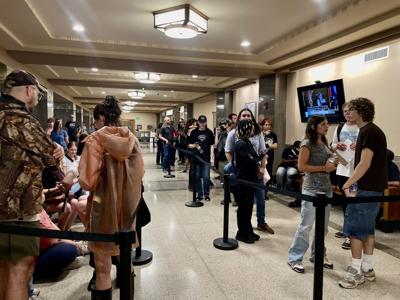

After a seven-hour Metro Council meeting Tuesday night during which concerns were heard from nearly 180 Nashvillians, the council advanced several pieces of legislation that could impose strict regulations on future Davidson County data centers.
Here’s what data-center-related bills moved forward at the council meeting and why members of the public are pushing back against the tech facilities.
Data Center Regulation Framework
Davidson County does not currently have any regulations on data centers — facilities that power computing software, AI and other digital and information technology infrastructure. This could soon change as the council unanimously voted Tuesday to advance a bill — sponsored by Councilmember Rollin Horton and co-sponsored by 27 of his colleagues — seeking to establish strict regulations on the tech centers. The bill was passed on its second of three readings.
Some of the regulations outlined in the bill include:
The construction of data centers that are more than 500,000 square feet would be banned. Other data centers would be classified as small, medium and large. Medium and large data centers between 20,000 and 499,000 square feet would be allowed only in industrial zoning districts and prohibited in residential areas and mixed-use districts.
Large data centers would be subject to additional rules targeting the location and method of approval. These centers would need a special exception from the Metro Board of Zoning Appeals and would require a public hearing.
The bill would also place restrictions on noise levels. Facilities would be limited to 65 decibels during the day and 55 decibels at night. The centers also would be required to use a closed-loop water system that prevents polluted water from being dumped into community water sources.
In addition, the facilities would be required to be sited a certain distance (depending on the size of the centers) from residential areas, daycare businesses, religious institutions, parks, zoos and other data centers. Prisons and Choose How You Move All-Access Corridors were also recently added to this list.
Why Are So Many Community Members Opposed to Data Centers?
A significant number of Tuesday’s speakers included those concerned about a data center proposed for a site located near the Nashville Zoo as well as one planned for the campus of Fisk University. Both have sparked vehement opposition from the community.

Zoo spokesperson says closing date for transaction is July 6
More than 170 Nashvillians spoke Tuesday in favor of Horton’s bill to regulate data centers. Residents including 5-year-olds, high schoolers, longtime Nashvillians, environmental activists and Fisk alumni all packed into the Metro Courthouse on Tuesday to support the bill, though many pushed for regulations that go even further.
Some citizens want all data centers to be banned in Davidson County, while other residents advocated for any data center in the area to be required to run on renewable energy sources. Many of those who spoke during Tuesday’s public hearing also pushed for the distance requirements to be increased.
Data centers are known to use large quantities of electricity, with power supply a key concern from some citizens who noted that the fallout after Winter Storm Fern led to hundreds of thousands of electrical outages in January.
A new report from nonpartisan think tank ThinkTennessee notes that electricity consumption by data centers in the Tennessee Valley region grew sevenfold between 2020 and 2025, and that residents living near the facilities often see higher electricity costs than otherwise.
Others, including Nashville Zoo president and CEO Rick Schwartz, are worried about potential loud noise being emitted from the data center — sound that could negatively impact the eating, sleeping and mating habits of the exotic wildlife facility's animals.
“The type of 24/7 noise disruption that has already impacted the health of cattle in rural areas causing lower milk production due to diminished feeding, inhibited breeding behaviors and premature or stillborn calves,” Schwartz said during the meeting. “We cannot risk those negative impacts on vulnerable animals like the clouded leopard, our signature conservation species.”
“It is my ethical responsibility to protect these animals,” added Schwartz. “I cannot stand by and let these animals in our care become an experiment of the long-term effects of data centers.”

State and local government leaders, university officials address community concerns regarding on-campus tech facility plan
Impact on the environment such as air pollution as well as contaminated waterways and stormwater infrastructure are also a major concern among some citizens. Some speakers cited previous examples of environmental racism in the historically Black neighborhoods of North Nashville that include the Fisk campus data center proposal.
“Currently, it appears as if Nashville cares more about animals than we do about the residents of North Nashville,” said Fisk alumnus Winston Wright. “Many of whom have already been impacted by other forms of harmful infrastructure, like Interstate 40, which has forced current and former residents to live with a legacy of intentional harm, displacement and health impacts, which still have not been solved.”
No one present at the council meeting spoke against the regulation bill.
Data Center Moratorium
Also on its second of three readings, the council advanced a 90-day pause on data center construction in Nashville, an effort backed by Mayor Freddie O’Connell.
The moratorium legislation is sponsored by Councilmember Courtney Johnston, whose district includes the Nashville Zoo. Several people spoke in favor of the moratorium, though many also pushed for an indefinite pause on the construction of data center projects.
Eminent Domain for Zoo-Area Site
The council also moved forward with condemnation legislation filed by the mayor’s office seeking to use eminent domain to acquire the zoo-area property being eyed for a data center by Atlanta-based tech company DC BLOX.
O’Connell has previously said that Metro has a “legitimate need for [the] property,” located at 648 Grassmere Park. If acquired by Metro, the property would be utilized for public use.
Following community backlash, Metro could take control of South Nashville property for public use
DC BLOX sent reporters an emailed press release just before the meeting’s start, stating the company held “productive discussions” with the board chair and CEO of the Nashville Zoo during “collaborative talks organized by the mayor’s office.”
The press release maintained that the facility would not function as an AI data center and that DC BLOX has committed to environmental stewardship as well as other measures to minimize noise, light and power-use from the center.
Soon after DC BLOX issued the press release, the mayor quickly fired back with a statement saying Metro is continuing with its eminent domain plans.
“I understand earlier this evening, DC BLOX issued a statement that makes a number of claims not worth repeating,” O'Connell said in a statement.
“The statement is inaccurate, wishful thinking that is divorced from reality and indicative of a company trying to repair a PR problem they caused for themselves. The timing would suggest an attempt to disrupt tonight's Council votes on data center legislation. To be clear, I called a meeting because there are three parties interested in the property, and Metro intends to acquire the land. We will proceed in Metro's interests.”
The eminent domain legislation passed on its first of three readings.
Once the three pieces of data center legislation were approved, councilmembers sped through the rest of their agenda before adjourning at approximately 2 a.m.



Post a comment as anonymous
Report
Watch this discussion.
(0) comments
Welcome to the discussion.
Log In
Welcome to the discussion.
Keep it clean. Please avoid obscene, vulgar, lewd, racist or otherwise abusive language. Comments featuring hate speech or threatening or violent content will not be tolerated.
PLEASE TURN OFF YOUR CAPS LOCK.
Be truthful. Don't knowingly lie or mislead.
Be proactive. Use the “report” link on any comment that violates our comment policy.
Share with us. We'd love to hear your feedback.