
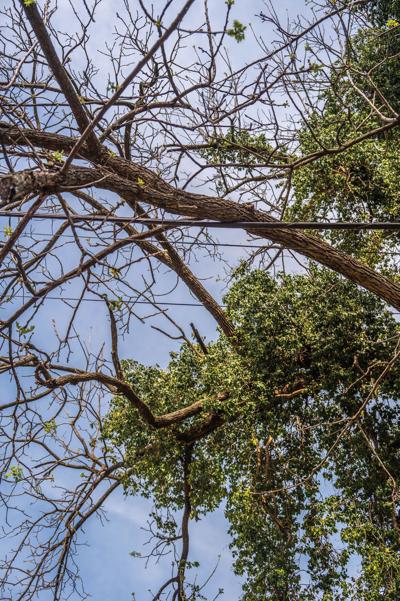


Densely wooded neighborhoods make up a corridor on the county’s western side running roughly from West Meade to Franklin Pike. The stretch, centered on Belle Meade and Forest Hills, also captures Nashville’s wealthiest ZIP codes, where stately single-family homes preside over large lots dotted with mature oak, hackberry and poplar.
People here love their trees, and they mourned the freezing days in January when treasured magnolias and pines split from the pressure of internal moisture, or survived long enough to turn from hero to villain, dropping limbs onto cars, homes or yards and triggering a still-ongoing process of brush clearance. The area’s sprawling lots and extensive canopy — an amenity for clean air and scenic beauty, and a boon to home prices — also put these neighborhoods at the end of NES’ already long power restoration list during Winter Storm Fern. In many cases, door-to-door brush removal companies were knocking on West Meade doors where homes still didn’t have power more than a week after loud cracks of splitting branches filled the early morning hours of Jan. 25.

Nonprofits, arborists and others are guarding our trees from invasive species, storms — and humans
Winter Storm Fern highlighted the city’s struggle to live within its tree canopy, where Nashville’s enormous urban forest can be both enemy and friend. Downed branches across the city made power restoration a time-intensive, tedious game of pickup sticks and immediately provoked an all-out tree-trimming effort from NES executive Teresa Broyles-Aplin.
“ Our estimates now suggest more than 2,000 trees destroyed,” Mayor Freddie O’Connell told a roomful of tree sympathizers at an early Arbor Day event in East Nashville on March 26. “NDOT has already collected over 1.4 million cubic yards of storm debris.”
That number will approach 2 million, O’Connell said, in the coming weeks. Oversized brush removal trucks have become a regular obstacle for Nashville drivers, just like the debris piles that still dot many front yards.
“ We’ve got some opportunity — the storm cleared older diseased trees, and it had an impact on deadwood,” O’Connell continued, pivoting his keynote address from eulogy to benediction. “In some places, the canopy is actually stronger. It also gives us a chance to begin renewal by planting back with stronger tree species in more appropriate locations and much greater diversity.”
Nashville’s tree efforts span multiple million-dollar nonprofits, advocacy groups and politically connected retirees. Former Senate Majority Leader Bill Frist, now the global chair of The Nature Conservancy, has devoted his post-Senate career to environmentalism, specifically the air-cleaning and carbon-sequestering potential of tree coverage. Mike Jameson — attorney, former Metro councilmember and principal legislative liaison in former Mayor John Cooper’s office — has swapped his city hall suit for ranger gear as an active member of the Tennessee Urban Forestry Council. Jameson greeted former colleagues as he distributed program flyers outside the mayor’s Arbor Day event.
The city’s Root Nashville campaign to plant 500,000 trees by 2050 draws the most civic attention as a proactive and ambitious effort, while canopy maintenance tends to get attention as a liability, as it’s seen now through NES’ aggressive and reactive tree-trimming plan that reads more as apology than preparation.

Amid the city’s development boom, advocates try to conserve the mature tree canopy
Tree workers have spoken out against “topping,” a clumsy but common practice of haphazardly lopping off limbs that creates unnaturally jagged branch patterns and ultimately weakens a tree’s ability to endure extreme weather. Other locals are trying to preserve the county’s contiguous urban canopy by codifying 100,000 acres into the Western Highland Rim Forest. John Overton High School assistant principal Kevin Aigbe accepted official recognition on March 26 from the city for a designated campus arboretum, one of dozens around Nashville functioning simultaneously as education, preservation and recreation. The city is still striving for a balance between the good and bad aspects of life in the forest.
“In the past several weeks, NDOT contractors have picked up the equivalent of over 125,000 standard dump trucks of trees, with limbs making up the majority of the debris,” added NDOT director Phillip Jones in his own remarks to the Arbor Day crowd. “It is a devastating event unlike anything I’ve seen in my 30-plus year career here at the city of Nashville. Trees make our city cool, the air cleaner, they mitigate stormwater challenges, they calm traffic, and they make our streets truly complete. I’m grateful that Nashville has leadership in Metro’s beautification commissioners, Metro Council, other agencies and partners, and our mayor’s office that understand the value of restoring our canopy.”

Stories on the local tree canopy, Tennessee quarries, the endangered Nashville crayfish and more — plus, how to get free trees and recycle your electronics



Post a comment as anonymous
Report
Watch this discussion.
(0) comments
Welcome to the discussion.
Log In
Welcome to the discussion.
Keep it clean. Please avoid obscene, vulgar, lewd, racist or otherwise abusive language. Comments featuring hate speech or threatening or violent content will not be tolerated.
PLEASE TURN OFF YOUR CAPS LOCK.
Be truthful. Don't knowingly lie or mislead.
Be proactive. Use the “report” link on any comment that violates our comment policy.
Share with us. We'd love to hear your feedback.