

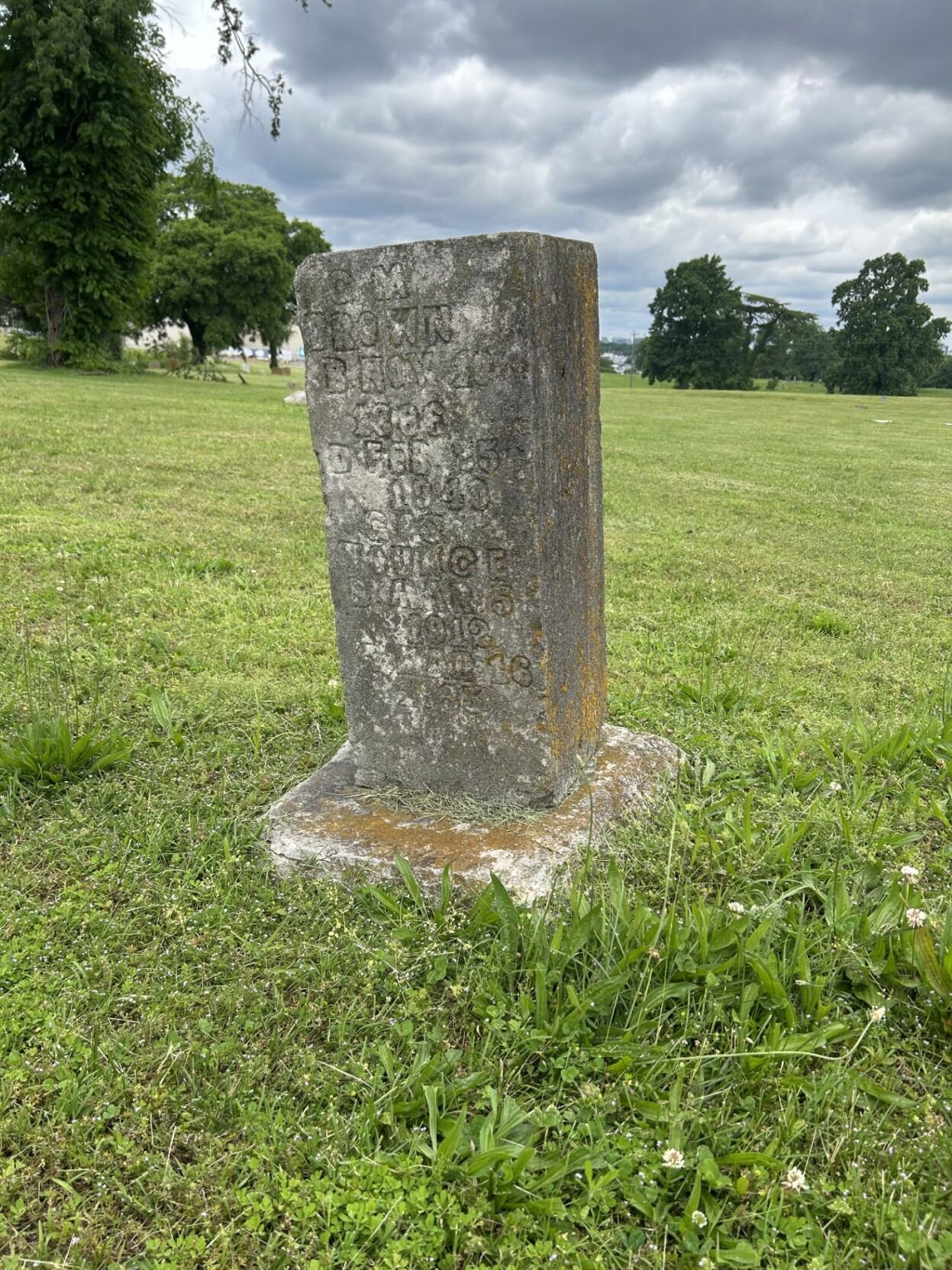
A gravestone at Mt. Ararat Cemetery
Since many of us made stops at cemeteries over Memorial Day weekend, I decided to set aside my plans to write about the state of Republican politics in Tennessee and instead head out to the cemetery myself.
Over in Mt. Ararat Cemetery, there is a rectangular-cube headstone that sits about two feet high. There are two names on it: CM Brown (1888-1940) and GC Younge (1912-1945). Their headstone was carved by Nashville sculptor William Edmondson, whom I've written about many times.

Long story short, William Edmondson was one of the most important artists to come out of Nashville. Born in 1876 to sharecroppers on the Compt…
CM Brown, based on his birth and death dates, is actually George Mack Brown. He was married to Pauline Price, and they had at least a daughter and grandkids. His mom and dad were Charles Brown and Ella Johnson. Edmondson’s mom was a Brown, and many people in William’s family married Johnsons. So at first, I thought George might be some relative of William’s — but if they are related, I couldn’t sort out how.
From Brown's death certificate, we learn that he died of complications from acute gangrenous appendicitis. From his death notice, we learn that he lived at 1609 16th Ave. N., but that his funeral was conducted at the Bass Street Baptist Church, and he was interred in the family lot at Mt. Ararat.
I’ve been looking into the lives of the people Edmondson made headstones for, just to try to understand how they crossed paths with him. I can say with certainty that Edmondson made headstones for Black people who were buried, with one exception, in Benevolent Society cemeteries, who usually either lived in his neighborhood or lived near where William grew up.
OK, so to recap: George Brown. Regular old guy with a regular old life, full of people who loved him and whom he loved in return. It’s not clear how he and Edmondson intersected.
That leads us to the second name on the gravestone: George Young (spelled "Younge" on the stone). Fair warning, this gets real sad real quick. So, George was born in 1912 to Tabitha Brunson, who was born in 1894. George lived at 1603½ 16th Ave. N., sometimes with his mom and grandma, other times just with his grandma. He was a neighbor of George Brown. On George Young’s death certificate, his mom names his father as Gus Young.
I have looked through old phone directories and census records, and there is no Gus Young. This doesn’t match what was in the papers, though. In 1930, Gus Young goes to federal prison for a year on liquor charges. In 1933, Gus Young back goes to federal prison for three years on liquor charges. But the thing that caught my eye was back in 1925, when Gus’ brother, James Young, shot his wife to death and turned the gun on himself, but only managed to get a good scalp bleed going. He then took Gus’ car to their mom’s house to get a drink. The mom’s name is Bettie. The Tennessean drops this bit in the middle of the story: “A coincidence is that Young’s brother, Orville Young a salesman, committed suicide after shooting to death Dennie Robinson at Robinson’s home, 1605 Ninth Avenue North, on July 29, 1922.” Coincidentally (or maybe not), James Young’s little son, who had to witness his dad kill his mom, was named George.
OK, this is more than enough to find someone. We have mother’s name, two brothers’ names, and a death date for the brother. We should have Gus. The Young family has seven sons. We’re looking for someone old enough to get someone pregnant in 1911, but still alive in 1933 (in order to go to prison). First up is Orville, who is out after his murder-suicide in 1922. Next is Samuel, who was born in 1885 and died in 1967. But Gus instead of Sam? Maybe? OK, into the maybe pile he goes. Third is James, but he’s out because we know he was driving his brother Gus’ car. Fourth is Oley, who died in 1918, so he wasn’t around for the madness that gripped his family. Fifth is Leland, who would have been 20 when George was conceived, and who lived until 1963, so was around for all the Gus activities. Leland was living near the corner of 18th and Buchanan when George was conceived. Also, Leland’s not in the 1930 Census, perhaps because he was busy in the court system. Plus, Leland’s kind of a stupid name. What kind of bootlegger or rum runner is named Leland? But Gus? Maybe. Next is Thomas, who gets off the list, first because he would have been very young (only 11 or 12 when George was conceived), and second because he died in 1927 from drinking too much. And last, Lewis, who’s out because he was born in 1906 and he’s not running around fathering children at 5 years old.
In the 1920 Census, Tabitha said she was a widow, though her last name was Darvin by then, and neither of her children with Charles Darvin had been born yet. So I think maybe she meant that she was a widow in the context of Gus. Meaning at the least that he wasn’t a part of their lives. And if he was a white guy from this pack of ultraviolent murderers, that was probably for the best. Except she lost her son to violence anyway. The family curse she couldn’t save her son from.
Buried deep in the March 21, 1935, issue of the Nashville Banner is this story:
Negro Robber Slain; Companion Captured
A Negro robber was shot to death and his companion captured by police shortly after 1:30 o’clock this morning as the pair fled from the L.B. Fuqua Grocery, 1001 Sixteenth Avenue, North after attempting to burglarize it.
Inspector John Griffin and Emergency Officers Gene Curley and Dave Beasley arrived at the grocery as the two Negroes ran from the front door ordered both men to halt. George Young, one of the Negroes, failed to stop and paid for his error with his life. His companion, Joseph Moore, 22, stopped when he saw Young fall to the sidewalk. He was taken to the police station and charged with house breaking and larceny.

Who was the Bernice Williams featured on a headstone by the famed Nashville sculptor?
The police killed George for running. Nothing indicates that he was dangerous or armed. They killed him for running. If that’s not sad enough, consider why George and Joseph might have been robbing a grocery store at night. Probably not for the money. That went to the bank already. Likely they were just hungry and desperate.
George’s mother was the informant on his death certificate. She reported that he was a chauffeur and was married to a woman named Bettie. I didn’t find any marriage certificate or wedding announcement. I did, however, find that Joseph, who had been there with George when he was killed, later married Bettie Kinnard. Maybe Joseph vowed to himself to take care of George’s girl?
Everything else we have to guess at. The two Georges were not related, but they lived in the same neighborhood. George and his wife would have been roughly the same age as George Young’s grandmother. I think the Browns rallied around George’s family and that they were not going to let that poor guy rot in a potter’s grave for stealing food. So they put him in with their family. William knew a few Kinnard families, or branches of the Kinnard family, so my guess is that he was brought in to make the headstone by Bettie or her relatives.
I saw pictures of this headstone from back in the 1970s, and at the time it had a stone bowl on top, like you might put fruit in, or rolls under a towel, or dough left to rise. When I think of that bowl, empty for eternity, it speaks to me of grief and outrage, that a young man should be shot in the back over groceries.
But that bowl is gone. I’ve never seen it in person, so it’s been missing for at least 20 years. Someone has stolen the thief’s bowl and stripped the gravestone of its indictment of police brutality.
But that indictment is not lost, even if the bowl is. Because I know the bowl should be there, and now you do too.



Post a comment as anonymous
Report
Watch this discussion.
(0) comments
Welcome to the discussion.
Log In
Welcome to the discussion.
Keep it clean. Please avoid obscene, vulgar, lewd, racist or otherwise abusive language. Comments featuring hate speech or threatening or violent content will not be tolerated.
PLEASE TURN OFF YOUR CAPS LOCK.
Be truthful. Don't knowingly lie or mislead.
Be proactive. Use the “report” link on any comment that violates our comment policy.
Share with us. We'd love to hear your feedback.