


William Edmondson's "The Reclining Man"
Imagine your grandma’s necklace.
My Grandma Phillips had two necklaces that immediately spring to mind. One my grandpa got her for their 50th wedding anniversary, a small diamond pendant. Intellectually I know it had five diamonds — one for each of my grandparents' children — but it my mind’s eye, it had one central diamond and six diamonds around that. I forgive myself for not remembering exactly. Grandma has been dead almost 30 years, and I was certainly never allowed to touch or play with that necklace.
But the other necklace I remember was in the drawer we grandkids were allowed to play in. And I remember it having a large, teardrop-shaped, faceted glass or plastic pendant that looked like a jewel. Imagine the “gem” on a ring pop, but flatter. And — now this is gross, but we’re talking about very old memories here, so I was a small child — I remember popping that thing in my mouth all the time. And I remember getting told that if I couldn’t keep it out of my mouth, I couldn’t play with it.
Just thinking about it, I can feel the weight of it in my hand. But I can’t tell you if it was red or clear. I thought about it all day yesterday, and I remember it both ways. Here’s the wild part. I texted my cousin, Amanda, who lives in the same town where my grandma lived (I did not) and asked her what color it was. She texted me back, “I thought it was green.”

Who was the Bernice Williams featured on a headstone by the famed Nashville sculptor?
I’ve been doing a lot of research about the people famed Nashville artist William Edmondson carved headstones for. I’m curious about how they crossed each other’s paths. A bunch of the people under Edmondson headstones were from Edgehill. They lived in his neighborhood.
But some of them were related to people William grew up with when his family members were sharecroppers on the Compton farm. Prior to the Civil War, the Comptons enslaved William’s family, and I’ve been trying to understand more of what life would have been like living on the Compton farm.
So there I am, reading through “The 1984 Archaeology Project at the Compton-Burton Farm, Davidson County, Tennessee” by Samuel D. Smith in the Tennessee Division of Archaeology Report of Investigations No. 21 from 2022. The tenant houses that Smith was excavating? One of them — though we don’t know which one — is the house William grew up in. The artifacts Smith was digging out of the ground? Some of them — and again, we don’t know which — are artifacts of William’s childhood.
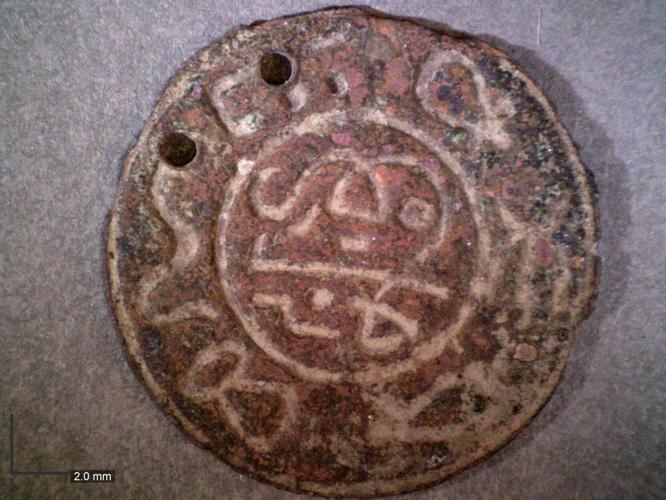
In other words, when William as an adult imperfectly remembered his grandmother’s things, these are them! Smith and his team found buttons and suspender clasps and Civil War bullets left over from when U.S. and Confederate forces crisscrossed Green Hills. They found marbles and a porcelain doll hand, scissors and beads, a tobacco pipe and a mouth harp, nails, bolts, wire and one brass token, pierced with two holes.

An antique token, housed at the Tennessee Division of Archaeology
It's not unusual to find pierced coins at 19th-century sites where Black people lived. The Hermitage found two pierced coins under the kitchen out there. The Northeast Museum Services Center has a great discussion of pierced coins and the superstitions surrounding them. But this particular coin in this particular place is wild!
I’m sure at least one of you has noticed the crude Arabic in the middle of the coin. It says “struck in Egypt.” It was probably not actually struck in Egypt, and the position of the holes through which the token would have been struck versus the tilt of the Arabic indicates to me that the person wearing the coin didn’t know that was even writing.
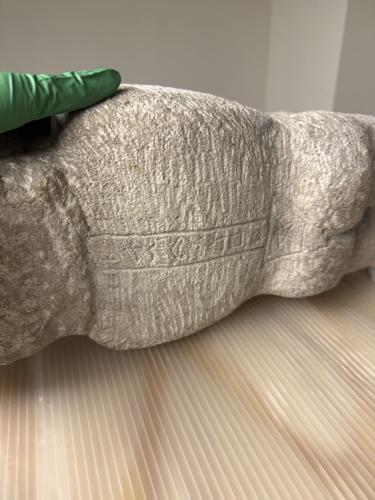
But I thought I recognized the symbols around the outside of the coin. I asked Aaron Deter-Wolf over at the Tennessee Division of Archaeology if I could come see the token. And I asked Cheekwood if they could send me a high-resolution picture of the back of William Edmondson’s sculpture, "The Reclining Man." "The Reclining Man" is a naked statue of a man, and on the back of the statue, Edmondson carved a line of symbols down his spine.
Scholars presume that the statue is Sidney Mttron Hirsch (yes, Mttron, as in the voice of God), who was the oddball of the Fugitive Poets at Vanderbilt. Germane to this discussion, he was a mystic occultist who allegedly studied Far Eastern esoterism. I say “allegedly” here because at the time Hirsch was gallivanting around the world, the most popular form of mystic belief among white people was Theosophy, which — to put it kindly — heavily recontextualized Buddhist and Hindu beliefs to suit Theosophic ends. Or to put it less kindly, a lot of Theosophy is just Buddhist and Hindu fanfic written by someone who has only heard the original stories third-hand but knows a lot about Masons. I haven’t researched Hirsch (as much as it seems like that might be fun to do), but just from my own knowledge of occultism in Nashville at that time, I would suggest we all be cautious about how much of Hirsch’s occultism was actual Far Eastern knowledge and how much of it was influenced by Theosophy.

How a headstone in a Madison cemetery connects to Edmondson, Tennessee Gov. William Carroll and Old Nashville's Black community
So when scholars saw a bunch of weird symbols on this statue, they assumed that they were symbols meaningful to Hirsch, even if no one who isn't Hirsch has been able to figure out said meaning.
But there I was last week, looking at this little gambling token — with its shoddy Arabic and its own weird symbols that seem designed to give the coin a mystic vibe — that was found where Edmondson grew up. Deter-Wolf put it under this magnifying thingy, and I was able to see, even now, how clear the symbols are.
If you were a little kid looking at this on the ankle or around the neck or on the wrist of an adult you saw every day and you were told it was magic, it’d stick with you. As Amanda and I have shown, maybe not exactly, but it’d stick.
Can we say for sure that Edmondson saw this token? No. But we can put it in the house where either he or his neighbors lived, and we can show that it was modified so that it could be worn. So it’s a cool possibility.
And it might tell us something about the friendship between Hirsch and Edmondson. Maybe two mystic minds got together to share their different versions of esoteric knowledge and the weird little symbols they had in common.



Post a comment as anonymous
Report
Watch this discussion.
(0) comments
Welcome to the discussion.
Log In
Welcome to the discussion.
Keep it clean. Please avoid obscene, vulgar, lewd, racist or otherwise abusive language. Comments featuring hate speech or threatening or violent content will not be tolerated.
PLEASE TURN OFF YOUR CAPS LOCK.
Be truthful. Don't knowingly lie or mislead.
Be proactive. Use the “report” link on any comment that violates our comment policy.
Share with us. We'd love to hear your feedback.