

This article is from our four-part cover package on the state legislature's special session on redistricting. See the rest here.
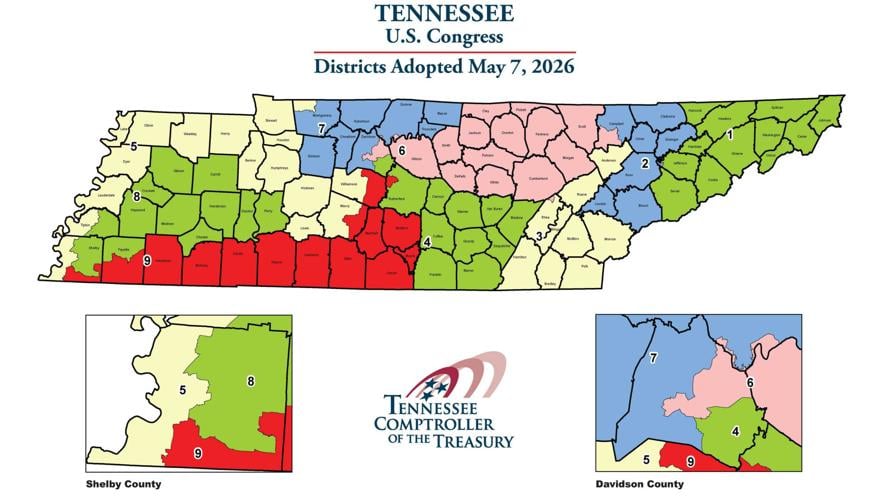
In 2022, Tennessee’s Republican supermajority split Nashville — a longtime Democratic stronghold in the U.S. House of Representatives — in three, diluting the city’s political power across the redrawn 5th, 6th and 7th Congressional Districts. Following this month’s special legislative session gerrymandering Memphis in much the same way, Nashville still remains carved in three, but the districts are different. The 4th, 6th and 7th Congressional Districts now intersect at the southern portion of Davidson County.
Those districts collide near Berry Hill, with the 7th running south of I-440 and east of I-65. The 6th sits north of I-440, and the 4th lies mostly to the east of I-65 and south of State Highway 155 within the confusing and convoluted map. The 7th encompasses the majority of Davidson County as well as all of Cheatham, Robertson, Dickson, Macon and Trousdale counties, along with the majority of Sumner and Montgomery counties.
U.S. Rep. Matt Van Epps — the Republican 7th Congressional District incumbent — won the seat in last year’s contested and nationally watched special election, defeating Democratic nominee and current state Rep. Aftyn Behn (D-Nashville). Van Epps is uncontested in this year’s Republican primary. Behn is not running for the seat this cycle, but two of her former primary opponents — state Rep. Vincent Dixie (D-Nashville) and political consultant Darden Copeland — have thrown their hats back in the ring for the Democratic Party nomination. Fellow Democrats Saletta Holloway and Joshua Warren Sales as well as independent candidates Andrew J. Koontz and Lowell Reynolds are also vying for the 7th seat.
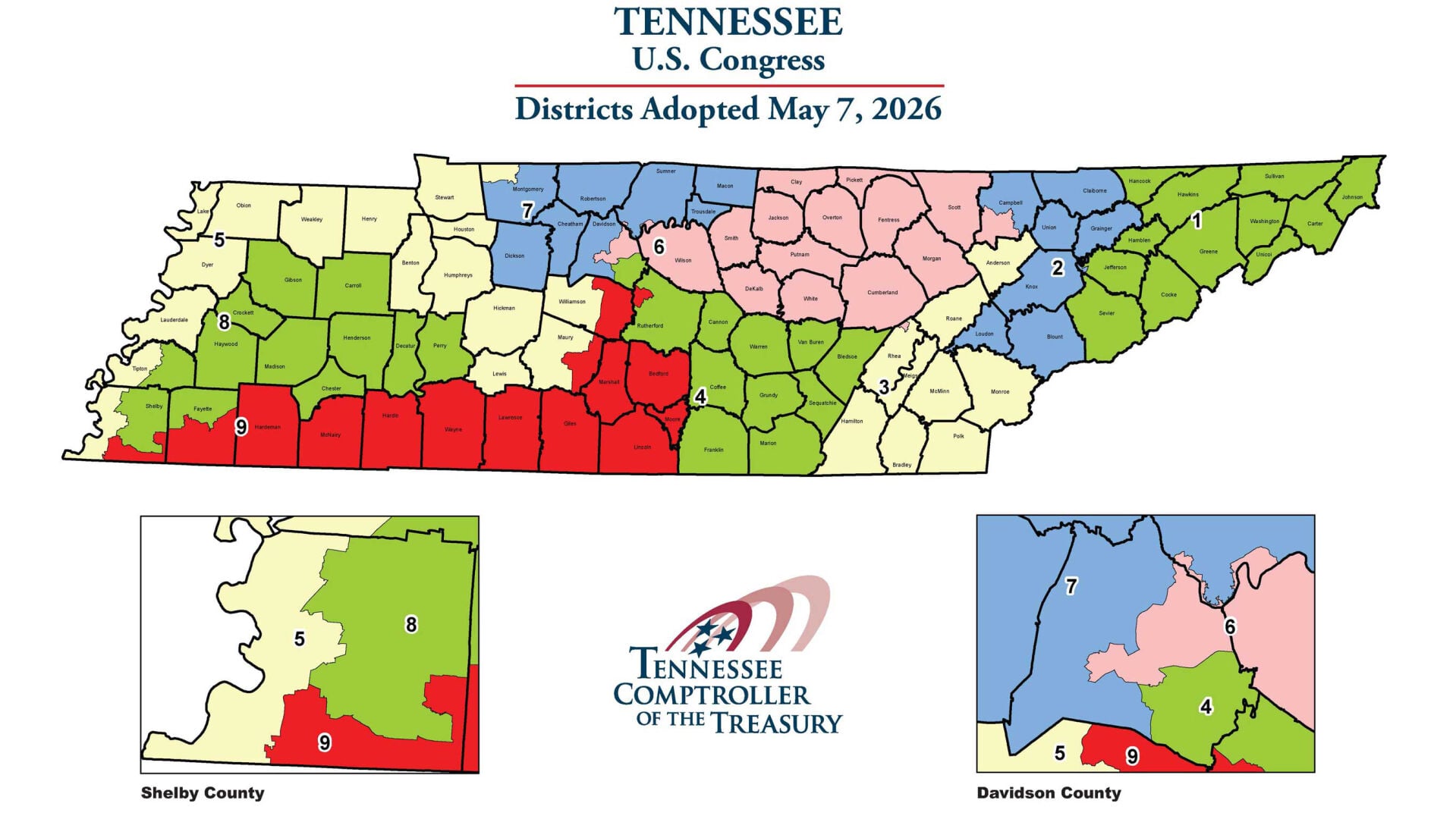
Tennessee's new congressional map, as passed by the state legislature
The 6th District now includes a track of middle and eastern Davidson County that stretches eastward into small portions of Sumner and all of Wilson, Smith, DeKalb, White, Putnam, Jackson, Clay, Overton, Cumberland, Morgan, Fentress, Pickett and Scott counties, as well as a sizable chunk of Campbell County. That seat is currently held by Republican U.S. Rep. John Rose, who is leaving Congress in hopes of being Tennessee’s next governor. State Rep. Johnny Garrett (R-Goodlettsville) is leading the pack of four Republicans seeking their party’s nomination in the 6th, alongside Natisha Brooks, Jon Henry and former U.S. Rep. Van Hilleary. Five Democrats — Lore Bergman, Mike Croley, Christopher Martin Finley, Miriam Leibowitz and Chaney Mosley — are also running for the seat, as are independent candidates Christopher B. Monday and Angus Purdy.
The 4th District stretches southeast into the majority of Rutherford County and encompasses Cannon, Coffee, Warren, Van Buren, Bledsoe, Sequatchie, Grundy, Marion and Franklin counties. Republican incumbent Rep. Scott DesJarlais — who has long been met with numerous personal and political scandals — is facing three primary challengers: Thomas E. Davis, Joshua James and Harold “Rocky” Jones. Victoria Broderick, who was defeated by DesJarlais in 2024, is again running for the Democratic nomination, as is Nashville Metro Councilmember Mike Cortese, who was running in the 5th prior to the redistricting. Other Democrats in the race include Cliff Huffman, Tim Lanier and Joyce E. Neal. Independent candidate Jacob Kristopher Anders is also running for the seat.
Redistricting now means that no part of Davidson County will be represented by Republican U.S. Rep. Andy Ogles of Tennessee’s 5th Congressional District — to the glee of many Nashvillians.

A four-part look at the fallout from the Republican supermajority’s successful gerrymandering attempts



Post a comment as anonymous
Report
Watch this discussion.
(0) comments
Welcome to the discussion.
Log In
Welcome to the discussion.
Keep it clean. Please avoid obscene, vulgar, lewd, racist or otherwise abusive language. Comments featuring hate speech or threatening or violent content will not be tolerated.
PLEASE TURN OFF YOUR CAPS LOCK.
Be truthful. Don't knowingly lie or mislead.
Be proactive. Use the “report” link on any comment that violates our comment policy.
Share with us. We'd love to hear your feedback.