
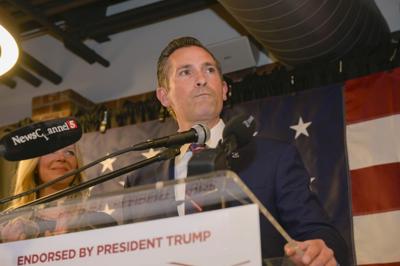

Republican Matt Van Epps won Tennessee’s 7th Congressional District in prime time last week, retaining the party’s slim majority in the U.S. House of Representatives. Spirited campaigning from Democratic state Rep. Aftyn Behn, floods of cash behind both candidates, turbulent political winds and special-election limelight briefly brought national attention to Middle Tennessee, which has long been written off by Democrats as deep-red Trump country.
Some point to Van Epps’ 16,000-vote winning margin to say Republicans still do own the district. Others say the race’s shift leftward across every county reflects America’s recent turn against Republicans and their unpopular president. While Van Epps comfortably tucked himself into Trump’s pocket, deeper punditry continues to scrutinize Behn with counterfactuals and hypotheticals. Did this youthful progressive’s relentless focus on affordability and health care access find a formula for success in rural America? Or did her leftist aura alienate too many centrist voters, squandering a set of perfect electoral conditions tailor-made for a Democratic upset?
Media is big business, and elections provide abundant fodder for articles and takes — especially now, with a historically polarizing president hemorrhaging approval points and readers desperate to read tea leaves ahead of the 2026 midterms. Each slice of the political spectrum can spin — and has spun — opaque election data to fit prior opinions about American voters. In the end, votes shook out exactly the way GOP state legislators drew the district in 2022, with a third of Nashville’s strong Democratic vote diluted against 11 rural counties and conservative suburbs. Right now, all we have is another vote tally from the Tennessee secretary of state.

After a special-election sprint, Trump-endorsed Army vet Matt Van Epps ultimately defeated state Rep. Aftyn Behn by 9 percentage points
Behn’s 9 percentage-point margin was a dramatic improvement for Democrats following the district’s two previous elections. Republican Mark Green beat former Nashville Mayor Megan Barry by 21.5 percentage points and 69,200 votes in 2024, and beat Nashville organizer and activist Odessa Kelly by 22 percentage points and 39,500 votes in 2022. As an incumbent member of Congress, former Army surgeon Green — who resigned in July — enjoyed a fundraising platform and name recognition in both elections. Newcomer Van Epps had neither, though Green gave him a head start on the race with an early endorsement, and Van Epps beat well-funded opponents in the Republican primary.
In 2025, every county in the district shifted toward Democrats. But all counties are not made equal.
Behn juiced Davidson County for 33,000 votes, more than twice the total number of Nashville Democrats who voted in the primary. Notably, Behn lost the county’s primary to fellow state Rep. Vincent Dixie. Behn’s Davidson County turnout game was clear in the weeks leading up to the Dec. 2 general election. Beginning in early voting, district residents were bombarded with texts and calls, an easy way for outside groups to spend money without coordinating directly with Behn’s campaign. She beat Odessa Kelly’s 30,000 county votes during the 2022 midterms, but fell far short of Megan Barry’s 48,000 votes in 2024 (a presidential election year). Behn’s trend of beating Kelly’s numbers but lagging behind Barry’s holds up across the district’s population centers, Clarksville and Williamson County, reinforcing widely held special-election logic: Turnout is the largest variable in a special election.
While Behn pulled in 13,000 more votes overall than Kelly did in 2022, Van Epps lost 11,000 Republican votes that went to Green that same year. This happened unevenly across the district. Behn’s urban and suburban vote margins far exceeded slight or negligible improvements in rural areas. Van Epps lost Republican voters around Nashville, Clarksville and Williamson County only slightly, but suffered a lack of interest from rural Tennessee. Many Republicans who turned out for Trump in 2024 and Green in 2022 just didn’t turn out for Van Epps. Final tallies alone do not clarify whether these are swing voters; Behn’s 81,100 special-election votes still fell short of Barry’s 2024 run, which captured 122,700 votes. In rural areas, margins stayed red but shifted toward Behn because Republicans didn’t turn out. In urban and suburban areas, margins shifted to Behn because Democrats did turn out.
Special-election postmortems continue to point to the same proven political science. Ballots bring out voters — both “for” and “against,” but mostly “for” in this district — when they have a familiar Republican name on them (i.e., Trump or Green). Republican support softened behind Van Epps. While she did not meaningfully win rural votes, Behn successfully rallied urban and suburban Democrats in high population areas. Midterms and the 2028 presidential race will likely bring much higher turnout, and hopefully, a real clash of ideas to replace what looks like an expensive round of partisan RSVPs.



