

This article is from our four-part cover package on the state legislature's special session on redistricting. See the rest here.
Dozens of signs read “Black Voters Matter.” Scrawled across countless other posters was the phrase “Protect the South: No Jim Crow Maps.”
These words were spelled out on placards carried by hundreds of protesters who flooded the Tennessee State Capitol earlier this month during a special session eliminating Tennessee’s only majority-Black district at the federal level — which also serves as the state’s only Democratic seat and includes much of Memphis.

A week after sine die, Lee tasks legislators to reconfigure Memphis House seat in the wake of SCOTUS decision
Following urging from President Donald Trump and U.S. Sen. Marsha Blackburn, Gov. Bill Lee called the special session to redistrict Tennessee and ensure that the state’s congressional delegation is fully Republican — a push that comes after a recent U.S. Supreme Court ruling gutting civil rights protections outlined in 1965’s Voting Rights Act.
If you ask members of the state’s Republican supermajority, who speedily approved the new congressional map, the districts were drawn only to ensure Tennessee’s delegation in the U.S. House of Representatives reflects what they call the state’s “conservative values.” They say racial demographics were not a factor in congressional mapmaking.
That’s not how Tennessee’s Black Democratic lawmakers see it.
State Senate Minority Leader Raumesh Akbari (D-Memphis) tells the Scene the new congressional map has caused a “deep level of hurt.” She notes this is especially poignant given Memphis’ role as a backdrop for the civil rights movement and as the site of Dr. Martin Luther King Jr.’s assassination.
“It’s not just about partisan redistricting,” says Akbari. “It’s about disrupting Black community in Memphis and disrupting our voices and our ability to be heard on a federal level.”
During the debate over the maps, state Sen. London Lamar (D-Memphis) grilled state Sen. John Stevens (R-Huntingdon) — who carried the redistricting legislation in the Senate — over his knowledge of Memphis’ demographics. When asked by Lamar on May 7 whether he was aware that Memphis is a predominately Black city, Stevens — who attended law school at the University of Memphis — said, “I am not.”
Lamar went on to ask, “Are you aware that Tennessee’s 9th Congressional District is the only majority-African American congressional district in this state?”
“No, I have no knowledge of that,” Stevens maintained.
The day before, Lamar posed the same questions to Stevens during a committee debate. Then he replied with, “I think you know the answer.”
Akbari says she thinks this was Republicans’ method of keeping any talk of race completely out of the discussion.
“Everyone knows the demographics of this state and demographics of one of our major cities, our second-largest city, our largest county,” she says of Memphis-Shelby County, which ranks among the U.S. cities with the highest Black population.
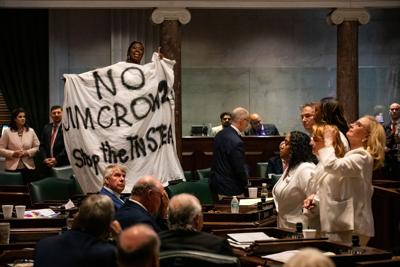
During one of the special session’s most notable moments, Sen. Charlane Oliver (D-Nashville) stood on her desk on the Senate floor, unveiling a sheet reading “No Jim Crow 2.0” and “Stop the TN Steal.” She sang “Lift Every Voice and Sing,” a hymn often referred to as the Black National Anthem.

Protests from demonstrators and Democrats mark heated final day of whirlwind special session
“I felt like if Black voting rights were not the thing to fight for, then what is?” Oliver tells the Scene of her decision to act in protest, which drew condemnation from Lt. Gov. Randy McNally (R-Oak Ridge). “This is the ultimate stand to take, and as a sitting senator, I needed to send a message to my colleagues who pride themselves on order and decorum, that what they’re doing is so out of order. It is so unprecedented that it requires an unprecedented response.”
In an interview with the Scene, Oliver recalls becoming emotional during a church service at Nashville’s historically Black Capers Memorial CME Church in the weeks following the special session. When the congregation began to sing the Black National Anthem, she began to cry.
“I just can’t hold back tears on just how much we are still having to fight the same fight that my parents and grandparents fought, and my great-great-great-uncle, who fought in the Civil War, for me to have freedom,” Oliver says. “We’re still fighting, and it’s also proof of just how fragile our democracy really is in our country right now.”
To her Republican colleagues who argue the redistricting doesn’t involve race, Oliver has a blunt response: “It’s just a bunch of bullshit.”
“We know what racism looks like,” Oliver says. “We have experienced it. We have lived experience. Our very existence is proof of that. We know what racism looks like, smells like, sounds like, tastes like. And this was racism, point blank. Period.”
Dr. Sekou Franklin is a longtime local political scientist and current political action chair for the NAACP’s Tennessee State Conference. (Disclosure: He has also written opinion pieces for the Scene in the past.) Franklin has worked in and studied redistricting and voting rights for more than 15 years, and he testified against the maps before Senate and House committees during the special session.
Franklin tells the Scene that the Supreme Court’s decision is both destructive and unprecedented. He says this could have larger ramifications outside of just Tennessee’s congressional maps, and the ruling could allow for gerrymandering at the local level including state legislative seats, county commissions and school boards.
“The Supreme Court [ruling] was an attempt to put not just their fingers on the scale but to put their whole body on the scale to shape and alter elections to the disadvantage of Black folks,” says Franklin.
He says the decision essentially gives legislative bodies a blueprint — or in his analogy, a recipe — for stripping predominately Black areas of political representation.
“Like down to how you measure how many ounces of sugar you put in a cake, it gives them a recipe for eliminating majority-Black districts,” says Franklin.
The Tennessee Senate Republican Caucus did not respond to the Scene’s request for an interview with Sen. Stevens.

A four-part look at the fallout from the Republican supermajority’s successful gerrymandering attempts



