

Cars kill hundreds of people in Tennessee every year. As of this writing, since the beginning of 2023, 1,100 people have died in traffic-related incidents in the state, and the past few years have seen relatively similar statistics. Tennessee can also be a dangerous place for workers: A 2020 cover story by Scene managing editor Alejandro Ramirez details advocacy efforts for safer and more equitable workspaces after the tragic death of 16-year-old Gustavo Ramirez, who fell from scaffolding while working at a construction site in Nashville.
Nashville has taken steps to improve safety around both cars and construction. The city’s Vision Zero plan aims to have zero pedestrian deaths by 2050. (So far this year, 39 pedestrians have been killed by drivers in Nashville; in 2022, 47 pedestrians were killed.) For workers, Metro councilmembers have organized for stronger safety regulations, though one recent bill was undermined by the state government.
At the crossroads of worker safety and traffic safety are road work zones. Here, crews from the Tennessee Department of Transportation are at risk, but so are drivers, passengers and even pedestrians. Tennessee sees thousands of work zone accidents every year, and while road crew fatalities have become more rare, they still do occur. Between 1948 and 2022, 113 TDOT workers have died on the job. The most recent fatality was TDOT employee Trent Johnston in 2022. Over the past few years, the Department of Transportation has taken steps to make drivers safer around work zones. As traffic around Nashville increases, these initiatives are more important than ever.
Tennessee has seen roughly 2,200 work zone accidents so far in 2023; 777 of these were in Nashville’s highway patrol district (District 3, which includes Davidson County and 11 nearby counties). This number is slightly lower than previous years: The state saw 3,561 work zone crashes in 2021 and 3,047 in 2022.
Rebekah Hammonds, a TDOT spokesperson representing Nashville’s region, explains that accidents set off longer chains of events than people realize. “One of the crashes we saw last month involved a crew repairing a guardrail, and that was because there was another crash that had just happened with other vehicles,” says Hammonds. “It’s this kind of vicious cycle when it comes to repair work like that.”
Hammonds says Nashville’s high numbers of work zone crashes are due to a variety of factors, including “people not paying attention, high speeds and the drastic volume of traffic that we see on a regular basis.” The Tennessee Department of Safety and Homeland Security reports that 1 in 9 work zone accidents this year has involved a distracted driver, but Hammonds notes that this number could be underreported, since most drivers won’t freely admit to being distracted. But distracted driving is definitely a focus for TDOT, along with their frequent messages to drivers to “slow down, move over.”
The Tennessee Department of Transportation runs its Work With Us campaign to encourage drivers to be aware of workers. They’ve recently had more initiatives to help reach Tennessee teenagers, including a TikTok contest with cash prizes.
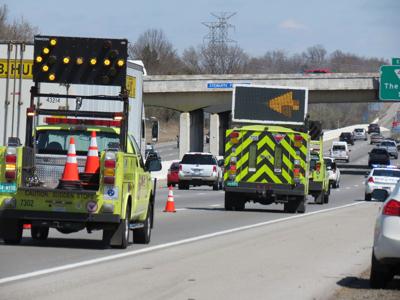
TDOT has also implemented structural changes to help make roads safer, including the new I-24 Smart Corridor, which gives drivers more time to respond to accidents by displaying lane closures on gantries well before the incident and enforcing temporary reduced speed limits. TDOT’s HELP operators — accident response units who administer life-saving aid and divert traffic — are particularly vulnerable to accidents because they respond during peak traffic times.
While it’s difficult to quantify the impact of the Smart Corridor on HELP crews with the current available data, Hammonds says she’s already heard from operators that the signage has made them safer. Drivers have been able to move over more quickly and give them more space to respond to accidents.
Many of TDOT’s initiatives are designed to protect their crews, but Hammonds points out that because of roadside machinery design, crews are actually much safer than most drivers in work zone accidents. Road crew trucks typically have impact attenuators, accordion-like devices designed to crumple in a crash, leaving vehicles relatively unharmed. Passenger vehicles don’t have the same kind of protection, Hammonds says, and usually come off much worse in a crash.
“When we say, ‘Slow down, move over,’ yes, it is 100 percent to protect our workers and contractors,” says Hammonds. “But really, it is also to protect the driver. When we see these crashes happen, the driver who runs into the barrier or attenuator or truck … they are the ones that receive the majority of the damage, because they’re hitting something like that at such a high rate of speed.”
Tennessee has seen significant changes to its road infrastructure, and population growth has put more stress on local and statewide traffic grids. More traffic means more crews on the road, and more chances for accidents. Still, Hammonds says, the most important message is the same one TDOT has been saying all along: “If it is possible, and you are driving through a work zone, please slow down and please move over.”



Post a comment as anonymous
Report
Watch this discussion.
(0) comments
Welcome to the discussion.
Log In
Welcome to the discussion.
Keep it clean. Please avoid obscene, vulgar, lewd, racist or otherwise abusive language. Comments featuring hate speech or threatening or violent content will not be tolerated.
PLEASE TURN OFF YOUR CAPS LOCK.
Be truthful. Don't knowingly lie or mislead.
Be proactive. Use the “report” link on any comment that violates our comment policy.
Share with us. We'd love to hear your feedback.