
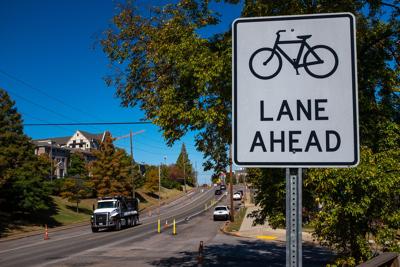
From Reddit to Nextdoor to Facebook, Nashvillians are arguing for more traffic cops, speed bumps and ways to get around the city that don’t include cars. As political momentum for a widespread mass transit network stalls, much of that energy is going toward better protections for pedestrians and cyclists. Regardless of politics or platform, council district or daily commute, much of the city is in rare agreement that Nashville roads are too dangerous and too crowded. So what happens next?
In August, the Metro Council passed the latest iteration of Vision Zero, a five-year outline that sets a goal of no roadway deaths by 2050. Like so much of what Metro produces, it’s a guiding document, meaning it requires a spate of additional legislation, funding, planning and coordination to actually happen. Many of its projects demand cooperation (and funding) from state and regional agencies like the Tennessee Department of Transportation and the Greater Nashville Regional Council. Vision Zero drew fierce pushback at the time from councilmembers due to a lack of clarity and urgency in its attempts to address roadway deaths. A five-year implementation plan followed, full of projects and timelines without specific sources of funding.
Since the beginning of the year, Davidson County has tallied 112 traffic-related deaths. Of those, 33 were pedestrians and two were cyclists. This is up from 104 in 2021 and 87 in 2020, statistics at the tragic extreme of nearly constant car-related damage and injuries. A Metro Nashville Police Department website keeps a live dashboard. The state has logged 54,925 crash injuries in Davidson County since 2010, making it the most dangerous county in Tennessee by injury crash rate.
Vision Zero hopes to be the city’s plan for safer roads, and includes a heatmap for car violence in Davidson County. State routes — lit up in red and orange, identified as “priority areas” — make up 46 percent of the high-injury network. Theoretically, actual projects to slow speeds and reduce traffic should follow. But maintaining, improving and regulating land is among the scarce territory directly controlled by the city government. Certain major routes — like Murfreesboro, Charlotte, Gallatin or Nolensville — were pre-interstate highways and remain the purview of state agencies. And as these are some of the city’s busiest and most dangerous roads, the cross-jurisdictional nature of these projects becomes an obstacle to significant change.
Funding is still a limiting factor and can come from a variety of places. Councilmembers can get projects on the city’s capital improvements budget, eventually funded via a capital spending plan. Projects on non-state roads are entirely within the purview of Metro. The city can rein in traffic with speed cushions or aggressively expand its bike lane network — the Complete and Green Street Project on 12th Avenue South is an example of a large, comprehensive, multipronged project that was locally funded and administered, though it lagged on its timeline. State roads like Murfreesboro and Nolensville pikes are in the jurisdiction of the Nashville Department of Transportation and Multimodal Infrastructure, but are TDOT’s assets. The state has its own planners and a budget. For some projects, the two agencies could go through the Greater Nashville Regional Council, a regional planning entity that allocates federal dollars, and has its own analyses for determining planning needs and priorities. Or the federal government could hand down money directly via grants. These are competitive and often tied to specific federal priorities. To qualify, a city must show a clear commitment to solving a specific problem.
Even putting speed bumps in neighborhoods can be a long, laborious process. District 17 Councilmember Colby Sledge has witnessed traffic-calming projects take nine to 12 months per application, snagged in bureaucracy even as nearly everyone agrees on what needs to happen.
“The overriding concern I hear, time and again, is, ‘Oh, well, what if we get sued,’ ” Sledge tells the Scene. “We know where people get killed. We know everything we need to know to make things better. We just have to go out and do it.”
Sledge explains that, in his experience, the city’s planning is very “conflict averse.” Plans get scrapped as soon as there’s any pushback, he says, even when everyone knows it’s for the greater good. The prospect of getting sued by a private party, usually a business, has killed transit improvements.
“I’d much rather us be in a lawsuit than be in a funeral,” says Sledge. “I think the last thing we need is a new plan.”
On Oct. 20, a 14-year-old MNPS student was killed in a collision on Briley Parkway, the city’s latest traffic-related death as of this writing. Three pedestrians were killed by cars in one week in late September, each in a different Nashville neighborhood. This summer, famed Nashville singer-songwriter Amy Grant was hospitalized after hitting a pothole on her bike — not a direct car-related injury, but an example of how Nashville’s roads privilege certain modes of transportation over others. In June, Councilmember At-Large Bob Mendes was hit on his e-bike near Charlotte Pike. His injuries were minor, but the incident put a spotlight on the dangers of non-car transportation. Mendes has been vocal about his adoption of e-biking and spoke out when Metro Parks had e-bike stations removed from Nashville greenways.
The idea of induced demand — “if you build it, they will use it” — lies at the core of transportation planning. As a growing bike network slowly takes back the city’s limited right-of-way, it’s molding users into advocates. From a bike lane, it’s much easier to see the inefficiency of cars that spew exhaust, stop and start, and often ferry more empty seats than passengers. Drivers — some of whom are distracted by cellphones or are otherwise playing loose with traffic laws — wield substantial physical power over pedestrians and cyclists and get little training on how to share the road with other forms of transportation.
Faced with a massive puzzle full of moving pieces with life-threatening stakes, planners and politicians are now trying to figure out how to get from here to there.





