
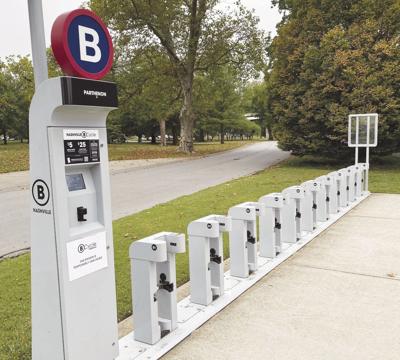


An empty BCycle station in Centennial Park
Metro Parks this week moved to shut down nine e-bike stations operated by BCycle on Nashville greenways, an escalation in an ongoing battle over e-bike usage in the city.
BCycle general manager Elese Daniel says the company was working with the Nashville Department of Transportation to find new locations for the stations.
Per Tennessee state law, class 1 and 2 e-bikes are allowed in all of the same places normal bikes are, and a clarification in summer 2021 determined that Metro Parks’ rule prohibiting motorized vehicles did not apply to e-bikes.
In the past year, there has been a back-and-forth between the parks department, NDOT and Metro councilmembers over e-bike usage, culminating in this week's developments.
“I tell you, it has an impact for the upcoming East Bank legislation,” At-Large Metro Councilmember Bob Mendes tells the Scene, adding that until Metro Parks changes its position on e-bikes, he will never vote on a plan giving them any control over space on the East Bank.
“As long as the parks department has key personnel that are resisting e-bikes, then they shouldn’t be in charge of a single shred of new greenway or park space on [the] East Bank,” Mendes says. “I’m not personally going to vote for something that I can’t ride my e-bike through.”
Mendes calls the situation “ridiculous” and a result of “the mayor’s office letting there be two different departments with different visions.”
“The mayor's office has never taken a position, ever, about this, and that lack of leadership is showing in the dysfunction that's going on,” Mendes says.
When asked for comment, a mayor’s office spokesperson directed the Scene to Metro Parks.
“Several BCycle stands are being relocated from Parks to other locations across the city, as Metro works towards a long-term solution that will increase access to bike share for all residents,” the parks spokesperson says. “We are excited about the potential to work with our partners at NDOT to offer a great program to residents of Nashville/Davidson County. We wholeheartedly believe a bike share program would be a great asset to this city.”
Mendes contends that while NDOT believes the greenways can be used for both recreation and transit, Metro Parks believes greenways should be used only for recreation, not transit.
In July 2021, Mendes wrote a letter to the Board of Parks and Recreation, co-signed by 15 other councilmembers, encouraging Metro Parks to support the use of e-bikes on greenways. In the letter, Mendes states that allowing e-bikes on greenways “will improve our transportation system and give Nashville residents the same opportunities that citizens in most other cities already enjoy.”
A study conducted by parks, NDOT and Metro Legal followed in an effort to determine safety considerations related to the operation of e-bikes on greenways. The Greenways for Nashville Commission then recommended that no changes be made to local regulations regarding e-bikes, saying “there is not currently sufficient information to determine that e-bike usage on greenways is unsafe.”
And while the only way e-bikes could be banned from greenways is through a Metro Council ordinance, Mendes says Metro Parks has not shifted its position on the popular mode of transportation.
“It’s hugely disappointing,” says Metro Councilmember Sean Parker, one of the 15 councilmembers who signed on to Mendes’ letter last year. “It’s a big loss for mobility in Nashville.”
Without the e-bike stations on greenways, Parker says, it will now be more difficult for older people and people with disabilities to “experience more of the parks.” Aside from this more recreational use, Parker says that e-bike usage on greenways is important for those who use bikes for transit.
“Nashville feels like it’s made for cars,” says Adam Devries, a Nashville resident who says that the inconsistency of bike lanes makes his e-bike commute “so dangerous.”
Devries says that a lack of bike lanes makes the use of greenways for transit even more important.
“Rather than constrict where people can ride their bike, maybe make bike riding more available in other places,” Devries says.
A study released in August found that, of 50 major U.S. cities surveyed, Nashville was the fourth-worst city for cyclists. Parker points to the city’s lack of a “low-stress bike network,” which is essentially places where cyclists can ride without fear of getting hit by a car.
“We’re working to make the rest of our streets better and lower-stress, but for right now, some folks are only comfortable riding in the greenways,” says Parker.
Update, Sept. 9, 5:15 p.m.: On Friday afternoon, the Scene received a statement from Jackie Jones, superintendent of community affairs for the Metro Board of Parks and Recreation. It reads, in part:
Greenways are linear parks that provide opportunities for recreation and alternative transportation for our citizens. However, e-bikes being allowed in parks and on greenways and the issues with BCycle, a private, for-profit, revenue-generating business, are two entirely different matters. …
The reason the BCycle bikes have been removed is that there is no contract with Metro Parks for this operation. … We had been advised that NDOT was planning to move forward with a one-year contract with BCycle to allow for time to work on a longer-term contract. We declined participation in a one-year contract since it was designed for a specific vendor (a practice Metro has disapproved of in the past) and not an RFP open to everyone. …
Having the bikes available for rental on park property without approval presents a significant liability for taxpayers and the department. Please know we believe a Metro-wide bike share program would be a great asset to our city. We are excited about the potential to participate in developing an RFP and helping to select a vendor(s) to offer a great bike share program to the city.



Post a comment as anonymous
Report
Watch this discussion.
(0) comments
Welcome to the discussion.
Log In
Welcome to the discussion.
Keep it clean. Please avoid obscene, vulgar, lewd, racist or otherwise abusive language. Comments featuring hate speech or threatening or violent content will not be tolerated.
PLEASE TURN OFF YOUR CAPS LOCK.
Be truthful. Don't knowingly lie or mislead.
Be proactive. Use the “report” link on any comment that violates our comment policy.
Share with us. We'd love to hear your feedback.